What would you assume if the water per second leaving the jar was less than the volume of water leaving the first fountain basin?
1 point
1
Question 2
2.
What this means is that if your circuit is one that only has one path, the path has to have the same current everywhere along that path. The the rate at which the volume of the water is being pumped in is the same rate at the intake of the pump, and the outlet of the pump, the outlet of the first basin and the outlet of the second basin. But what if the first basin had a lot of different outlets?

It looks like the rate of water from the top of the fountain is more than the rate of water falling from the one of the outlets on the first basin. What is the relationship between all the outlets of the first basin and the rate of water from the top of the fountain?
1 point
1
Question 3
3.
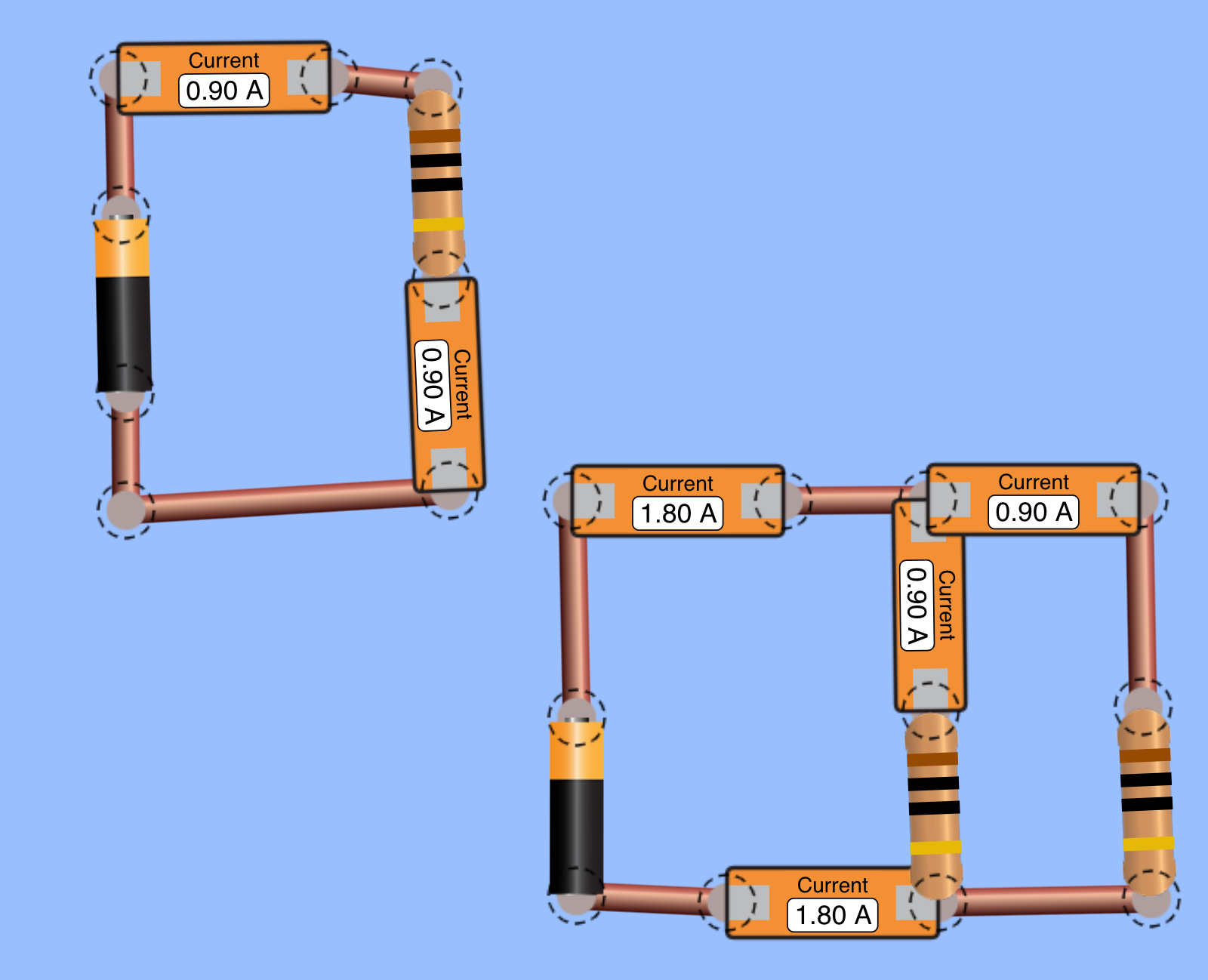
Drag the statement to the circuit that it describes.
Other Answer Choices:
If a path branches into multiple paths, the current of all the breakaway paths will add to the original current.
The current through a single path is always constant
1 point
1
Question 4
4.
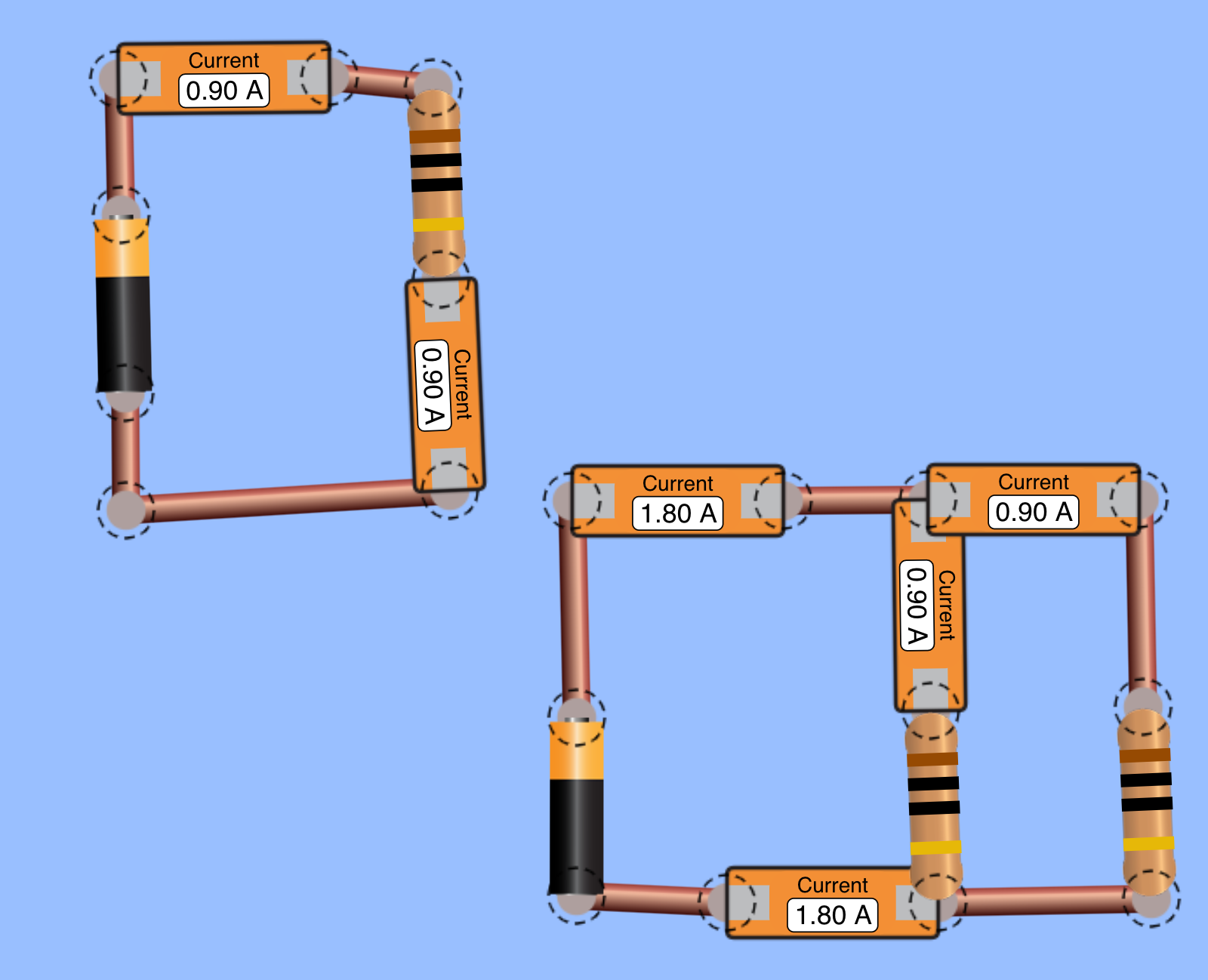
The lines on the resistors give information about the resistance of the resistors. What do you think it means that all the lines on all three resistors are the same?
1 point
1
Question 5
5.
Each battery shown is a 9 V battery. Given that, calculate the resistance in Ohms of the resistor on the top left.
1 point
1
Question 6
6.
What would the resistance of the resistor in the top left be if the current were 1.80, rather than 0.90?
1 point
1
Question 7
7.
This is called finding the equivalent resistance. you can find the resistance of a whole section of a circuit by pretending the whole section is one resistor. If you know the voltage across the whole section and the current going into the section and out of the section is the same. any questions?
1 point
1
Question 8
8.
Use Kirchhoff’s Voltage Law to find the missing voltage differences in the following circuits. For these circuits, current flows clockwise and potential difference is measured clockwise.
Other Answer Choices:
4V
1V
-4V
-7V
7V
16V
-1V
1 point
1
Question 9
9.
In a series section of a circuit, the current follows __________ .The current from the beginning of the section__________. The voltage drop across the different parts of the section __________
1 point
1
Question 10
10.
In a parallel section of a circuit, the current follows __________ .The current from the beginning of the section__________. The voltage drop across the different parts of the section __________
1 point
1
Question 11
11.
Using the phet simulation to the left, create one circuit that is just a battery and a light bulb and another series circuit with one battery and three light bulbs. are the lights brighter or less bright for the three ligghtbulbs than a circuit with one light?
1 point
1
Question 12
12.
consider the following picture of a garden water feature.
what would happen in this situation if the volume of water per second leaving the jar at the top was larger than the volume of water per second leaving the first fountain basin? What would you assume?
1 point
1
Question 13
13.
delete the three light circuit and put in three lights in parallel. Are the lights brighter or less bright?
1 point
1
Question 14
14.
So in this analogy, often called the hydraulic analogy, match the aspect of the water circuit to the corresponding aspect of the electrical circuit
Draggable item
arrow_right_alt
Corresponding Item
water
arrow_right_alt
battery
a water wheel, or other machine powered by the flowing water
arrow_right_alt
electrons
flow rate of water
arrow_right_alt
voltage
water pump
arrow_right_alt
current
water pressure
arrow_right_alt
resistor
valve
arrow_right_alt
switch
1 point
1
Question 15
15.
create a circuit with some areas with elements in series, some areas with elements in parallel. Add current meters to the circuit. This current meter has to be in series with the area you are measuring, and must have an extremely low resistance. Explain why.
1 point
1
Question 16
16.
use the voltmeter to test the voltage across different elements. The voltmeter should have practically infinite resistance and should be in parallel with whatever it is measuring. Explain why.
1 point
1
Question 17
17.
Just play with this simulation for a while. Do you have an idea of the purpose of a fuse?
1 point
1
Question 18
18.
Why does the battery catch fire sometimes?
1 point
1
Question 19
19.
There are three types of christmas lights - one where if a bulb goes dead, the entire string goes out, one where if a bulb goes dead a whole section of the string goes out and one where if a bulb goes dead, only that bulb is affected. Explain these three strings in terms of parallel and series circuits.
1 point
1
Question 20
20.
series vs parallel circuits - what they look like
series vs parallel circuits - finding equivalent resistance