Log in
Sign up for FREE
arrow_back
Library
S4W6 Review homework
By Gwyneth Lenfest
star
star
star
star
star
Share
share
Last updated 7 months ago
8 questions
Add this activity
1
PS.6.a
Required
1
1
Required
1
1
1
1
1
Question 1
1.
Identify the different forms of energy as potential or kinetic energy
Chemical
Nuclear
Sound
thermal
Gravitational
Radiant
Potential Energy
Kinetic Energy
Question 2
2.
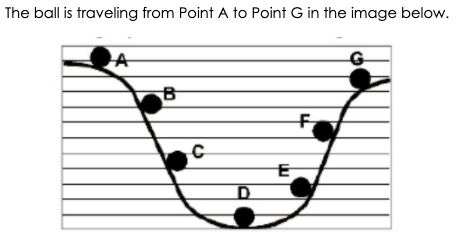
Which letter shows the ball when it has the
maximum kinetic
energy?
NOTE: The ball moves ONCE from letter A to letter G
A
D
G
C
Question 3
3.
Which of the following is newtons first law of motion
Energy can neither be created or destroyed
an object in motion stays in motion until acted on by an unbalanced force
Entropy is always increasing
force= mass x acceleration
you can never achieve absolute 0
For every action there is an equal and opposite reaction
Question 4
4.
vocab word - inertia is the tendency of an object to resist change. this means that
Things with a lot of inertia are easier to move than less inertia
things with a lot of inertia are harder to move than less inertia
things will move at the same rate from the same force no matter what their inertia is
Question 5
5.
Pushing off the wall at the ice skating rink and going the
opposite
direction is an example of Newton’s
1st Law
2nd Law
3rd Law
None of the Laws
Question 6
6.
A cart
accelerating slower
when mass was increased is an example of Newton’s
1st Law
2nd Law
3rd Law
None of the Laws
Question 7
7.
A vector has
magnitude
direction
a fixed starting point
a fixed ending point
a pet
an equal and opposite reaction
a coordinate system
Question 8
8.
To add vectors you
draw the component vectors with their tails together, and draw the resultant vector from the head of one vector to the head of the other
Draw one component vector, and then draw the second component vector starting at the head of the first vector. Draw the resultant vector from the tail of the first to the head of the second.
Draw a line from the tail of one to the head of the other from wherever the vectors are drawn.
draw a line from the head of one to the tail of the other, and then another line from the tail of the first to the head of the other. The resultant vector is where those lines intersect.