Preskoči na glavni sadržaj
Prijava
Sign up for FREE
arrow_back
Biblioteka

4.8 Constraints and Optimization

star
star
star
star
star
Posljednje ažuriranje over 1 year ago
15
Napomena autora:

OBJECTIVES & STANDARDS

Math Objectives

  • Represent constraints by equations or inequalities

  • Graph the solutions to a linear inequality in two variables with multiple constraints

  • Solve a system of inequalities graphically

  • Find an optimal solution to a system of inequalities built from realistic constraints

Common Core Math Standards

  • Link to all CCSS Math

  • CCSS.PRACTICE.MP3

  • CCSS.PRACTICE.MP4

  • CCSS.HSA.REI.D.12

  • CCSS.HSA.CED.A.3

Personal Finance Objectives

  • Understand how constraints play a role in business

  • Apply logical principles to make optimal decisions

National Standards for Personal Financial Education

Spending

  • 2a: Select a product or service and describe the various factors that may influence a consumer’s purchase decision.

  • 2b: Describe a process for making an informed consumer decision

DISTRIBUTION & PLANNING

Distribute to students

  • Student Activity Packet

  • Application Problems

Intro/Warm-Up
Learn It
Practice It
Learn It 2
Application/ Exit Ticket

Desmos (Linked in Google Classroom)

OBJECTIVES & STANDARDS

Math Objectives

  • Represent constraints by equations or inequalities

  • Graph the solutions to a linear inequality in two variables with multiple constraints

  • Solve a system of inequalities graphically

  • Find an optimal solution to a system of inequalities built from realistic constraints

Common Core Math Standards

  • Link to all CCSS Math

  • CCSS.PRACTICE.MP3

  • CCSS.PRACTICE.MP4

  • CCSS.HSA.REI.D.12

  • CCSS.HSA.CED.A.3

Personal Finance Objectives

  • Understand how constraints play a role in business

  • Apply logical principles to make optimal decisions

National Standards for Personal Financial Education

Spending

  • 2a: Select a product or service and describe the various factors that may influence a consumer’s purchase decision.

  • 2b: Describe a process for making an informed consumer decision

DISTRIBUTION & PLANNING

Distribute to students

  • Student Activity Packet

  • Application Problems

ANALYZE: Find a Common Solution

You’re deciding what activity to do on a weekend with your friends. You want to find something that makes everyone happy, balancing their desires around time and money. Work with a partner to figure out what activities, if any, are options that will make everyone happy.

Friends’ Desires

  • Sandra: Wants to spend at least 3 hours together but has a budget of $50

  • Larry: 5 hour limit and doesn’t care how much it costs

  • Bethany: Is fine with any length of time, but has a budget of $35

  • Chris: Wants to spend at least 2 but no more than 4 hours, and has budgeted $60 for the weekend

Activities available

  • Laser Tag: $30 each and 4 hours total

  • Sailing: $20 each and a 6 hour total

  • Hang Gliding: $50 and a 3 hour total

  • Movie: $20 and 3 hour total

  • Go Karting: $15 and 1 hour total

  • Hiking: $5 and 5 hour total

  • Pottery Class: $45 and 4 hour total

1
1
Pitanje 2
2.

Which person was easiest to plan around? Why?

1
1

Graphing Complex Constraints

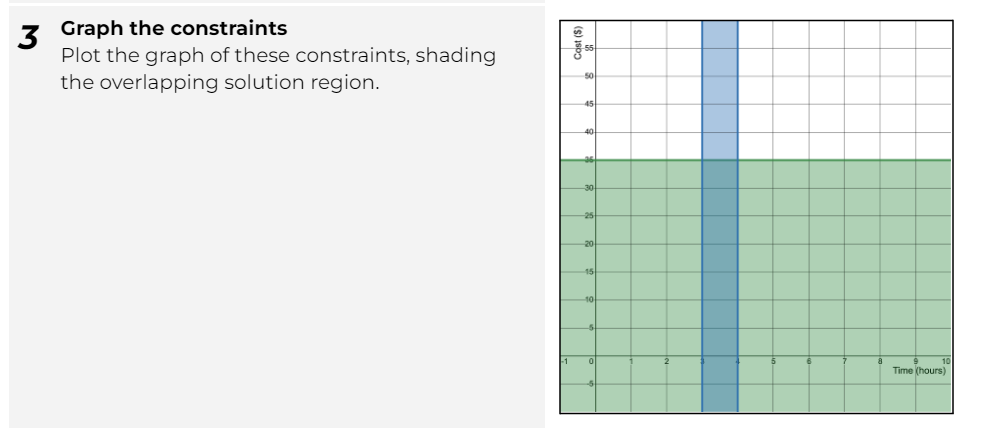
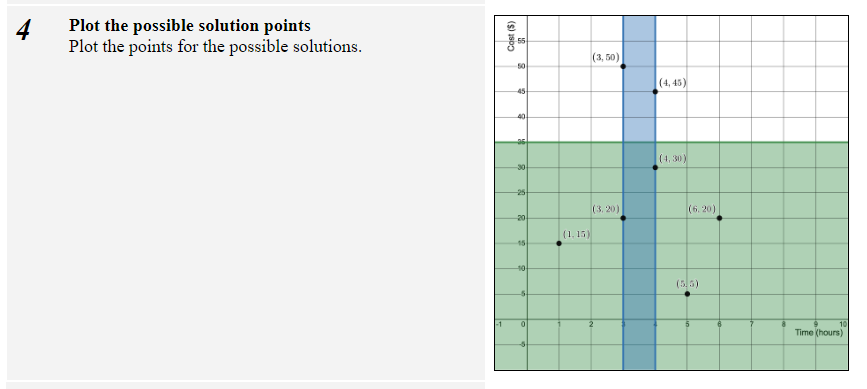
Solving systems with many constraints can be easier if you graph those constraints and find a region for all solutions. Let’s graph the constraints from the intro problem with the four friends and their activities using the two factors of time(x) and money(y).

Review the completed example problem.

Constraints with Varying Slopes

The above constraints were all horizontal or vertical lines, but sometimes constraints can have positive or negative slopes like we saw in earlier lessons. The solution steps are still the same, but you are less likely to have fully redundant constraints. Complete the following practice problem with a sloped constraint.

You have a maximum of 7 hours after school to either do homework (x) or hang out with friends (y). Your mother says you need to do at least 2 hours of homework every night and you want to spend at least 3 hours with your friends. Find and interpret three possible solutions to how to spend your evening time.

Fill in the right side of the table below for this problem.

3
Pitanje 5
5.
1
1
Pitanje 7
7.

Step 3: Graph the constraints

1
1
1
1

Optimization

Optimization is the practice of finding the BEST of all possible solutions. It involves first finding the set of all possible solutions and second, testing those solutions in an optimization equation that either maximizes or minimizes a certain parameter. Graphing is particularly helpful because possible solutions will ALWAYS be found at/near the corners of a solution region, or in other words, where two or more constraints meet.

Notice the steps are similar but NOT exactly the same as just solving for any solution.

Example: Widget Factory

You work for a factory that makes widgets and doodads. Each widget takes 3 hours to make and sells for $20, while doodads take 4 hours each and sell for $30. How many widgets(x) and doodads(y) should you make in a 40 hour work week to maximize your sales revenue?

10
Pitanje 12
12.

https://www.desmos.com/calculator/9ybmqczgjo

Use this desmos and screen shot your answer in the show your work section:

Screen shot=(windows+shift+s)

Paste = (Ctrl+V)

Optimization

Solve the following optimization problem.

Hassan is baking cookies for his school bake sale fundraiser. He decides on making oatmeal chocolate chip (m) and peanut butter cookies (p). He is planning on selling the peanut butter cookies for 20 cents each, and the oatmeal chocolate chip for 25 cents each. He is limited to 700 cookies total by his ingredients, and he doesn’t want to make more than 400 of either cookie. He must make at least half as many peanut butter cookies as oatmeal chocolate chip cookies. How many of each kind of cookie should he make to get the most money?

4
Pitanje 13
13.
1
Pitanje 14
14.

Graph the system of inequalities in Desmos & screen shot your graph.

2
Pitanje 15
15.
Pitanje 1
1.

Which activities would satisfy all four friends?

Pitanje 3
3.

Which 2 people were hardest to plan around? Why?

Pitanje 4
4.

Describe the process in words that you used to solve the problem.

Pitanje 6
6.

Step 2: Eliminate redundant constraints

Are there constratints, if so what are they?

Pitanje 8
8.

Step 4: Plot the possible solution points

Plot 3 points for the possible solutions.

Pitanje 9
9.

Step 5: List solutions

Identify 3 points that fall within the shaded solution region

Pitanje 10
10.

Interpret what one of these solutions means in the real world context

Pitanje 11
11.

Are fractional solutions allowed in this problem, for example (4 ½ , 2 ½)? Why or why not?