Interpret solutions to inequalities in terms of a real-world context.
Common Core Math Standards
Link to all CCSS Math
CCSS.PRACTICE.MP3
CCSS.PRACTICE.MP4
CCSS.HSA.REI.D.12
CCSS.HSA.CED.A.3
Personal Finance Objectives
Model budgeting constraints based on two sources of income.
National Standards for Personal Financial Education
Earning Income
11a: Evaluate the benefits and costs of gig employment, such as driving for a cab or delivery service.
DISTRIBUTION & PLANNING
Distribute to students
Student Activity Packet
Application Problems
OBJECTIVES & STANDARDS
Math Objectives
Graph linear inequalities and identify solutions.
Write linear inequalities from word problems.
Interpret solutions to inequalities in terms of a real-world context.
Common Core Math Standards
Link to all CCSS Math
CCSS.PRACTICE.MP3
CCSS.PRACTICE.MP4
CCSS.HSA.REI.D.12
CCSS.HSA.CED.A.3
Personal Finance Objectives
Model budgeting constraints based on two sources of income.
National Standards for Personal Financial Education
Earning Income
11a: Evaluate the benefits and costs of gig employment, such as driving for a cab or delivery service.
DISTRIBUTION & PLANNING
Distribute to students
Student Activity Packet
Application Problems
Intro - Warm-Up
INTERACTIVE: The Uber Game
We all encounter different limitations as we go through the day - what we can and can’t do.
We have to make decisions based on those limitations. How do we spend our limited time, money, and energy? Play the game and answer the reflection questions.
1 point
1
Question 1
1.
Which choices were the hardest to make in the game? Why?
1 point
1
Question 2
2.
While playing the game, what limitations or constraints did you face?
1 point
1
Question 3
3.
At the end of the game, how much did you earn per hour on average?
1 point
1
Question 4
4.
Write an equation representing how many hours you have to work (x) in order to earn $1,000 after paying expenses (y).
1 point
1
Question 5
5.
Adjust your equation to reflect that you want to earn MORE than $1000, not exactly $1000.
Explore It
Linear Inequalities
In the previous activity, you made trade-offs based on real-world constraints. We can represent these types of constraints using linear inequalities. Explore the example inequality and graph below, before learning how to graph real-world linear inequalities in the next activity.
1 point
1
Question 6
6.
You’re looking for two numbers that add up to less than 35. Identify three possible sets of numbers that add up to less than 35.
1 point
1
Question 7
7.
Write a linear inequality to represent that constraint, where x is one number and y is the other number._______
1 point
1
Question 8
8.
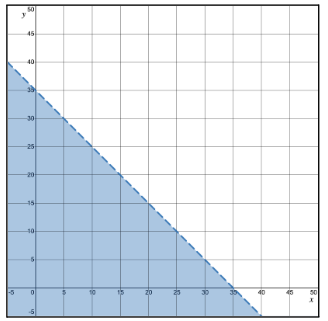
The graph below represents that inequality.
What do you notice about this graph? How is it similar or different from graphs you’ve seen of linear equations?
1 point
1
Question 9
9.
Mark the three solutions from Question 1 on the graph of the inequality in the Show Your Work below. What do you notice?
1 point
1
Question 10
10.
What do you think the shaded region represents on the graph?
1 point
1
Question 11
11.
Mark the point (19, 16) on the graph.
Is (19, 16) a solution to the inequality x + y < 35? Why or why not?
Why do you think the line in the graph is dashed, not solid?
Learn It
Graphing Linear Inequalities
Graphing linear inequalities can be a useful way to visualize and understand constraints. You already know how to graph linear equations; in this activity, you’ll learn how to graph linear inequalities.
A linear inequality is like a linear equation, except it uses an inequality sign (<, ≤, >, ≥) instead of an equals sign (=). In a linear equation, all the solutions that satisfy the equation fall exactly in a line when graphed. In a linear inequality, the solution set includes all the points that satisfy the inequality, which are represented by the shaded area.
1 point
1
Question 12
12.
Summarize: What is the difference between a linear inequality and a linear equation?
Graph the linear inequality y ≥ 15x in Desmos.
Note: This represents Cole’s earnings working as a lead barista, where he earns at least $15 per hour, depending on tips.
1 point
1
Question 13
13.
1. Identify key features
In slope-intercept form, find the y-intercept and slope. In standard form, find the x-intercept and y-intercept.
1 point
1
Question 14
14.
2. Graph the line
If the inequality uses ≤ or ≥, the line is solid. If it uses < or >, the line is dashed.
1 point
1
Question 15
15.
3. Test point and shade
Choose a point and plug it into the inequality. If the point makes the statement true, shade that side of the line. If not, shade the other side.
1 point
1
Question 16
16.
Identify solution(s)
1 point
1
Question 17
17.
Jordan wants to earn more than $120 each week. They earn $12 per hour as a lifeguard and $8 per hour babysitting. Graph the linear inequality representing this scenario: 12x + 8y > 120
1 point
1
Question 18
18.
Identify key features
Intercepts and/or slope
1 point
1
Question 19
19.
2. Graph the line
Is the line Dashed or solid?
1 point
1
Question 20
20.
3, Test point and shade
Choose a point and plug it into the inequality. If the point makes the statement true, shade that side of the line. If not, shade the other side.
1 point
1
Question 21
21.
4. Identify solution(s)
1 point
1
Question 22
22.
Mark the point (7, 7) on the graph from question 17. Would Jordan earn enough money if they worked 7 hours lifeguarding and 7 hours babysitting? Justify your response.
1 point
1
Question 23
23.
Is (8, 3) a solution to this inequality? How do you know?
1 point
1
Question 24
24.
Desmos #1:
ACTIVITY: Point Collector- Lines
Follow your teacher’s instructions to complete this Desmos activity. Then, answer the question.
When graphing a linear inequality, how do you know which direction to shade?
1 point
1
Question 25
25.
Contextualizing Linear Inequalities
You know how to write linear equations from word problems. Now, you’ll adapt that skill to write linear inequalities. Look out for key phrases that will tell you which sign to use, like “at least”, “a minimum” and “no more than”. *Notes in Book*
10 points
10
Question 26
26.
Lovely needs to earn at least $770 per week. She works part-time as a cashier for $11 per hour. She also earns $35 per hour doing freelance event photography, but it is hard to find freelance work.
a. Define your variables. x=_______ y=_______
b. Write an inequality representing the scenario._______
c. Graph the inequality (desmos - and screen shot into the Show your work).
d. If she only worked as a cashier, at least how many hours would she need to work?_______
e. Is working all of her hours as a cashier an optimal real-world solution?_______ Why or why not?_______
f. The point (0, 22) is a solution. What does that mean in this context? _______ Why is it NOT an optimal real-world solution?_______
g. If you were Lovely, what solution would you choose?_______ Why?_______
1 point
1
Question 27
27.
At most, Lovely can find 10 hours of freelance photography work each week.
Write an inequality representing this constraint._______
Graph the inequality. (Desmos & Screen Shot)
6 points
6
Question 28
28.
Match each inequality with the situation it represents.
Draggable item
arrow_right_alt
Corresponding Item
A $50 one-time signing bonus and earnings up to $15 per hour
arrow_right_alt
y ≥ 15x + 50
A transportation budget of at most $50 to spend on $1 bus rides and $15 cab rides
arrow_right_alt
y ≤ 15x + 50
A yard sale earns more than $50 selling $15 clothing items and $1 books
arrow_right_alt
y > 15x - 50
A $50 one-time signing bonus and earnings of at least $15 per hour
arrow_right_alt
y ≤ 15x - 50
A $50 one-time expense to purchase necessary supplies and maximum earnings of $15 per hour
arrow_right_alt
x + 15y ≤ 50
A $50 one-time expense to purchase necessary supplies and earnings of more than $15 per hour
arrow_right_alt
x + 15y > 50
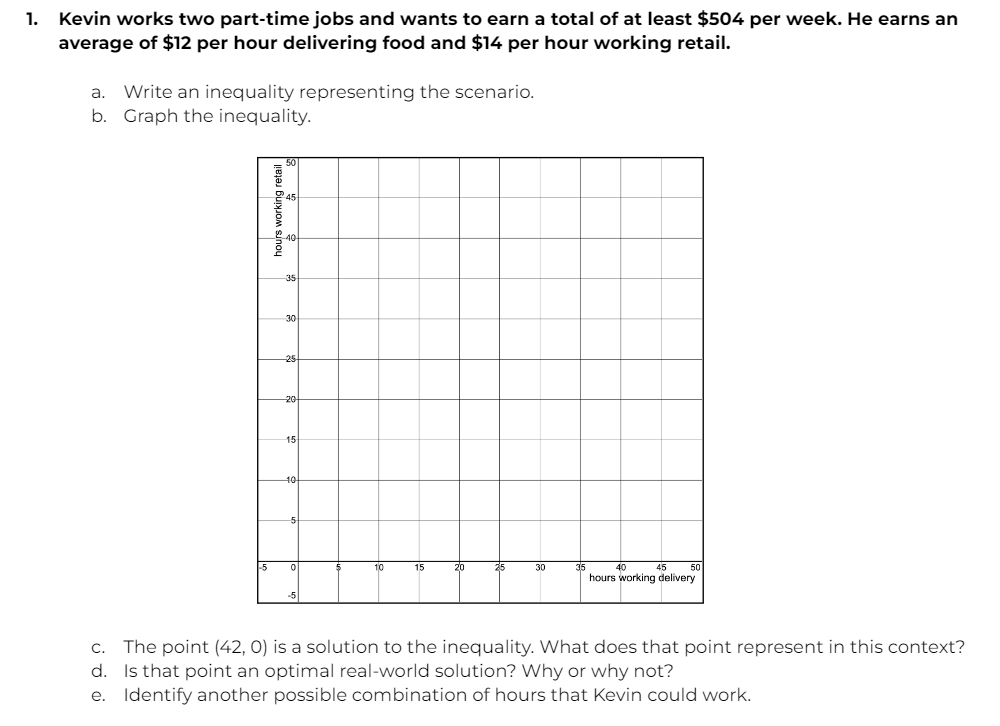
Kevin works two part-time jobs and wants to earn a total of at least $504 per week. He earns an average of $12 per hour delivering food and $14 per hour working retail.
2 points
2
Question 29
29.
a. Write an inequality representing the scenario._______
Graph the inequality (DESMOS & Screenshot)
1 point
1
Question 30
30.
c. The point (42, 0) is a solution to the inequality. What does that point represent in this context?
1 point
1
Question 31
31.
d. Is that point an optimal real-world solution? Why or why not?
1 point
1
Question 32
32.
e. Identify another possible combination of hours that Kevin could work.
Sana works part-time in event management earning $20 per hour. She also does freelance carpentry projects for $25 per hour. She wants to earn more than $750 per week.
Write an inequality to represent the scenario.
Graph the inequality.
Identify one possible solution to the inequality. Is it reasonable in this context? Why or why not?
Sana covers her basic expenses with $750, but wants to save up for a vacation. How much extra would she earn if she worked 30 hours in event management and 15 hours in carpentry?
If Sana can’t find any hours of carpentry work, at least how many hours would she need to work in event management to meet her basic needs?
What is the fewest number of hours that Sana could work and still earn more than $750? Justify your response.
5 points
5
Question 33
33.
Write an inequality to represent the scenario._______
Graph the Inequality and Screen Shot in Desmos. Mark off X and Y Intercepts on your graph.
1 point
1
Question 34
34.
Identify one possible solution to the inequality. Is it reasonable in this context? Why or why not?
1 point
1
Question 35
35.
Sana covers her basic expenses with $750, but wants to save up for a vacation. How much extra would she earn if she worked 30 hours in event management and 15 hours in carpentry?
1 point
1
Question 36
36.
If Sana can’t find any hours of carpentry work, at least how many hours would she need to work in event management to meet her basic needs?
1 point
1
Question 37
37.
What is the fewest number of hours that Sana could work and still earn more than $750? Justify your response.
Quentin works as a used car salesman, where he earns $8 per hour and an average commission of $260 per car sold. He wants to earn at least $1040 per week.
Write an inequality to represent this scenario, where x represents hours worked and y represents cars sold.
Graph the Inequality
The point (35, 3) is a solution. What does it represent in this context?
If Quentin only sells two cars that week, at least how many hours would he need to work?
If Quentin wants to work a standard 40-hour workweek, at least how many cars would he need to sell?
Identify one point that IS a solution but is NOT reasonable in the real-world context. Justify your response.
5 points
5
Question 38
38.
Write an inequality to represent this scenario, where x represents hours worked and y represents cars sold._______
Graph the inequality, Desmos Screen Shot, mark up the X and Y intercepts.
1 point
1
Question 39
39.
The point (35, 3) is a solution. What does it represent in this context?
1 point
1
Question 40
40.
If Quentin only sells two cars that week, at least how many hours would he need to work?
1 point
1
Question 41
41.
If Quentin wants to work a standard 40-hour workweek, at least how many cars would he need to sell?
1 point
1
Question 42
42.
Identify one point that IS a solution but is NOT reasonable in the real-world context. Justify your response.
5 points
5
Question 43
43.
Noel is a waiter in a restaurant who is paid the federal minimum wage for tipped workers: $2.13. They also keep 70% of the tips left by their tables. So, they always earn at least $2.13 per hour, but their actual earnings vary.
Write an inequality to represent Noel’s earnings, y, if they work x hours._______
Graph the inequality using Desmos.
The point (40, 200) is a solution to the inequality. What does that mean in this context?_______
At that point, how much did Noel take home from tips?_______
At that point, how much did diners leave in tips total?_______
3 points
3
Question 44
44.
Although Noel’s base pay is only $2.13, federal law says their total earnings, including tips, must at least meet the minimum wage of $7.25 per hour (or sometimes the state minimum wage).
Write a new inequality representing Noel’s earnings, y, if they work x hours._______
Graph that inequality on the same Desmos graph as Question 43.
If Noel works 30 hours, what is the minimum they can earn?_______
Identify one point that was a solution to the inequality in Question 1 but is NOT a solution to your new inequality._______
3 points
3
Question 45
45.
If Noel takes home less than the federal minimum wage, their employer is required to make up the difference.
If Noel works 40 hours and earns $290, how much does their employer owe them?_______
If Noel works 50 hours and keeps $140 in tips, how much does their employer owe them?_______
If Noel works 20 hours and their diners leave a total of $60 in tips, how much does their employer owe them?_______