
Mountains covered in deciduous forests

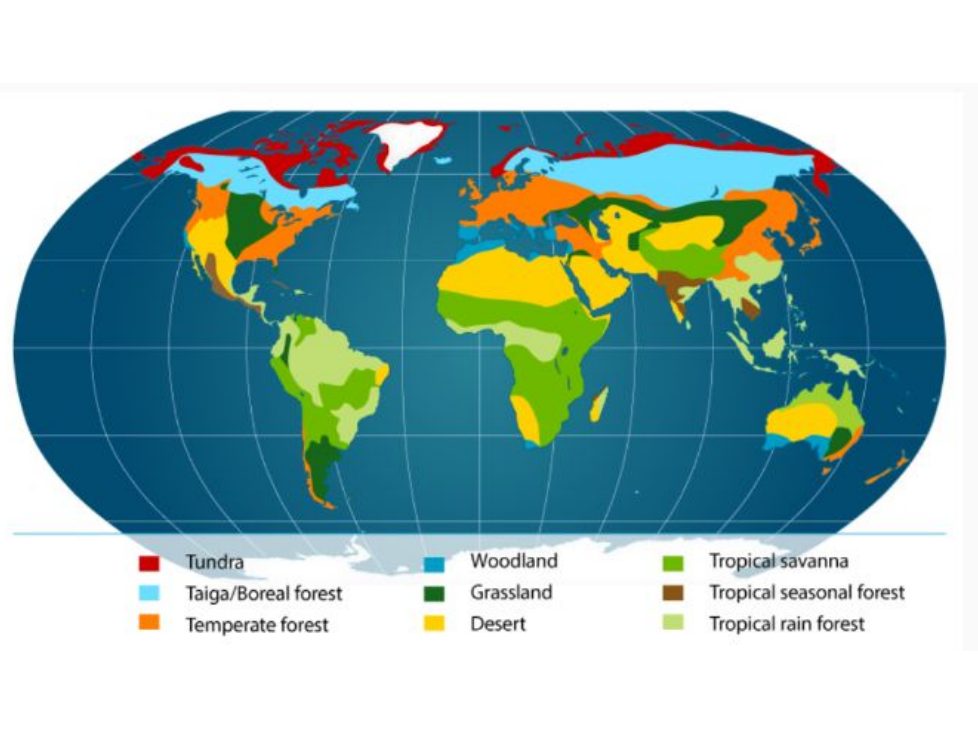
Biomes are classified primarily according to the characteristics of their plants. Biomes are also characterized by temperature, precipitation, and animal species that live there.
* The tundra is a treeless biome with a layer of permanently frozen soil, called permafrost, below the surface.
* The boreal forest is also called northern coniferous forest or taiga.
* The temperate forest is composed mostly of broad-leaved, deciduous trees--trees that shed their leaves in autumn.
* Open woodlands and mixed shrub communities are found in areas with less annual rainfall than temperate forests.
* A biome that is characterized by fertile soils that are able to support a thick cover of grasses is called grassland.
* A desert is any area in which the annual rate of evaporation exceeds the rate of precipitation.
* A tropical savanna is characterized by grasses and scattered trees in climates that receive less precipitation than some other tropical areas.
* Tropical seasonal forests, also called tropical dry forests, grow in areas of Africa, Asia, Australia, and South and Central America.
* Warm temperatures and large amounts of rainfall throughout the year characterize the tropical rain forest biome.
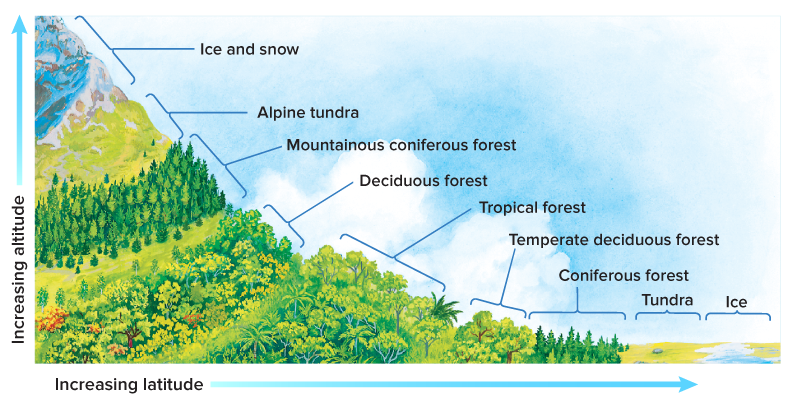
Let's talk about mountains. Often mountains are left off the list of biomes. Mountains are found throughout the world and do not fit the definition of just one biome. The climate characteristics, plant life, and animal life vary depending on elevation.
If you go up a mountain you'll notice that abiotic conditions such as, temperature and precipitation, change with increasing elevation. These variations allow many communities to exist on mountains. The biotic communities also change with increasing altitude, and the tops of tall mountains may even support communities that resemble those of the tundra.
Polar regions border the tundra at high latitudes. They're cold all year round, and covered by a thick layer of ice. In fact some scientists don't consider polar regions to be a true biome because they are ice masses, not true land areas with soil.
The coldest temperatures ever recorded (-89oC) was in Antarctica, which lies in the southern polar region. Within the southern polar region lies Antarctica. Colonies of penguins live in Antarctica. Additionally, whales and seals patrol the coasts, preying on penguins, fish, or shrimplike invertebrates called krill.
In contrast, the average winter temperature in the northern (arctic) polar region is about -30oC. The arctic summer in some areas becomes warm enough that some vegetables can be grown. In this northern polar region lies the ice-covered Arctic Ocean and Greenland. The arctic polar region supports many species, including polar bears and arctic foxes. Human societies have also inhabited this region throughout history.
What is the name for a large geographic areas with similar climax communities?
Which biome occurs in the United States and once contained huge herds of grazing herbivores?
Which land biome contains the greatest species diversity?
Which land biome has an annual rate of evaporation that exceeds the rate of precipitation?
How is a boreal forest different from tundra?
A
The biome characterized by warm temperature and large amounts of rainfall is the
Which biome occurs in the United States and once contained huge herds of grazing herbivores?