The graph shows the distance an object traveled over time. Which line segment represents the time interval during which the object was moving at a positive constant speed?
1 point
1
Question 2
2.
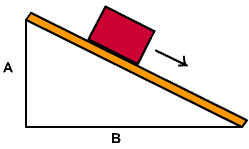
A block is sliding down a ramp with a constant incline. Near the bottom, the surface gets rougher and the block slows down. What force caused it to slow down?
1 point
1
Question 3
3.
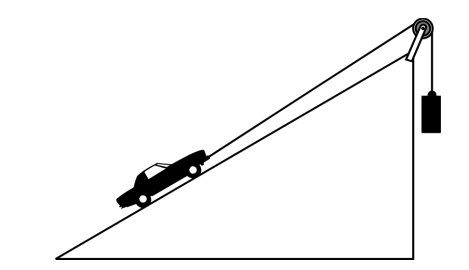
This diagram shows a ramp with a toy car at the bottom. A string is attached to the front of the car and the string goes over a pulley at the top of the ramp. A weight is attached to the other end of the string. What would be most responsible for the toy car being pulled up the ramp?
Driving Home Newton's Laws of Motion
Automobiles, baseballs, skateboards and bicycles --the world is full of things that are in motion. Centuries ago the British physicist Sir Isaac Newton stated three laws that describe the ways in which things move. These are Newton's three laws of motion:
The first law: Unless acted upon by an outside force, a body at rest tends to stay at rest, and a body in motion tends to stay in motion.
The second law: Acceleration is equal to the net force acting on a body divided by its mass.
The third law: For every action force there is an equal and opposite reaction force.
A driver starts her car and steps on the gas pedal. The car gradually accelerates to 50 km/hr. A few minutes later, the driver suddenly slams on the brakes to avoid hitting a box in the road. As the car comes to a stop, the driver's body appears to lurch forward in the seat until it is restrained by the seatbelt.
1 point
1
Question 4
4.
What law best explains why the driver's body appears to lurch forward when the brakes are suddenly applied?
1 point
1
Question 5
5.
A student is driving her car when an insect strikes her windshield. Which of the following statements best describes the forces in this situation?
1 point
1
Question 6
6.
A force of 5 N is required to increase the speed of a box from a rate of 1.0 m/s to 3.0 m/s within 5 s along a level surface. What change would most likely require additional force to produce the same results?
1 point
1
Question 7
7.
A ball is dropped from the top of a tall building. As the ball falls, the upward force of air resistance becomes equal to the downward pull of gravity. When these two forces become equal in magnitude, the ball will
1 point
1
Question 8
8.
A small stone is shot straight up in the air. The figure shows a plot of the stone's position vs. time (air resistance is ignored). When is the velocity of the stone 0 m/s
1 point
1
Question 9
9.
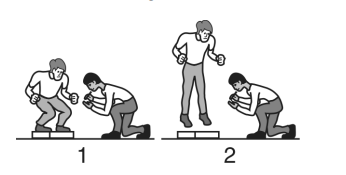
A student in a lab experiment jumps upward off a common bathroom scale as the lab partner records the scale reading. What does the lab partner observe during the instant the student pushes off?
1 point
1
Question 10
10.
A hot air balloon exerts a force of 1200 N while lifting a load of 800 N. Which free-body force diagram depicts the forces involved?
1 point
1
Question 11
11.
The figure shows a block that is being pulled along the floor. According to the figure, what is the acceleration of the block?
1 point
1
Question 12
12.
A ball is dropped from rest from a height 6.0 meters above the ground. The ball falls freely and reaches the ground 1.1 seconds later. What is the average speed of the ball?
1 point
1
Question 13
13.
To calculate the momentum of a pickup truck with a velocity of 25 m/s east, it is also necessary to know which of the following?
1 point
1
Question 14
14.
Mike, who has a mass of 75 kg, is running at 2.6 m/s. He accidentally collides with Tom, who has a mass of 125 kg and is not moving. Which of the following statements describes how much momentum each person has before the collision?
1 point
1
Question 15
15.
What impulse must be applied to a 25.0-kg cart to cause a velocity change of 12.0 m/s?
1 point
1
Question 16
16.
A student drops two eggs of equal mass simultaneously from the same height. Egg A lands on the tile floor and breaks. Egg B lands intact without bouncing, on a foam pad lying on the floor. Compared to the magnitude of the impulse on egg A as it lands, the magnitude of the impulse on egg B as it lands is
1 point
1
Question 17
17.
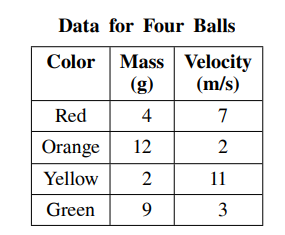
Four colored balls are thrown against a wall. The table below shows the masses and velocities of the balls.
Which ball had the greatest momentum when it hit the wall?
1 point
1
Question 18
18.
Four solid balls, each with a different mass are moving at the same speed. Which ball would require the most force to stop its motion?
1 point
1
Question 19
19.
Which could cause a decrease in the momentum of a moving object?
1 point
1
Question 20
20.
Which two quantities can be expressed using the same units?