Reading: Grade 3 (2023)

Last updated 4 months ago
8 questions
To the Bat Cave
Originally published in Click Magazine, October 2009

1 Every spring, mother bats fly to certain safe, warm caves to give birth and raise their babies. Some of these nursery caves have only a few bats, but in others, thousands of bats cover the ceiling and walls.

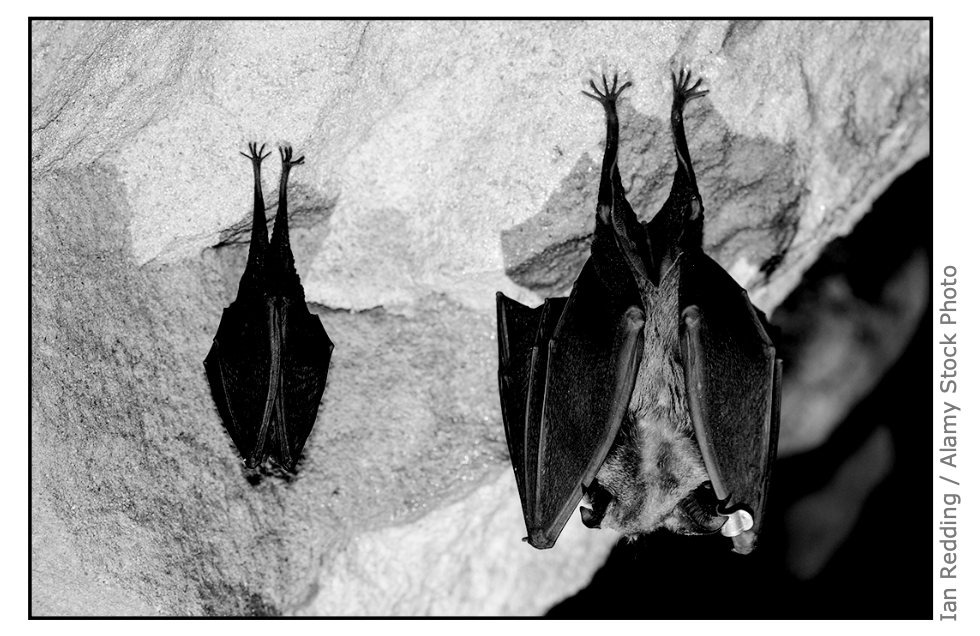
2 When a baby bat is born, it cannot fly and it has no fur, but it has strong claws on its feet. It hooks those claws into a crack in the cave ceiling and hangs upside down to roost like a grown-up bat.

3 The mother bats leave their babies every evening to hunt for food. They return when the sky begins to grow light. Then each mother nurses her baby and spends the day sleeping in the dark cave.

4 Soon the baby bats are big enough to fly and hunt outside with their mothers. All summer long, the bats grow fat, eating as much as they can each night and sleeping in the nursery cave during the day.

5 When summer ends and the weather begins to get cold, the bats must find a new place to live. Some fly to warm places where food is plentiful in winter. Others fly to hibernation caves, where they sleep for the entire winter.

6 Hibernation caves are colder and wetter than nursery caves. The temperature may be just above freezing, and sometimes little drops of water cover the hibernating bats.

7 When a bat hibernates, its body temperature drops and its heartbeat and breathing slow down. Its body works so slowly that the bat uses barely any energy. It can live for months without eating, using the energy stored in the fat it gained in the summer.

8 It doesn’t sound comfortable, but it’s just right for a bat’s long winter sleep.

“To the Bat Cave” from Click, Oct. 2009. © 2009 Cricket Media.
1

What does the word “nursery” tell the reader about the caves?

To the Bat Cave
Originally published in Click Magazine, October 2009

1 Every spring, mother bats fly to certain safe, warm caves to give birth and raise their babies. Some of these nursery caves have only a few bats, but in others, thousands of bats cover the ceiling and walls.

2 When a baby bat is born, it cannot fly and it has no fur, but it has strong claws on its feet. It hooks those claws into a crack in the cave ceiling and hangs upside down to roost like a grown-up bat.

3 The mother bats leave their babies every evening to hunt for food. They return when the sky begins to grow light. Then each mother nurses her baby and spends the day sleeping in the dark cave.

4 Soon the baby bats are big enough to fly and hunt outside with their mothers. All summer long, the bats grow fat, eating as much as they can each night and sleeping in the nursery cave during the day.

5 When summer ends and the weather begins to get cold, the bats must find a new place to live. Some fly to warm places where food is plentiful in winter. Others fly to hibernation caves, where they sleep for the entire winter.

6 Hibernation caves are colder and wetter than nursery caves. The temperature may be just above freezing, and sometimes little drops of water cover the hibernating bats.

7 When a bat hibernates, its body temperature drops and its heartbeat and breathing slow down. Its body works so slowly that the bat uses barely any energy. It can live for months without eating, using the energy stored in the fat it gained in the summer.

8 It doesn’t sound comfortable, but it’s just right for a bat’s long winter sleep.

“To the Bat Cave” from Click, Oct. 2009. © 2009 Cricket Media.
1

How does the photo help the reader understand the passage “To the Bat Cave”?

To the Bat Cave
Originally published in Click Magazine, October 2009

1 Every spring, mother bats fly to certain safe, warm caves to give birth and raise their babies. Some of these nursery caves have only a few bats, but in others, thousands of bats cover the ceiling and walls.

2 When a baby bat is born, it cannot fly and it has no fur, but it has strong claws on its feet. It hooks those claws into a crack in the cave ceiling and hangs upside down to roost like a grown-up bat.

3 The mother bats leave their babies every evening to hunt for food. They return when the sky begins to grow light. Then each mother nurses her baby and spends the day sleeping in the dark cave.

4 Soon the baby bats are big enough to fly and hunt outside with their mothers. All summer long, the bats grow fat, eating as much as they can each night and sleeping in the nursery cave during the day.

5 When summer ends and the weather begins to get cold, the bats must find a new place to live. Some fly to warm places where food is plentiful in winter. Others fly to hibernation caves, where they sleep for the entire winter.

6 Hibernation caves are colder and wetter than nursery caves. The temperature may be just above freezing, and sometimes little drops of water cover the hibernating bats.

7 When a bat hibernates, its body temperature drops and its heartbeat and breathing slow down. Its body works so slowly that the bat uses barely any energy. It can live for months without eating, using the energy stored in the fat it gained in the summer.

8 It doesn’t sound comfortable, but it’s just right for a bat’s long winter sleep.

“To the Bat Cave” from Click, Oct. 2009. © 2009 Cricket Media.
1

According to the passage "To the Bat Cave," why do bats eat all summer?

To the Bat Cave
Originally published in Click Magazine, October 2009

1 Every spring, mother bats fly to certain safe, warm caves to give birth and raise their babies. Some of these nursery caves have only a few bats, but in others, thousands of bats cover the ceiling and walls.

2 When a baby bat is born, it cannot fly and it has no fur, but it has strong claws on its feet. It hooks those claws into a crack in the cave ceiling and hangs upside down to roost like a grown-up bat.

3 The mother bats leave their babies every evening to hunt for food. They return when the sky begins to grow light. Then each mother nurses her baby and spends the day sleeping in the dark cave.

4 Soon the baby bats are big enough to fly and hunt outside with their mothers. All summer long, the bats grow fat, eating as much as they can each night and sleeping in the nursery cave during the day.

5 When summer ends and the weather begins to get cold, the bats must find a new place to live. Some fly to warm places where food is plentiful in winter. Others fly to hibernation caves, where they sleep for the entire winter.

6 Hibernation caves are colder and wetter than nursery caves. The temperature may be just above freezing, and sometimes little drops of water cover the hibernating bats.

7 When a bat hibernates, its body temperature drops and its heartbeat and breathing slow down. Its body works so slowly that the bat uses barely any energy. It can live for months without eating, using the energy stored in the fat it gained in the summer.

8 It doesn’t sound comfortable, but it’s just right for a bat’s long winter sleep.

“To the Bat Cave” from Click, Oct. 2009. © 2009 Cricket Media.
1

According to the passage "To the Bat Cave," what happens when a bat goes into hibernation?

Select two correct answers.

To the Bat Cave
Originally published in Click Magazine, October 2009

1 Every spring, mother bats fly to certain safe, warm caves to give birth and raise their babies. Some of these nursery caves have only a few bats, but in others, thousands of bats cover the ceiling and walls.

2 When a baby bat is born, it cannot fly and it has no fur, but it has strong claws on its feet. It hooks those claws into a crack in the cave ceiling and hangs upside down to roost like a grown-up bat.

3 The mother bats leave their babies every evening to hunt for food. They return when the sky begins to grow light. Then each mother nurses her baby and spends the day sleeping in the dark cave.

4 Soon the baby bats are big enough to fly and hunt outside with their mothers. All summer long, the bats grow fat, eating as much as they can each night and sleeping in the nursery cave during the day.

5 When summer ends and the weather begins to get cold, the bats must find a new place to live. Some fly to warm places where food is plentiful in winter. Others fly to hibernation caves, where they sleep for the entire winter.

6 Hibernation caves are colder and wetter than nursery caves. The temperature may be just above freezing, and sometimes little drops of water cover the hibernating bats.

7 When a bat hibernates, its body temperature drops and its heartbeat and breathing slow down. Its body works so slowly that the bat uses barely any energy. It can live for months without eating, using the energy stored in the fat it gained in the summer.

8 It doesn’t sound comfortable, but it’s just right for a bat’s long winter sleep.

“To the Bat Cave” from Click, Oct. 2009. © 2009 Cricket Media.
1

How does the author organize the passage "To the Bat Cave"?

Why Catch Bats?
by Monica Vavra
Originally published in Highlights, November 2006

1 “Hurry!” I called, as the setting sun began coloring the clouds above. Soon the bats would wake and leave their roosts to forage for the night. Tunneling through the canopy of trees above, they would feed on insects flying over the stream.

2 Our research team stretched the mist-net, a long gauzy volleyball-style net, across the wide streambed. The mist-net poles were pounded into the bank, tied to trees, and surrounded by rocks to secure them. It looked as if we were ready for a nighttime game of volleyball. But we weren’t volleyball players. We were scientists studying the bat populations outside San Antonio, Texas.

3 What kinds of bats lived there? Were they healthy? How did humans living close by affect them? We needed to know the answers so we could help protect them. We hoped the bats would be caught in the mist-net when they came to feed. Then we would be able to study them.

4 “Make sure the net is high enough above the water,” I said. If a bat were caught in the net, its weight might make the net sag into the water below. Then the bat could drown. But we would never let this happen.

5 We tested the net. We knotted a handkerchief, which is about the weight of one of the bats in our area. We gently tossed it into the bottom of the net. The net sagged slightly but did not reach the water. The bats would be safe.

6 Darkness was coming. We found a spot to sit on the stream bank. We waited quietly, listening to the trill of spring peepers and the buzz of the cicadas living in the trees.

7 Thirty minutes passed. I slipped on my leather gloves. I needed to protect my hands because bats can bite or scratch if they are scared. The white light from my flashlight bobbled in front of me as I walked down the rocky bank to check the net.

8 I slowly shone the flashlight across the length of the net. Toward the bottom, I saw a gleam of copper.

9 “Red bat!” I called out. I gently removed the little bat from the net. He was small in my hands, like a mouse with wings. Bright coppery-orange fur covered his body. His leathery wings were folded. He lay quietly in my hands while my assistant brought the scale and my notebook.

10 “Lasiurus borealis,” I said. My assistant wrote down the red bat’s scientific name. “Red bats roost in trees, hanging from the stem of a leaf. They eat insects like crickets, flies, and cicadas,” I told him.

11 We stretched open the wings of the bat, and I measured him with a tape measure. “Twenty-nine-centimeter wingspan and 10.3 centimeters in length,” I said. “This one is a male.” My assistant wrote that down in the notebook.

12 It was time to weigh the bat. We hung a small cloth bag from a special scale that is held at its top by hand rather than set on the ground. The scale was set to zero with the bag hanging from it. Now only the bat’s weight, and not the weight of the bag, would be measured.

13 “Twelve grams—a healthy weight for a male red bat,” I said, reading from the scale.

14 I held the bat in my hands and walked downstream to release him. I needed to be far enough from the net so the bat would not be caught again. Carefully, I put him down on the ground. The bat scrabbled through the leaves. Then he took off, flying through the dark to forage. That night alone, our red bat would eat his weight in insects.

15 We caught two more red bats, repeating the process with each. Both were healthy males, about the same size and weight as the first. We recorded all the information in the notebook.

16 At midnight, we packed the mist-nets and headed home. But our work wasn’t done. We still had questions. Why did we catch only males? Were there more males than females in this area? If so, why? Or was it just accidental that we hadn’t caught any females?

17 Also, we knew that other bat species had been found in the area. One was a small brown cave bat, and the other was a Brazilian free-tailed bat. Yet we had caught neither of these. Were we in the wrong spot? Or had their habitat been destroyed?

18 We didn’t know the answers, but as scientists we would work to find out. We would have to return, again and again, to gather more information. Only time and a lot more research would give us the answers to these questions.

“Why Catch Bats?” by Monica Vavra, from Highlights, Nov. 2006. © 2006 Highlights for Children, Inc.
1

In the passage 'Why Catch Bats?' the author states that collecting information about the bat population is important. Which statements are proof the researchers were gathering data?

Select two correct answers.

Why Catch Bats?
by Monica Vavra
Originally published in Highlights, November 2006

1 “Hurry!” I called, as the setting sun began coloring the clouds above. Soon the bats would wake and leave their roosts to forage for the night. Tunneling through the canopy of trees above, they would feed on insects flying over the stream.

2 Our research team stretched the mist-net, a long gauzy volleyball-style net, across the wide streambed. The mist-net poles were pounded into the bank, tied to trees, and surrounded by rocks to secure them. It looked as if we were ready for a nighttime game of volleyball. But we weren’t volleyball players. We were scientists studying the bat populations outside San Antonio, Texas.

3 What kinds of bats lived there? Were they healthy? How did humans living close by affect them? We needed to know the answers so we could help protect them. We hoped the bats would be caught in the mist-net when they came to feed. Then we would be able to study them.

4 “Make sure the net is high enough above the water,” I said. If a bat were caught in the net, its weight might make the net sag into the water below. Then the bat could drown. But we would never let this happen.

5 We tested the net. We knotted a handkerchief, which is about the weight of one of the bats in our area. We gently tossed it into the bottom of the net. The net sagged slightly but did not reach the water. The bats would be safe.

6 Darkness was coming. We found a spot to sit on the stream bank. We waited quietly, listening to the trill of spring peepers and the buzz of the cicadas living in the trees.

7 Thirty minutes passed. I slipped on my leather gloves. I needed to protect my hands because bats can bite or scratch if they are scared. The white light from my flashlight bobbled in front of me as I walked down the rocky bank to check the net.

8 I slowly shone the flashlight across the length of the net. Toward the bottom, I saw a gleam of copper.

9 “Red bat!” I called out. I gently removed the little bat from the net. He was small in my hands, like a mouse with wings. Bright coppery-orange fur covered his body. His leathery wings were folded. He lay quietly in my hands while my assistant brought the scale and my notebook.

10 “Lasiurus borealis,” I said. My assistant wrote down the red bat’s scientific name. “Red bats roost in trees, hanging from the stem of a leaf. They eat insects like crickets, flies, and cicadas,” I told him.

11 We stretched open the wings of the bat, and I measured him with a tape measure. “Twenty-nine-centimeter wingspan and 10.3 centimeters in length,” I said. “This one is a male.” My assistant wrote that down in the notebook.

12 It was time to weigh the bat. We hung a small cloth bag from a special scale that is held at its top by hand rather than set on the ground. The scale was set to zero with the bag hanging from it. Now only the bat’s weight, and not the weight of the bag, would be measured.

13 “Twelve grams—a healthy weight for a male red bat,” I said, reading from the scale.

14 I held the bat in my hands and walked downstream to release him. I needed to be far enough from the net so the bat would not be caught again. Carefully, I put him down on the ground. The bat scrabbled through the leaves. Then he took off, flying through the dark to forage. That night alone, our red bat would eat his weight in insects.

15 We caught two more red bats, repeating the process with each. Both were healthy males, about the same size and weight as the first. We recorded all the information in the notebook.

16 At midnight, we packed the mist-nets and headed home. But our work wasn’t done. We still had questions. Why did we catch only males? Were there more males than females in this area? If so, why? Or was it just accidental that we hadn’t caught any females?

17 Also, we knew that other bat species had been found in the area. One was a small brown cave bat, and the other was a Brazilian free-tailed bat. Yet we had caught neither of these. Were we in the wrong spot? Or had their habitat been destroyed?

18 We didn’t know the answers, but as scientists we would work to find out. We would have to return, again and again, to gather more information. Only time and a lot more research would give us the answers to these questions.

“Why Catch Bats?” by Monica Vavra, from Highlights, Nov. 2006. © 2006 Highlights for Children, Inc.
1

Which sentence would the reader most likely agree with after reading the passage "Why Catch Bats?"

Why Catch Bats?
by Monica Vavra
Originally published in Highlights, November 2006

1 “Hurry!” I called, as the setting sun began coloring the clouds above. Soon the bats would wake and leave their roosts to forage for the night. Tunneling through the canopy of trees above, they would feed on insects flying over the stream.

2 Our research team stretched the mist-net, a long gauzy volleyball-style net, across the wide streambed. The mist-net poles were pounded into the bank, tied to trees, and surrounded by rocks to secure them. It looked as if we were ready for a nighttime game of volleyball. But we weren’t volleyball players. We were scientists studying the bat populations outside San Antonio, Texas.

3 What kinds of bats lived there? Were they healthy? How did humans living close by affect them? We needed to know the answers so we could help protect them. We hoped the bats would be caught in the mist-net when they came to feed. Then we would be able to study them.

4 “Make sure the net is high enough above the water,” I said. If a bat were caught in the net, its weight might make the net sag into the water below. Then the bat could drown. But we would never let this happen.

5 We tested the net. We knotted a handkerchief, which is about the weight of one of the bats in our area. We gently tossed it into the bottom of the net. The net sagged slightly but did not reach the water. The bats would be safe.

6 Darkness was coming. We found a spot to sit on the stream bank. We waited quietly, listening to the trill of spring peepers and the buzz of the cicadas living in the trees.

7 Thirty minutes passed. I slipped on my leather gloves. I needed to protect my hands because bats can bite or scratch if they are scared. The white light from my flashlight bobbled in front of me as I walked down the rocky bank to check the net.

8 I slowly shone the flashlight across the length of the net. Toward the bottom, I saw a gleam of copper.

9 “Red bat!” I called out. I gently removed the little bat from the net. He was small in my hands, like a mouse with wings. Bright coppery-orange fur covered his body. His leathery wings were folded. He lay quietly in my hands while my assistant brought the scale and my notebook.

10 “Lasiurus borealis,” I said. My assistant wrote down the red bat’s scientific name. “Red bats roost in trees, hanging from the stem of a leaf. They eat insects like crickets, flies, and cicadas,” I told him.

11 We stretched open the wings of the bat, and I measured him with a tape measure. “Twenty-nine-centimeter wingspan and 10.3 centimeters in length,” I said. “This one is a male.” My assistant wrote that down in the notebook.

12 It was time to weigh the bat. We hung a small cloth bag from a special scale that is held at its top by hand rather than set on the ground. The scale was set to zero with the bag hanging from it. Now only the bat’s weight, and not the weight of the bag, would be measured.

13 “Twelve grams—a healthy weight for a male red bat,” I said, reading from the scale.

14 I held the bat in my hands and walked downstream to release him. I needed to be far enough from the net so the bat would not be caught again. Carefully, I put him down on the ground. The bat scrabbled through the leaves. Then he took off, flying through the dark to forage. That night alone, our red bat would eat his weight in insects.

15 We caught two more red bats, repeating the process with each. Both were healthy males, about the same size and weight as the first. We recorded all the information in the notebook.

16 At midnight, we packed the mist-nets and headed home. But our work wasn’t done. We still had questions. Why did we catch only males? Were there more males than females in this area? If so, why? Or was it just accidental that we hadn’t caught any females?

17 Also, we knew that other bat species had been found in the area. One was a small brown cave bat, and the other was a Brazilian free-tailed bat. Yet we had caught neither of these. Were we in the wrong spot? Or had their habitat been destroyed?

18 We didn’t know the answers, but as scientists we would work to find out. We would have to return, again and again, to gather more information. Only time and a lot more research would give us the answers to these questions.

“Why Catch Bats?” by Monica Vavra, from Highlights, Nov. 2006. © 2006 Highlights for Children, Inc.
1

What information about bats is discussed in both passages?