Science: Grade 7 (2024)
star
star
star
star
star
Last updated 4 months ago
8 questions
As students enter their classroom, they observe the teacher lighting the wick of a candle. As soon as the candle is lit, the teacher places the candle in a container and tightly seals the container. As the candle burns, they notice the wax melts, flows down the side, and changes back into a solid at the base. This is shown in the model the students drew.
The students recall that when you light a candle, the heat of the flame melts the wax near the wick. This liquid wax is then drawn up the wick by capillary action. The heat of the flame vaporizes the liquid wax (turns it into a hot gas) that combines with oxygen to form carbon dioxide and water vapor.
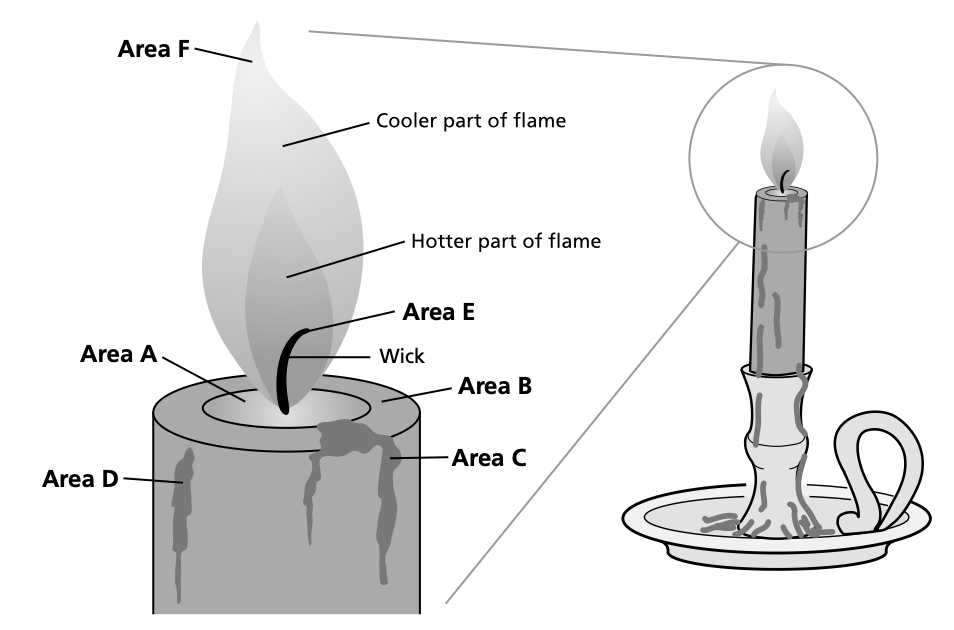
The candle is burned in a container that is tightly sealed. The mass of the candle is about 45 grams, and the mass of the container is about 505 grams. After a few minutes, the flame goes out.
The teacher reminds the students that what they are observing is a chemical reaction because a chemical change is occurring.
1
In which one part of the model doeschemical change most likelyoccur?
In which one part of the model does
chemical change most likely
occur?
1
How do the substances at Area B and Area F of the model compare?Select the TWO best answers.
How do the substances at Area B and Area F of the model compare?
Select the TWO best answers.
1
What one way do the particles inArea A of the model most likelycompare to those in Area B?
What one way do the particles in
Area A of the model most likely
compare to those in Area B?
1
Which one answer best explainswhy the candle wax solidifies inArea D?
Which one answer best explains
why the candle wax solidifies in
Area D?
1
After the candle inside the sealed container stopped burning, the teacher measured the mass of the container and candle together. She then measured the mass of the unburned part of the candle alone.
Which one answer best explains why the candle burns out within a few minutes of being placed in the closed container?
After the candle inside the sealed container stopped burning, the teacher measured the mass of the container and candle together. She then measured the mass of the unburned part of the candle alone.
Which one answer best explains why the candle burns out within a few minutes of being placed in the closed container?
1
Which one answer best predicts the result of these measurements?
1
Sofia wants to create a model illustrating the difference between the molecules of wax in the liquid state and the molecules of wax in the solid state. To accomplish this her model must be able to effectively represent which of these differences?
4
After their experiments, the teacher relit the candle and allowed it to burn until it was no longer visible and the flame went out. John, one of the students, made a comment about the candle being “all burned up.” Another student, Sofia, remarked that the candle really was still in the room, but that it just wasn’t a candle anymore.
Explain why Sofia’s comment is supported by the Law of Conservation of Matter. Describe a model that explains how the mass of the candle could still remain in the room even after it has all been burned.
After their experiments, the teacher relit the candle and allowed it to burn until it was no longer visible and the flame went out. John, one of the students, made a comment about the candle being “all burned up.” Another student, Sofia, remarked that the candle really was still in the room, but that it just wasn’t a candle anymore.
Explain why Sofia’s comment is supported by the Law of Conservation of Matter. Describe a model that explains how the mass of the candle could still remain in the room even after it has all been burned.