Science: Grade 11 (2024)
star
star
star
star
star
Sidst opdateret about 1 year ago
8 Spørgsmål
In addition to the worry about Lyme disease, the city council has been receiving a number of complaints about the impact of the deer on humans. Complaints include the following:
increased car-deer collisions
grazing of bushes, shrubs, flowers, and gardens
muddy and eroded local parks due to overgrazing
damage to agricultural production
The council has been asked to develop a solution to the problem and is considering a number of possible options. They are considering the benefits and limitations of these options:
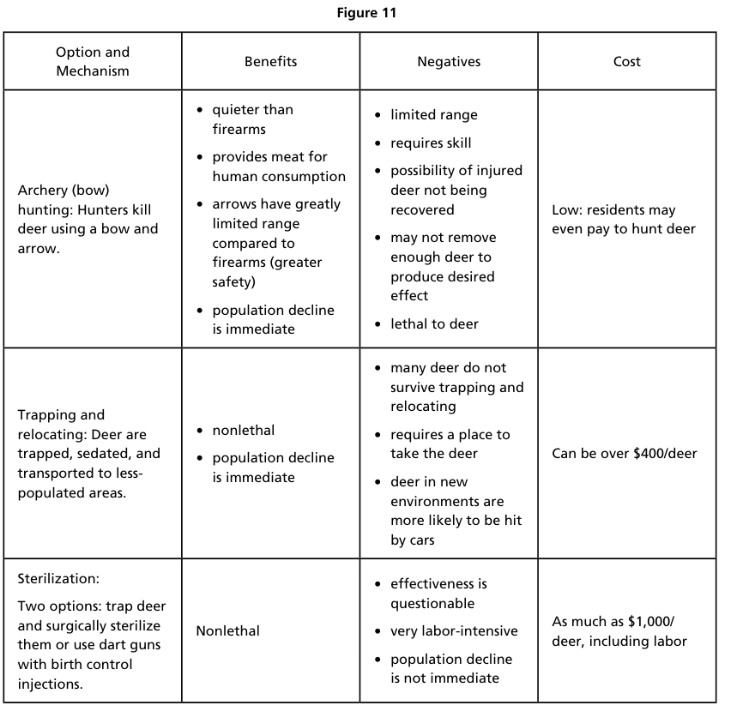
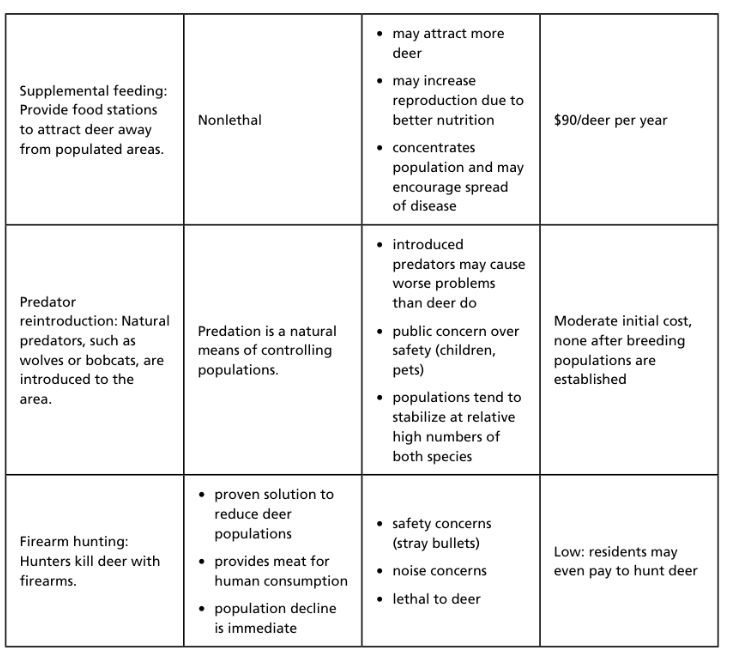
Consider the proposed solutions to the problem of deer overpopulation.
A. Construct an explanation for which option is the best solution. Explain why that option would be the best and what factors influenced your evaluation.
B. Construct an explanation for which option is the least favorable solution. Explain why that option would be the least favorable and what factors influenced your evaluation.
C. Explain how the proposed solutions might be refined to create the best possible solution. Explain why that would be the best possible solution. Note that you are not limited to only the ideas in the chart but are free to add original ideas of your own to create a best possible solution.
As they were driving home from soccer practice one evening, Taylor and her mother had to swerve to avoid a deer that ran across the road in front of them.
“Gosh, there sure are a lot of deer in our neighborhood,” Taylor said.
“Yes, there sure are,” her mother replied. “There weren’t nearly as many deer around here when I was a kid. If the population keeps growing, we may be in deer up to our eyeballs soon.”
Taylor became interested in how the deer population had increased in her neighborhood and what effect it might have on the ecosystem. She found this information on statewide deer population growth over time.
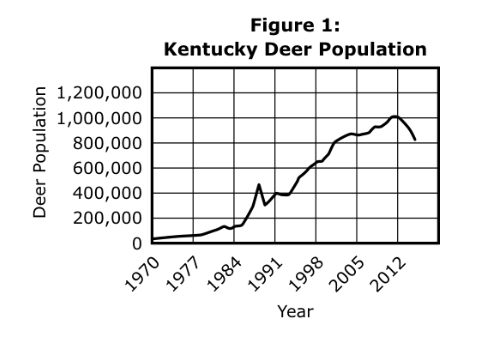
Data shown for the Ohio and Connecticut deer populations ends at 2000 and 2005 respectively, while the Kentucky data continues into 2015. Taylor wondered whether the Ohio and Connecticut deer population data would eventually reveal the same trend seen in Kentucky after 2005.
For the Ohio and Connecticut deer populations to demonstrate the same trend as seen in Kentucky after 2005, which one of these would have to be true?
The data table in Figure 4 and the graph in Figure 5 show the deer population change in Ohio and Kentucky between 1984 and 1991.
Which one possible influence might best explain the population change between 1988 and 1989?
The changes observed between Figure 4 and Figure 5 reflect changes in the ecosystem. Which organisms in the ecosystem (represented by the food web in Figure 6) would be indirectly impacted by a change in deer population?
Select two correct answers.
Considering the series of changes illustrated between Figures 7, 8, and 9, which observation indicates the greatest decrease in the long-term stability of the ecosystem?
Taylor thinks about the Kentucky deer population data from Figure 1 (in tab 1) and how it is related to the observations she made at her grandfather’s farm.
Which statement is best supported by Taylor’s observations of the ecosystem changes over time?
What relationship in the data in Figure 10 supports the government official’s claim?
If the study is representative of the ecosystem in Taylor’s community, what implications does this data have for the human population?