7-5: Identification of the Romanovs using STR Profiling
star
star
star
star
star
Last updated 8 months ago
6 questions
Note from the author:
At the conclusion of this activity, you will be able to do the following:
Analyze the STR profiles of the nine skeletal remains found at the Romanov gravesite.
Given the STR profiles of Tsar Nicholas, Tsarina Alexandra, and the STR profiles obtained from the other skeletal remains in the gravesite, determine which remains belonged to the tsar and tsarina’s children and which belonged to the nonfamily members (servants and the family doctor).
Determine which allele in each child was inherited from the mother (tsarina) and which allele was inherited from the father (tsar) based on STR profiles.
Summarize how kinship or lack of kinship is established using STR profiles.
At the conclusion of this activity, you will be able to do the following:
Analyze the STR profiles of the nine skeletal remains found at the Romanov gravesite.
Given the STR profiles of Tsar Nicholas, Tsarina Alexandra, and the STR profiles obtained from the other skeletal remains in the gravesite, determine which remains belonged to the tsar and tsarina’s children and which belonged to the nonfamily members (servants and the family doctor).
Determine which allele in each child was inherited from the mother (tsarina) and which allele was inherited from the father (tsar) based on STR profiles.
Summarize how kinship or lack of kinship is established using STR profiles.
Background
In 1991, the skeletal remains of Tsar Nicolas II and his wife Tsarina Alexandra were identified among the nine sets of remains recovered from a mass gravesite in Russia. Evidence from the bone fragments indicated the sex and age, but the dental work and DNA evidence provided a more definite identification.
The Russians labeled the skeletons numerically. Skeletal remains 7 were of a middle-aged woman whose ribs showed possible signs of damage from bayonet thrusts. Dr. Lowell Levine, forensic odontologist, noted her elaborate and beautiful dental work. Two crowns were made of platinum and other crowns were made from porcelain with gold fillings. This type of dental work was practiced in Germany, Alexandra’s homeland. None of the servants would have been able to afford such expensive dental work. Therefore, skeletal remains 7 were identified as belonging to the tsarina, Alexandra.
Skeletal remains 4 were identified as Tsar Nicholas II. The skeleton was of a fairly short middle-aged man with signs of wear and deformation in the hipbones, possibly a result of years of riding on horseback. The skull was wide with a sloping forehead and a flat palate resembling Tsar Nicholas II . The teeth had evidence of periodontal disease.
The forensic team’s next concern was to determine if any of the remaining seven skeletons belonged to the Romanov children. One method used, along with the skeletal and dental analyses, was STR analysis. The American scientists were able to identify three of the Romanov daughters, Olga, Maria, and Tatiana. The four other skeletal remains in the mass gravesite belonged to three servants and a physician. The remains of the youngest children, Alexei the Crown Prince and Anastasia, were not found in this gravesite. Their remains were discovered in 2006 in a second gravesite.
In this activity, you will examine the data obtained from the nine STR profile analyses of the skeletal remains of the bodies found in the 1991 mass gravesite and determine which of the nine skeletal remains belong to the Romanov children.
Part 1
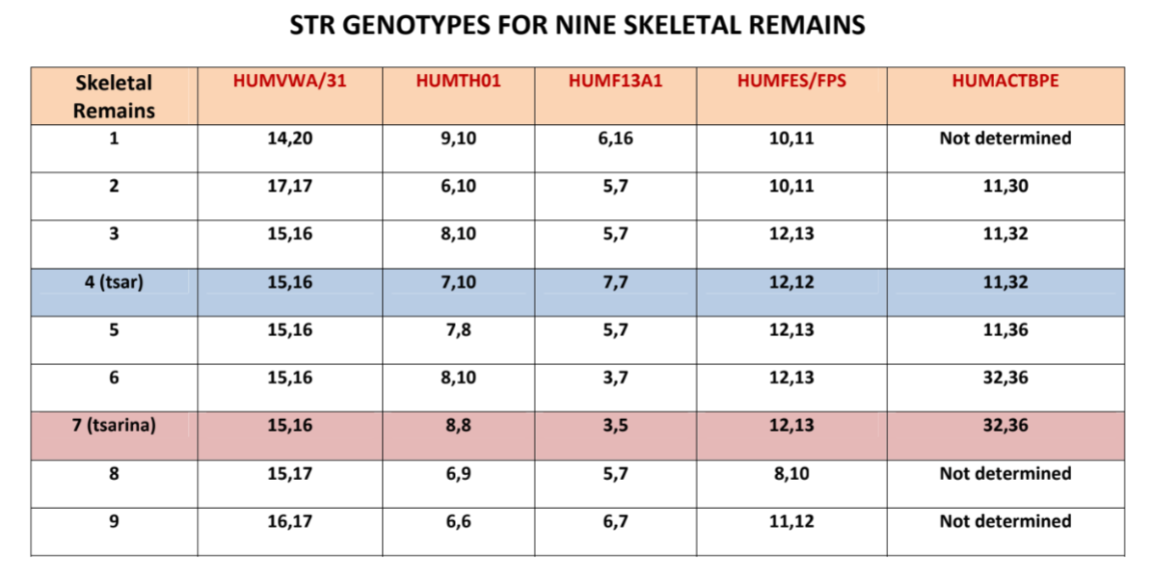
Refer to the data table labeled STR Genotypes for Nine Skeletal Remains at the end of this activity or to Act 7-5 WKST: STR Genotypes. This data table provides the STR profiles for five STR markers used in the identification of nine skeletal remains found in the first gravesite in 1991. The skeletal remains are identified by numbers 1 through 9 in the left column.
Skeletal remains 4 were identified as belonging to Tsar Nicholas II (blue) and skeletal remains 7 were identified as Tsarina Alexandra (pink), based on bone, tooth, and DNA analysis.
Each person’s STR profile is read from left to right. When examining a person’s STR profile, place either a ruler or a blank sheet of paper under the name to make it easier to see the STR profile and not confuse it with another line.
The top of the data table refers to the five STR markers used in the analysis. The “HUM” prefix refers to human.
Five STR markers used in the DNA analysis of the skeletal remains are:
HUMVWA/31
HUMTH01
HUMF13A1
HUMFES/FPS
HUMACTBP2
Your task is to analyze the STR profiles from the remains of the nine people buried in the mass gravesite. Determine if any of the skeletal remains could belong to the Romanov children based on STR alleles inherited from the tsar (skeletal remains 4) and from STR alleles inherited from the tsarina (skeletal remains 7).
For each of the skeletal remains from numbers 1, 2, 3, 5, 6, 8, and 9, use a red pencil to circle the allele that could have been inherited from the tsarina.
Use a blue pencil to circle the allele that could have been inherited from the tsar.
For example, locate STR marker HUMTH01 on the data table. Locate the STR profile for remains 3. The genotype for STR marker HUMTH01 is (8, 10). The 8 allele could have been inherited from the tsarina and the 10 could have been inherited from the tsar. On the data table found in Act 7-5 WKST: STR Genotype for skeletal remains 3 under HUMTH01, circle the 8 in red and the 10 in blue. If the allele does not come from either the tsar or tsarina, do not circle the allele. Repeat this process for the STR marker HUMTH01 for remains 1, 2, 5, 6, 8, and 9.
Repeat the process for the other four STRs (HUMVWA/31, HUMF13A1, HUMFES/FPS, and HUMACTBP2) and circle the allele inherited from the tsarina in red and circle the allele inherited from the tsar in blue.
To determine if the skeletal remains could have been one of the Romanov children, verify if they have inherited one allele from the tsar and one allele from the tsarina for each of the five STRs. (Note that it may be easier to view data for individual skeletal remains if you place a blank sheet of paper under the number of the remains and view the data from left to right.)
1 point
1
Question 1
1.
STR Genotypes for 9 skeletal remains.
Use red to circle the allele that could have been inherited from the tsarina.
Use blue to circle the allele that could have been inherited from the tsar.
1 point
1
Question 2
2.
Compare your answers with the answers of another student. Do you agree? If not, check both of your answers for any errors.
1 point
1
Question 3
3.
In the table “STR Genotypes for Nine Skeletal Remains,” highlight the number of the skeletal remains that you have identified as a child of the tsar and tsarina.
Final Analysis
1 point
1
Question 4
4.
Refer to skeletal remains 2 and 8. Could those skeletal remains be children of the tsar and tsarina? Support your answer using evidence from the STR analysis. Support your claim with evidence.
1 point
1
Question 5
5.
Based on your analysis of all five STRs, which skeletal remains are those belonging to the Romanov children, and which skeletal remains are those that belong to the nonrelated individuals? Cite evidence from your study to justify your conclusion.
1 point
1
Question 6
6.
Did any of the skeletal remains (other than the children), have any STR pairs that had one allele from the tsar and one allele from the tsarina for a specific STR marker? Support your claim with evidence.