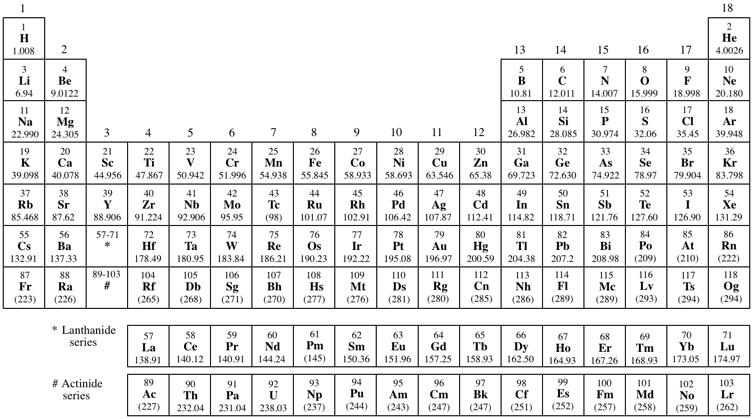

Malleability and ductility are characteristics of substances with
Which of the following atom's Lewis dot notation shows six valence electrons?
How many valence electrons to strontium atoms generally lose?
Match the following electronegativities to their respective atoms.
| Draggable item | arrow_right_alt | Corresponding Item |
|---|---|---|
Aluminum | arrow_right_alt | 3.0 |
Helium | arrow_right_alt | 2.2 |
Lithium | arrow_right_alt | 1.5 |
Arsenic | arrow_right_alt | 1.0 |
Hydrogen | arrow_right_alt | N/A |
Nitrogen | arrow_right_alt | 2.1 |
The melting points of ionic compounds are higher than the melting points of molecular compounds because
Which of the properties listed below is NOT a property of ionic compounds?
The electrons involved in the formation of a chemical bond are called

Which of the pairs of elements below will form the LEAST polar bond?
Metallic Bonds have all the following characteristics, except
Match the element with its correct Lewis Dot Structure for covalent bonding
| Draggable item | arrow_right_alt | Corresponding Item |
|---|---|---|
Fluorine (F) | arrow_right_alt | 4 dots |
Carbon (C) | arrow_right_alt | 3 dots |
Boron (B) | arrow_right_alt | 7 dots |
Match the number of covalent bonds with the appropriate element
| Draggable item | arrow_right_alt | Corresponding Item |
|---|---|---|
2 covalent bonds | arrow_right_alt | Hydrogen (H) |
3 covalent bonds | arrow_right_alt | Oxygen (O) |
1 covalent bond | arrow_right_alt | Nitrogen (N) |
What is the defining characteristic of a covalent bond?
In a water molecule (H2O), what type of bond is between the Hydrogen and Oxygen atoms?
Which of these compounds does NOT form a covalent bond?
Covalent bonds can only occur between atoms of the same element.
In a covalent bond, the atom with the higher electronegativity completely takes the electrons from the other atom.
If oxygen has an electronegativity of 3.5 and hydrogen has an electronegativity of 2.1, what is the difference in electronegativity?
Using the Pauling scale, sodium (Na) has an electronegativity of 0.93, whereas chlorine (Cl) has an electronegativity of 3.16. What is the difference?
Carbon (electronegativity - 2.55) forms a covalent compound with hydrogen (electronegativity - 2.1). Calculate the difference in electronegativity.
Using the Octet Rule and the electron configuration of each element, select all of the the answers that explain what the elements need to do in order to achieve stability.
Show the Ionic compound formation equation for Li and Cl.
Match the following metals to form alloys.
| Draggable item | arrow_right_alt | Corresponding Item |
|---|---|---|
copper | arrow_right_alt | carbon |
tin | arrow_right_alt | zinc |
iron | arrow_right_alt | copper |
Why are metals shiny?
Based on the table, which of the following statements is true?