Preskoči na glavni sadržaj
Prijava
Sign up for FREE
arrow_back
Biblioteka

4.6 Budgeting for Fixed Cost

star
star
star
star
star
Posljednje ažuriranje over 1 year ago
33 questions
Napomena autora:
Intro-Warm-Up
Learn It
MATH CONNECTION -PERCENTS AND INEQUALITIES
Exit Ticket
1
1
1

OBJECTIVES & STANDARDS

Math Objectives

  • Represent constraints by equations or inequalities

  • Understand how changing parameters alters inequalities with two variables

Common Core Math Standards

  • Link to all CCSS Math

  • CCSS.PRACTICE.MP1

  • CCSS.HSA.REI.D.12

  • CCSS.HSA.CED.A.3

Personal Finance Objectives

  • Understand factors that affect net worth

  • Differentiate between fixed/variable expenses and needs/wants

  • Consider common fixed costs and explore various ways to reduce them

  • Specifically assess housing costs and how to reduce them

  • Identify government aid programs to assist with expenses

National Standards for Personal Financial Education

Spending

  • 1b: Develop a budget to allocate current income to necessary and desired spending, including estimates for both fixed and variable expenses.

DISTRIBUTION & PLANNING

Distribute to students

  • Student Activity Packet

OBJECTIVES & STANDARDS

Math Objectives

  • Represent constraints by equations or inequalities

  • Understand how changing parameters alters inequalities with two variables

Common Core Math Standards

  • Link to all CCSS Math

  • CCSS.PRACTICE.MP1

  • CCSS.HSA.REI.D.12

  • CCSS.HSA.CED.A.3

Personal Finance Objectives

  • Understand factors that affect net worth

  • Differentiate between fixed/variable expenses and needs/wants

  • Consider common fixed costs and explore various ways to reduce them

  • Specifically assess housing costs and how to reduce them

  • Identify government aid programs to assist with expenses

National Standards for Personal Financial Education

Spending

  • 1b: Develop a budget to allocate current income to necessary and desired spending, including estimates for both fixed and variable expenses.

DISTRIBUTION & PLANNING

Distribute to students

  • Student Activity Packet

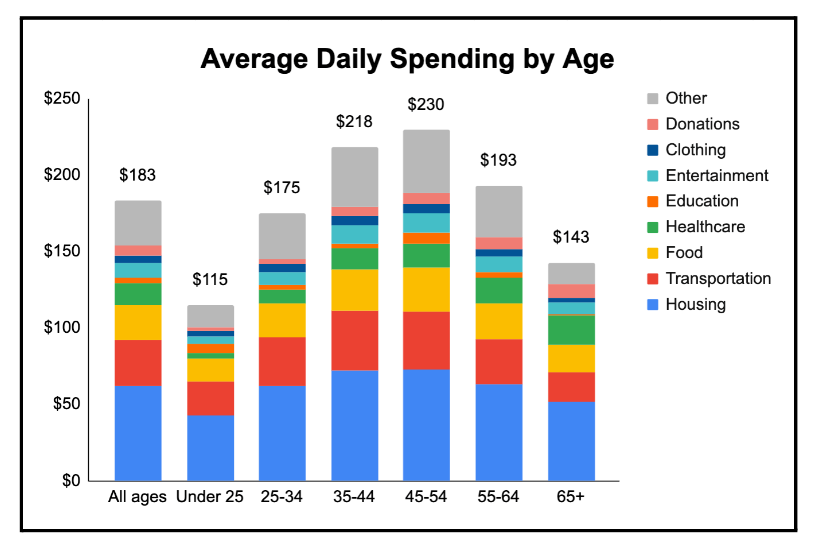
DATA CRUNCH: How Does Spending Differ Across Generations?

Analyze the data and answer the questions on this worksheet to complete the Data Crunch.
1
Pitanje 1
1.

Which spending category makes up the majority of spending across all age groups?

1
Pitanje 2
2.

Which age group has the lowest average daily spending? How much do they spend? a day

1
Pitanje 3
3.

Estimate how much people under the age of 25 spend on food each day.

1
Pitanje 4
4.

Based on this graph, do you think most people spend more money on needs or wants? Explain your reasoning.

1
Pitanje 5
5.

Housing costs are lower for people above 55 years old, compared to people between 35 and 54 years old. Hypothesize: why that might be the case?
VIDEO: What is Wealth?

In the previous resource, you looked at people’s opinions of what it means to be ‘rich’ or ‘poor’ and saw how that was a very relative measure. Read this article for a more concrete explanation of what wealth is, then answer the following questions.

1
Pitanje 6
6.

What is the definition of wealth according to this video?

1
Pitanje 7
7.

What would keep someone with a high income from being wealthy?

1
Pitanje 8
8.

What do you think are the top three MOST IMPORTANT regular expenses for most people?

1
Pitanje 9
9.

How could budgeting help someone build their wealth no matter what their income is?

1
Pitanje 10
10.

Do you think there are any situations where a person would not be able to build wealth? Explain.

ACTIVITY: MOVE: Organize Budget Expenses

Follow your teacher’s instructions to complete this activity about budgeting for different expences.

1
Pitanje 11
11.

Summarize the difference between variable and fixed expenses.

20
1
Pitanje 13
13.

Which do you think has a bigger impact on your finances as a student (fixed or variable)?

1
1
1

ARTICLE: 23 Effective Ways to Reduce Housing Costs

Housing costs (rent or mortgage) are the largest single expense for most households. Skim this article for tips on various ways you can save on housing expenses.

3
Pitanje 17
17.

Pick your three favorite strategies to read in more detail. Explain why you felt they were important.

ARTICLE: Top 10 Ways To Reduce Your Fixed Expenses

Housing may be the largest, but it’s not the only fixed expense in your budget. There are many different ways to approach budgeting with all your fixed expenses. Take a look at these ten tips for saving money on fixed expenses, then pick ONE tip and answer the following questions for that resource.

1
Pitanje 18
18.

Pick ONE tip and list how this tip could benefit someone who uses it

1
Pitanje 19
19.

For that same tip, list reasons why someone would NOT follow that advice, whether because they’re not able to or don’t want to.

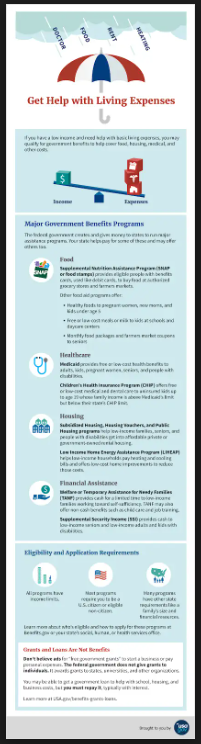
INFOGRAPHIC: Government Benefits

In addition to steps you can take on your own, there are resources that can help you balance your finances on a tight budget. The federal government is just one provider of these types of resources.. Take a look at this infographic highlighting government benefits programs available, then answer the following questions.

1
Pitanje 20
20.

Describe one thing you learned about benefits available to American citizens from the federal government.

1
Pitanje 21
21.

There are many families that do not receive the benefits they qualify for. What do you think are some reasons eligible families might not take advantage of these resources?

INTERACTIVE: Family Budget Calculator

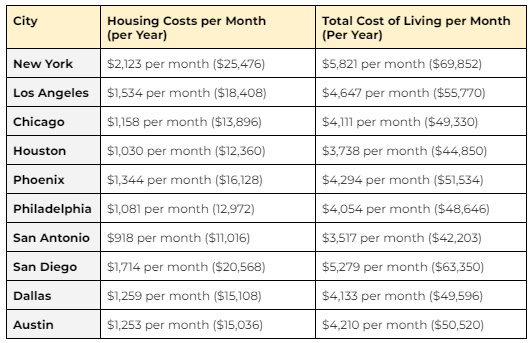
The following table uses information from the Family Budget Calculator for the cost of living for one adult with no children living in the 15 largest metropolitan areas in the US in 2024. Use the table to answer the questions that follow.

1
Pitanje 22
22.

San Antonio has the lowest housing cost on this list. What percent of the total cost of living does housing represent there?

1
Pitanje 23
23.

New York City has the highest housing cost on this list. What percent of the total cost of living does housing represent there?

4
1
1
2
2
2
2
Pitanje 31
31.

What is the difference between wealth and income?

1. Wealth is a measure of what you earn while income measures assets minus debts

2. Wealth is a measure of assets minus debts while income measures what you earn

3. Wealth is a measure of what you earn while income measures debts minus assets

4. Wealth is a measure of debts minus assets while income measures what you earn

Pitanje 32
32.

The single biggest expense for most households is...

1. Transportation

2. Food

3. Housing

4. Travel

Pitanje 33
33.

Which accurately describes the characteristics of fixed costs?

1. Fixed costs are easy to change but generally result in small savings

2. Fixed costs are easy to change but generally result in large savings

3. Fixed costs are difficult to change and generally result in small savings

4. Fixed costs are difficult to change but generally result in large savings

Pitanje 12
12.
  • Groceries

  • Housing/Rent

  • Utilities

  • TV/Streaming Services

  • Internet

  • Cell Phone and Data Plan

  • Dining Out/Restaurants

  • Entertainment

  • Travel

  • Clothing

  • Health Insurance

  • Transportation

  • Electronics

  • Emergancy Fund

  • Student Loan Payments

  • Credit Card Payments

  • Retirement Savings

  • Personal Savings Goals

  • Personal Care (shampoo/hair/nails)

  • GIfts

  • Fixed Needs

  • Variable Needs

  • FIxed Wants

  • Variable Wants

Pitanje 14
14.

Do you think that would be different as an adult? Why or why not?

Pitanje 15
15.

If you wanted to save money, would it be easier to cut down on fixed expenses or variable expenses? Why?

Pitanje 16
16.

Do you think you'd save more money by reducing your fixed or variable expenses? Why?

Pitanje 24
24.

The federal government defines a person to be housing-burdened if their housing costs are at least 30% of their income (not 30% of the cost of living). If you earn the national median wage of $59,384.

  1. What is your minimum annual housing cost to be considered housing-burdened?$

  2. In which of these cities would you be considered housing-burdened? ( 3 cities)

Pitanje 25
25.

You live in New York City and currently spend $40/day on variable expenses and $4,852/month on fixed expenses. Write an equation that models your total monthly expenses based on how many days have passed since the beginning of the month.

Pitanje 26
26.

You make exactly the cost of living in New York from the article as your salary. Write an inequality that would have to be true to make sure that you do not go over your monthly budget.

Pitanje 27
27.

Is your budget feasible for a month, assuming a month is 30 days? How do you know?

Pitanje 28
28.

You want to try adjusting your fixed expenses in order for the scenario in question 26 to be within budget.

  1. Calculate how much your fixed expenses need to be in order to stay within budget on $40 per day.fixed expences =

  2. Write a new linear equation to model your monthly spending after x days.

Pitanje 29
29.

Now instead, you want to try adjusting your variable expenses in order for the scenario in question 26 to be within budget.

  1. Calculate how much your variable expenses need to be in order to stay within budget having $4,852 in fixed, monthly expenses.

  2. Write a new linear equation to model your monthly spending after x days.

Pitanje 30
30.

Which budget change would you rather make, fixed or variable. Why?