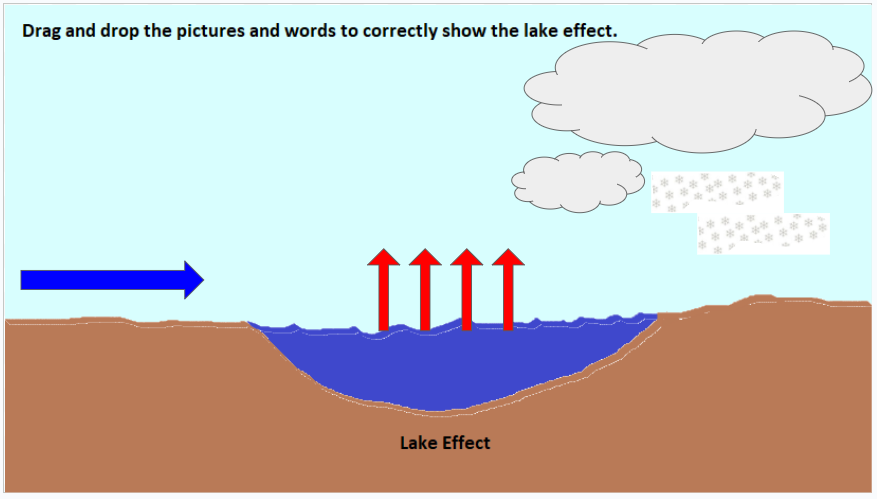
Drag and Drop the words and phrases to correctly show the lake effect.
Mmuae Afoforo a Wobɛpaw:
Condensation and Clouds Form
Warmer water
Cold wind
Evaporation
Lots of snow
Please read the passage and then answer the questions that follow.
The Lake Effect is a meteorological phenomenon that occurs in regions situated near large bodies of water, such as the Great Lakes in North America. This phenomenon is especially prominent during the late fall and winter winter months when cold, dry air masses move over the relatively warmer waters of a lake. The temperature difference between the cold air above and the warmer water below can lead to the formation of distinct weather patterns. The Lake Effect is most known for producing heavy snowfall in the areas downwind of the lakes, making it a significant aspect of the winter climate in these regions.
What is the Lake Effect, and when does it occur?
What is the main cause of the Lake Effect phenomenon?
Which season is the Lake Effect most prominent?
What is one of the most significant impacts of the Lake Effect on the areas downwind of the lakes?
In which region of North America is the Lake Effect phenomenon most commonly observed?
Drag and Drop the words and phrases to correctly show the lake effect.
Lake Effect Lake effect is a meteorological phenomenon that occurs when cold air passes over a warmer body of water, such as a lake. This causes the air to pick up moisture and heat from the water, leading to the formation of clouds and precipitation. Lake effect can have a significant impact on the weather in coastal regions near large bodies of water. Assessment Questions: 1. What is the primary cause of lake effect? a) Cold air passing over a warm body of water b) Warm air passing over a cold body of water c) Hot air passing over a warm body of water d) Cold air passing over a cold body of water 2. Which of the following is a characteristic of lake effect snow? a) It occurs only in summer months b) It is caused by warm air currents c) It can result in heavy snowfall in localized areas d) It is the same as regular snowfall 3. How does lake effect affect the temperature of coastal regions? a) It causes a decrease in temperature b) It causes an increase in temperature c) It has no effect on temperature d) It depends on the season 4. Which of the following locations is most likely to experience lake effect? a) A city located hundreds of miles inland b) A coastal town near a large lake c) A desert region with no nearby water bodies d) A mountainous area with high elevation 5. What role does the wind play in lake effect? a) It has no effect on lake effect b) It helps to disperse the clouds formed by lake effect c) It intensifies the lake effect by carrying the moisture and heat further inland d) It causes the lake effect to occur only in coastal areas Answer Key: 1. a) Cold air passing over a warm body of water Explanation: Lake effect occurs when cold air passes over a warmer body of water, causing it to pick up moisture and heat. 2. c) It can result in heavy snowfall in localized areas Explanation: Lake effect snow can lead to heavy snowfall in specific regions, often near the shores of lakes. 3. b) It causes an increase in temperature Explanation: Lake effect can lead to an increase in temperature in coastal regions due to the influence of the warmer lake water. 4. b) A coastal town near a large lake Explanation: Coastal towns near large lakes are more likely to experience lake effect due to the proximity to the water body. 5. c) It intensifies the lake effect by carrying the moisture and heat further inland Explanation: The wind helps carry the moisture and heat from the water further inland, intensifying the lake effect phenomenon.