4.7 Budgeting for Variable Cost

Last updated 10 months ago
32 questions
Note from the author:
OBJECTIVES & STANDARDS
Math Objectives
  • Analyze real-life constraints using systems of inequalities
  • Identify and contextualize solutions to a system of inequalities
Common Core Math Standards
  • Link to all CCSS Math
  • CCSS.PRACTICE.MP4
  • CCSS.HSA.CED.A.3
Personal Finance Objectives
  • Analyze strategies for budgeting variable expenses
  • Describe common costs associated with car ownership
  • Summarize strategies for reducing everyday spending on significant variable costs, including transportation and food.
National Standards for Personal Financial Education
Spending
  • 1b: Develop a budget to allocate current income to necessary and desired spending, including estimates for both fixed and variable expenses.
  • 1c: Explain methods for adjusting a budget for unexpected expenses or emergencies.
  • 5b: Brainstorm consumer research strategies and resources to use when making purchase decisions.
DISTRIBUTION & PLANNING
Distribute to students
  • Student Activity Packet
  • PLAY: Budget Frenzy Worksheet
OBJECTIVES & STANDARDS
Math Objectives
  • Analyze real-life constraints using systems of inequalities
  • Identify and contextualize solutions to a system of inequalities
Common Core Math Standards
  • Link to all CCSS Math
  • CCSS.PRACTICE.MP4
  • CCSS.HSA.CED.A.3
Personal Finance Objectives
  • Analyze strategies for budgeting variable expenses
  • Describe common costs associated with car ownership
  • Summarize strategies for reducing everyday spending on significant variable costs, including transportation and food.
National Standards for Personal Financial Education
Spending
  • 1b: Develop a budget to allocate current income to necessary and desired spending, including estimates for both fixed and variable expenses.
  • 1c: Explain methods for adjusting a budget for unexpected expenses or emergencies.
  • 5b: Brainstorm consumer research strategies and resources to use when making purchase decisions.
DISTRIBUTION & PLANNING
Distribute to students
  • Student Activity Packet
  • PLAY: Budget Frenzy Worksheet
Intro-Warm-Up
ACTIVITY: PLAY: Budget Frenzy
You know how to budget for fixed expenses, like rent or insurance premiums. But what about those purchases and bills that just pop up? Follow your teacher’s instructions to play the game.
Learn It
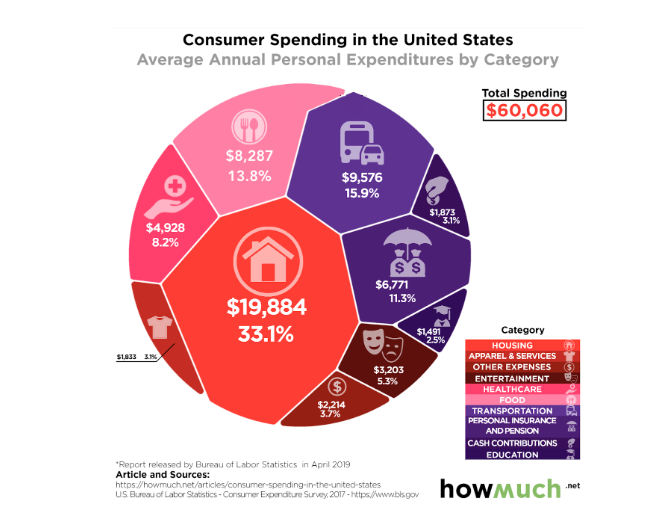
INFOGRAPHIC: Consumer Spending in the United States
Let’s start with a big-picture view of how the average American spends their money. What are the biggest fixed and variable expenses? Review the infographic and answer the questions.

1

What are the three largest spending categories? What percentage of their income do Americans spend in each category?

1

Which spending categories do you think mostly comprise fixed costs? Justify your response.

1

Which category do you think would be the hardest to budget for on a monthly basis? Why?

ARTICLE: Make Sure Variable Expenses Don’t Derail Your Budget With These 4 Tips
As you observed in the infographic, variable expenses make up a large portion of our spending. But it can be tricky to budget for variable expenses since they change from month to month. Read this article to learn some strategies. Then, answer the questions.


4 Ways to Budget for Variable Expenses

Budgeting for variable expenses is an inexact science, but there are ways to make it easier.

1. Use the Average of Your Expenses

Prepare for fluctuating costs by calculating what you spend on average in a given budget category and use that as a baseline in your budget.
To find your average spend, add up everything you spent on say, groceries, over the past year and divide by 12. You could also use the average of three or four months, but it won’t be as comprehensive.
There will be months when you spend more and months when you spend less. That’s why it’s important to set money aside to account for those fluctuations. Money experts refer to this practice as setting up a sinking fund.
During the months when you spend less than average, you’ll divert the extra money into your sinking fund. Then when a higher bill comes along — like my electric in the height of summer in Florida — you can pull from those savings to make up the difference.

2. Treat Variable Expenses Like Fixed Expenses

You have no control over whether gas prices will jump up or if your babysitter will suddenly want a buck more per hour. But you can do your best to stick to consistent spending limits for your variable expenses whenever possible.
Use the cash envelope system to adhere to the spending limits you set for your variable expenses. For example, you might stick $100 in an envelope for dining out. Once you’ve used all the cash in the envelope, no more spending on restaurants until it’s time to refill the envelope.
Pro Tip
Ask your utility companies if they offer a plan where you pay a flat amount each month based on average usage. Then you aren’t surprised with a major increase (or decrease) from month to month.

3. Inflate Estimated Costs for Your Variable Expenses

Another way to deal with fluctuating monthly expenses is to give yourself a spending cushion by budgeting for more than you think you’ll spend. For example, if you regularly spend between $250 to $300 a month on groceries, budget $325 or $350. That should be enough money to buy food for the month without breaking your budget (and without having to do any math).
This approach only works if you have enough wiggle room in your budget. If you’re living paycheck to paycheck or you have zero emergency savings, you’re better off sticking to a budget that’s more strict.
If you inflate your projected costs, it’s likely you’ll have some money left over at the end of the month. You could put that cash toward savings, paying off debt or maybe just pocket it for something fun — totally up to you.

4. Do Your Best to Plan in Advance

Of course, you don’t have a crystal ball to predict what your variable expenses will be to the last cent. But you can try to anticipate expenses in advance. Don’t let yourself be surprised by what you could have planned for.
When you sit down to create your budget for the month, take a moment to think about the things you’ll do during the next few weeks. Is there a movie coming out that you’ve been dying to see? Add the cost of movie tickets, popcorn and drinks to your entertainment budget. Is a friend’s birthday coming up? Budget some money to go out and celebrate.
Get as detailed as you can so your budget will be as accurate as possible.

Don’t Let Variable Expenses Throw You Off Budget

The unpredictable factor of variable expenses may drive you crazy, but there’s one good thing about those costs not being set in stone: You can usually find ways to lower them.
Use coupons when shopping and check rebate sites after you’ve made your purchases. Adjust the temperature on your thermostat and water heater to reduce your utility costs. Make your own cleaning supplies. Organize a potluck dinner during the next holiday, instead of cooking (and buying) everything yourself. The saving possibilities are wide.
Nicole Dow is a senior writer at The Penny Hoarder. Buying generic brands is one thing she does to lower the cost of her variable expenses.
1

Briefly summarize the four approaches to budgeting for variable expenses.

4
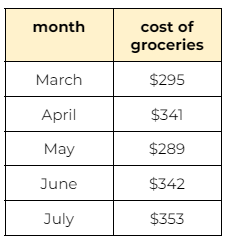
You're planning your grocery budget, so you take a look at your past 5 months of expenses.


  1. How much would you budget if you used the average monthly expense?_______
  2. If you used the cash envelope method, would you budget that same amount?_______ Why or why not?_______
  3. How much would you budget if you used an inflated estimate of your monthly expense?_______
1

Which strategy do you think would work best for you? Why?

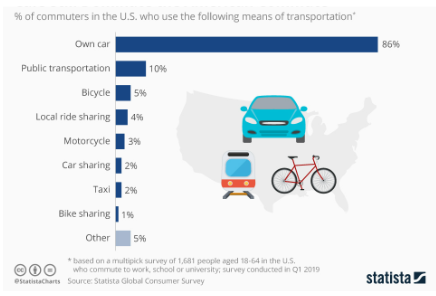
GRAPH: ​​Cars Still Dominate the American Commute
For most Americans, transportation is their highest variable expense. Review the data for how Americans get to work and consider the factors that influence our transportation choices.

1

Write a title that summarizes the graph.

1

Think about how people get around in your area. Do you think this national data matches your local transportation patterns? Why or why not?

1

What factors do you think influence peoples’ transportation choices? Why?

1

Hypothesize: What societal factors might encourage more people to bike or use public transportation?

VIDEO: What are the True Costs of Car Ownership?
If, like the majority of Americans, you’re planning on driving to work, you’ll need to budget for a car. The costs of car ownership go beyond just car payments. Watch the video and answer the questions.
1

Which category of a 50/30/20 budget do you think transportation expenses fall into? Why?

1

What expenses do you need to plan for in your transportation budget before buying a car?

1

What do you think is the advantage of factoring in periodic expenses, like new tires, into your monthly car budget, even if you don’t pay those expenses every month?

ARTICLE: How to Figure Out Your Monthly Food Budget
After transportation, food is the next biggest variable expense for most Americans. It can be hard to track food spending and to decide how much to budget for food. Read the article to learn some benchmarks and strategies for food budgeting. Then, answer the questions.
1

How have trends in food spending changed since 1960?

1

How much does the USDA estimate a thrifty family of two will spend on food each month?

1

What strategies could you use to determine your monthly food budget?

1

What factors influence how you or your family make decisions about food?

VIDEO: How to Save Money on Everyday Expenses
You know how to create a budget for your variable expenses, but what if you’re looking to reduce your spending? There are small ways to save money on variable expenses, including food, utilities, and entertainment. Watch this video to learn some tricks to reduce your spending. Then, answer the questions.
1
Complete the table below with at least one strategy to save money in each category.
Groceries_______
Utilities_______
Transportation_______
Entertainment_______
The video mentions saving money by comparing unit price while shopping. Unit price is the cost of one unit of something, like one pencil, one ounce of chips, or one pound of butter. You can find unit price by dividing the total price by the number of units.
1

Based on unit price, which is a better deal on cereal:

1

You’re comparing prices for avocados: a large bag of 15 avocados for $22.50 or a small bag of 3 avocados for $5.25. Which is the better deal based on unit price?

1

Make an inference: why might you choose to buy something that has a higher unit price than the alternative?

MATH CONNECTION - REPRESENTING CONSTRAINTS WITH INEQUALITIES
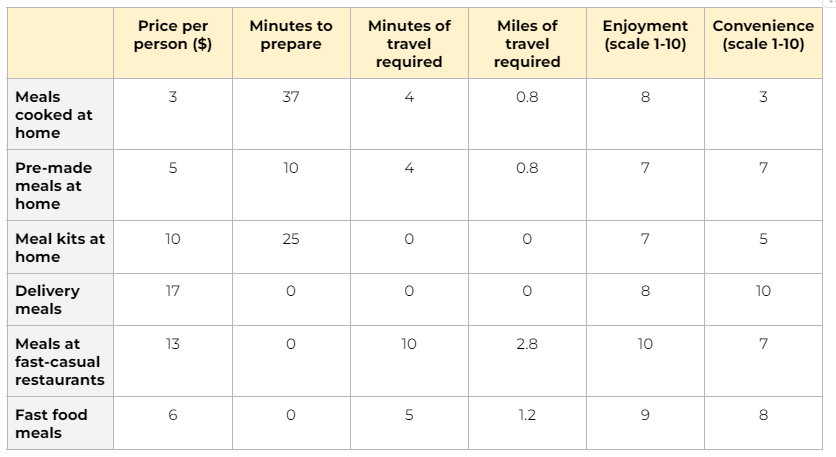
Logan’s family is looking at their food budget and considering which combination of meal options would be the best for them. The table below includes their cost, time requirements, enjoyment, and convenience for each meal option. Note: home cooking requires some travel based on the distance to the grocery store.

Part I: Equations
Logan chooses two meal options as the basis for his family’s meal plan for the month (30 days). He writes the following inequalities to represent their constraints.
  • x + y ≥ 3(30)
  • 4(3x) + 4(13y) ≤ 1404
  • 0.8x + 2.8y ≤ 100
  • y ≥ 2
1

Which two meal options did Logan choose? How do you know? Hint: focus on the coefficients in the second and third equations.

1

What do each of Logan’s inequalities mean in context? Complete the table to describe each constraint.

1
How many people are in Logan’s family?_______ How do you know?_______
1

Part II: Graph
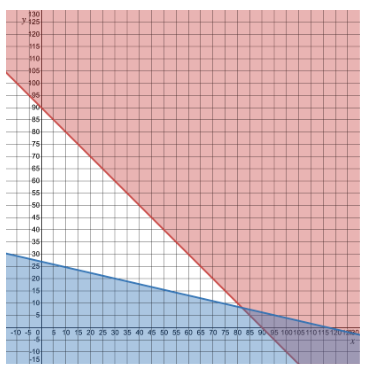
Logan graphed two of the constraints from Part I.

Which two inequalities did Logan graph?

1
Identify a possible solution to the inequality._______ What does that point represent in this context?_______
1

Would your solution from Question 26 fit the family’s other constraints? Test it algebraically and show your work.

1

Part III: Reflection
If you were building a personal food budget, which meal options would you choose? Why?

1
Write an inequality for a constraint that you might face in creating your own personal food budget._______
Exit Ticket
1

Willie often realizes he’s overspent on food when his checking account balance runs low at the end of the month, but he doesn’t know how much he should be budgeting. All of the following are ways for Willie to determine his food budget, EXCEPT…
1. Review his past bank statements to find the average he spends on food each month
2. Look up the USDA estimated cost for different food plans to use as a benchmark
3. Track how often he eats at restaurants each month to avoid needing a food budget
4. Calculate 10% of his income to set aside for food spending each month

1

Which of the following is a variable expense?
  1. $18 TV streaming subscription
  2. $23 dinner at a restaurant
  3. $40 monthly gym membership
  4. $850 rent payment

1

All of the following are needs that should be included in the transportation budget for your car, EXCEPT...
  1. Car payment
  2. Average gas expenses
  3. New paint job
  4. Routine maintenance