1
1
1
1
1
1
1
1
1
1
1
Put the scientific terms in the correct category. Put them in order from SIMPLE (on top) to In-Depth (on bottom)
Scientific Theory
Scientific Law
Scientific Fact
Hypothesis
Explanation Statements of Why
Description/Observation statements of How
Select the TWO jobs of a theory below
Why can't science say that Christianity or the Bible are true?
What is the closest thing to "truth" in science?
Since scientists avoid using the term "true", what would they say instead about a fact that has been repeatedly confirmed through testing and is widely accepted as being accurate.
What happens to a hypothesis once it is confirmed
What are the two ways we can change our Presuppositions?
The purpose of an experiment is to ________
Which of the following things can change something that is "true"
The goal of science (in general, not just for christians) is to _________
A successful or strong ________ is one that produces definitive results and can be replicated
Christian scientists have an advantage in that they are on right terms with God so they are not impacted by the Fall
There can be no conflict between the belief in God and the study of the world he created.
If a theory is found to be accurate over time, it is upgraded to a law
Everyone has a worldview and each person's worldview is different from everyone elses.
All scientific information is temporary
Because science is not trying to find "truth" or answer questions about religion/God, science is morally neutral
Science is not in the business of making ______ ________
To be valid, a hypothesis must be __________
_____________ is the best tool we have for understanding the world around us.
ESSAY DIRECTIONS: You must choose 2 out of the 3 essays to answer. The third essay is extra credit, you do not HAVE to do it but it would be good insurance/extra points if you have time.
For EVERY essay response: Please make sure you are answering ALL parts of this question prompt. Double check your answer, including your spelling and grammar, before you submit.
What did God command in the Creation Mandate AND how do we interpret this as a command to "do science"?
Science doesn't say the Bible is true, yet, there are multiple scientific proofs/discoveries that serve to support and confirm the Creation Theory from the Bible (that God created the universe).
IN 3+ COMPLETE SENTENCES:
Identify why science doesn't say the Bible is true AND explain one of the scientific proofs we learned about in class (from the videos), identifying how it serves to support/confirm the Creation Theory from the Bible.
IN 3+ COMPLETE SENTENCES, Explain how a Christian worldview impacts someone's approach to science AND identify two ways a christian scientist can use science to lessen the consequences of the Fall.
HINT: These are EQ answers from your cornell notes, not general statements about how God wants us to love others and his creation.
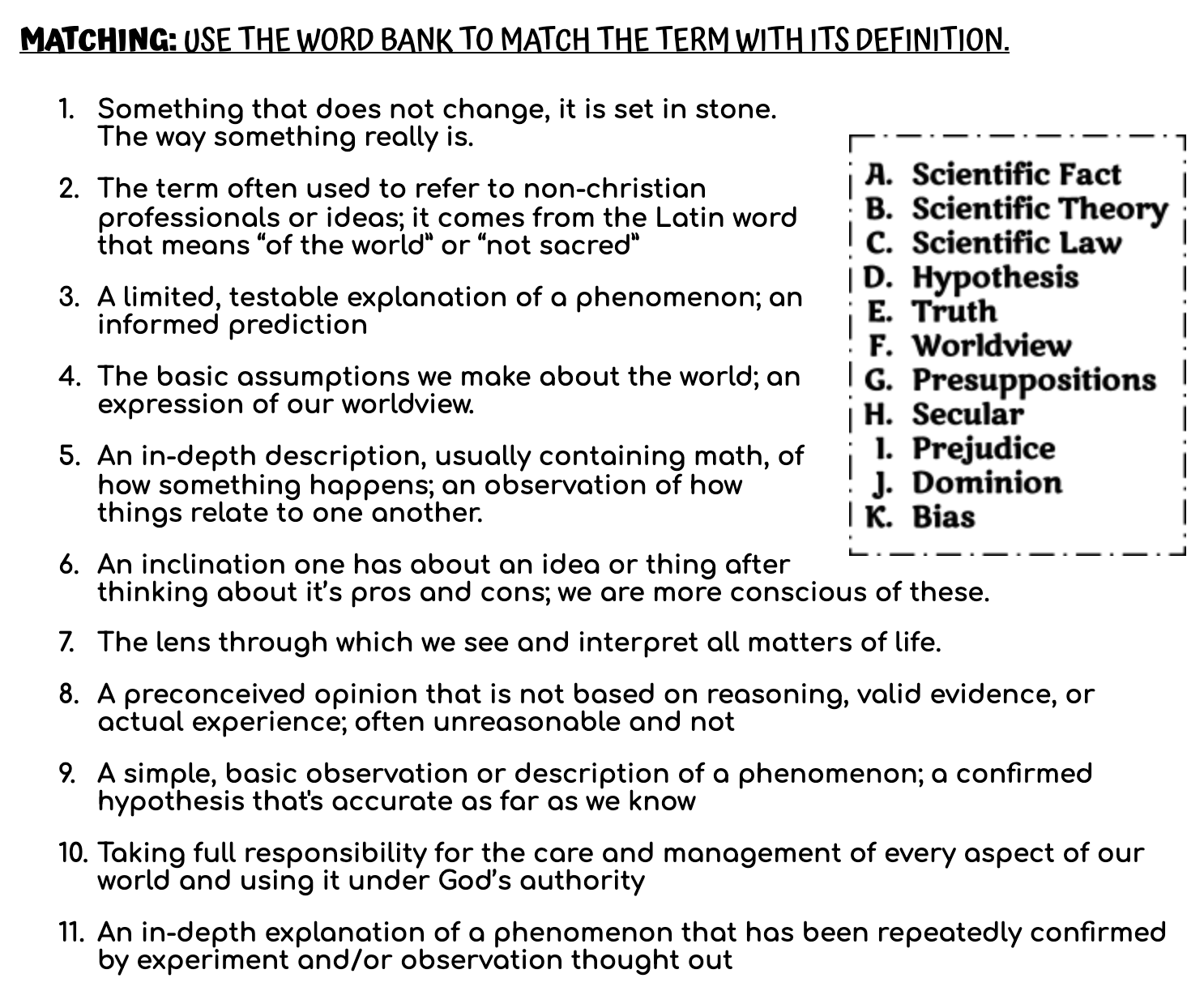
Something that does not change, (with time or new information) it is set in stone. The way something really is.
The term often used to refer to non-christian professionals or ideas; it comes from the Latin word that means “of the world” or “not sacred”
A limited, testable explanation of a phenomenon; an informed prediction
The basic assumptions we make about the world; an expression of our worldview.
An in-depth description, usually containing math, of how something happens; an observation of how things relate to one another.
An inclination one has about an idea or thing after thinking about it’s pros and cons; we are more conscious of these.
The lens through which we see and interpret all matters of life.
A preconceived opinion that is not based on reasoning, valid evidence, or actual experience; often unreasonable and not thought out
A simple, basic observation or description of a phenomenon; a confirmed hypothesis that's accurate as far as we know
Taking full responsibility for the care and management of every aspect of our world and using it under God’s authority
An in-depth explanation of a phenomenon that has been repeatedly confirmed by experiment and/or observation thought out
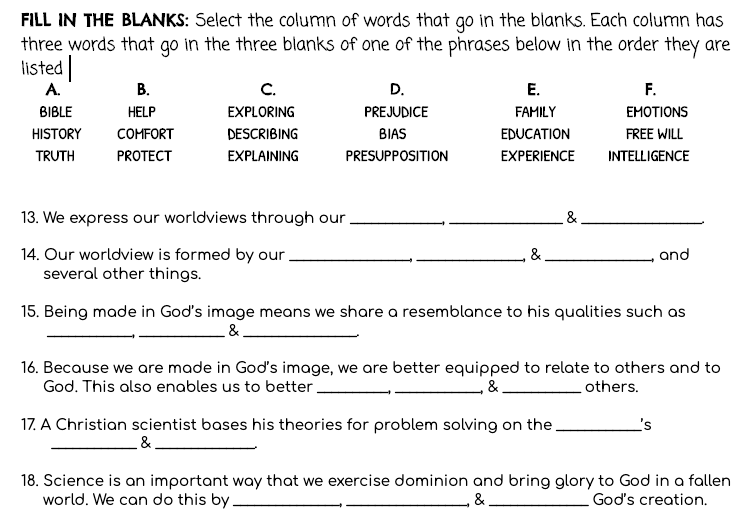
We express our worldviews through our _____, _____ & _____
Our worldview is formed by our _____, _____, ______, and several other things (like religion, socio-economic status, friends/relationships).
Being made in God's image means we share a resemblance to his qualities, such as ____, ____ & ___.
Because we are made in God's image, we are better equipped to relate to others and to God. This also enables us to better ____, _____, & _____ others.
A Christian scientists bases his theories for problem solving on the _____'s _____ & _____.
Science is an important way that we can exercise dominion and bring glory to God in a fallen world. We can do this by ____, ____ & ____ God's creation