1
1
1
1
1
1
1
1
1
One of the properties that makes copper, Cu, useful for household wiring is its ability to conduct electricity. Which other element is most likely to conduct electricity?
Which element group is typically shiny and good at conducting heat and electricity?
Which characteristic does not typically apply to nonmetals on the periodic table?
What two properties are typically associated with metals?
Rank the folowing physical properties as Metals, Nonmetals or Metalloids. NO OPTION WILL BE USED TWICE. Pick whatever the BEST answer is for each physical property.
Semi-conductor
Good Insulator
High Electronegativity (only High)
Roughly 7 elements on the periodic table
Low Electronegativity
A brittle solid at room temperature
Dull with poor luster
Gas at room temperature
Ductile
Malleable
Good Conductor
Shiny with good luster
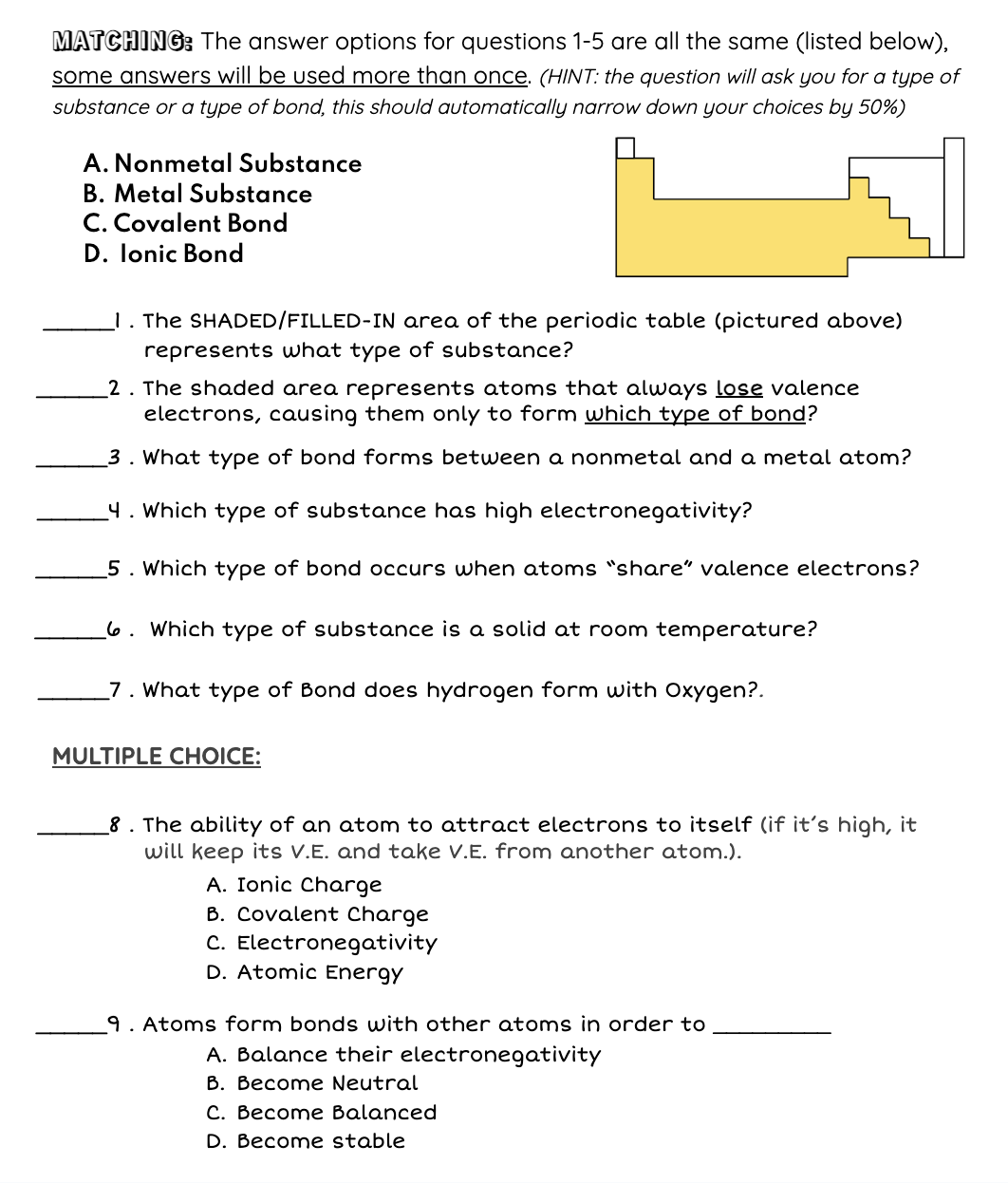
Metals
Nonmetals
Metalloids
Which two options best describe the appearance of most metals?
Means a substance can be pounded or hammered into thin sheets or molded into shapes.
The measure of ease at which an electric charge or heat can pass through a material
Ability of an object to reflect light
The tendency of a material to fracture or shatter under pressure
the way most metals can be stretched into a wire
A material that keeps electricity or heat (or cold) from transferring

Good Conductor
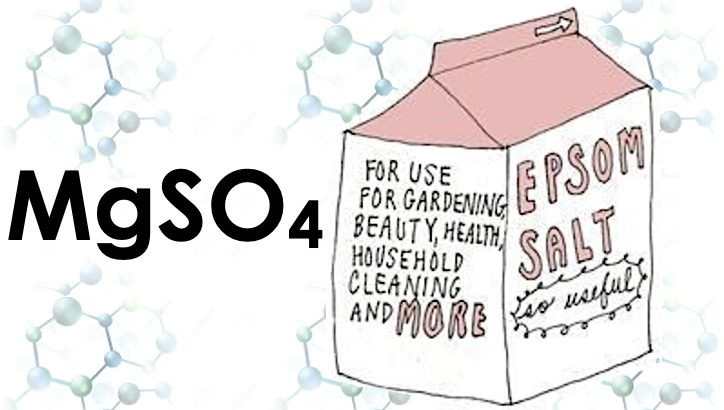
Brittle & Flammable
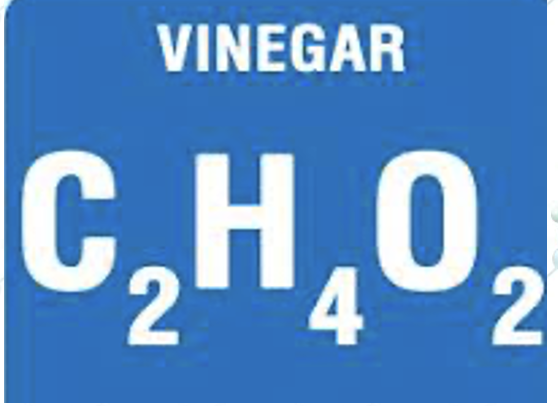
Low Melting & Boiling points
Soluble in Water
Contains atoms with a net charge
Always Exothermic when bonds form or break
Covalent Bond
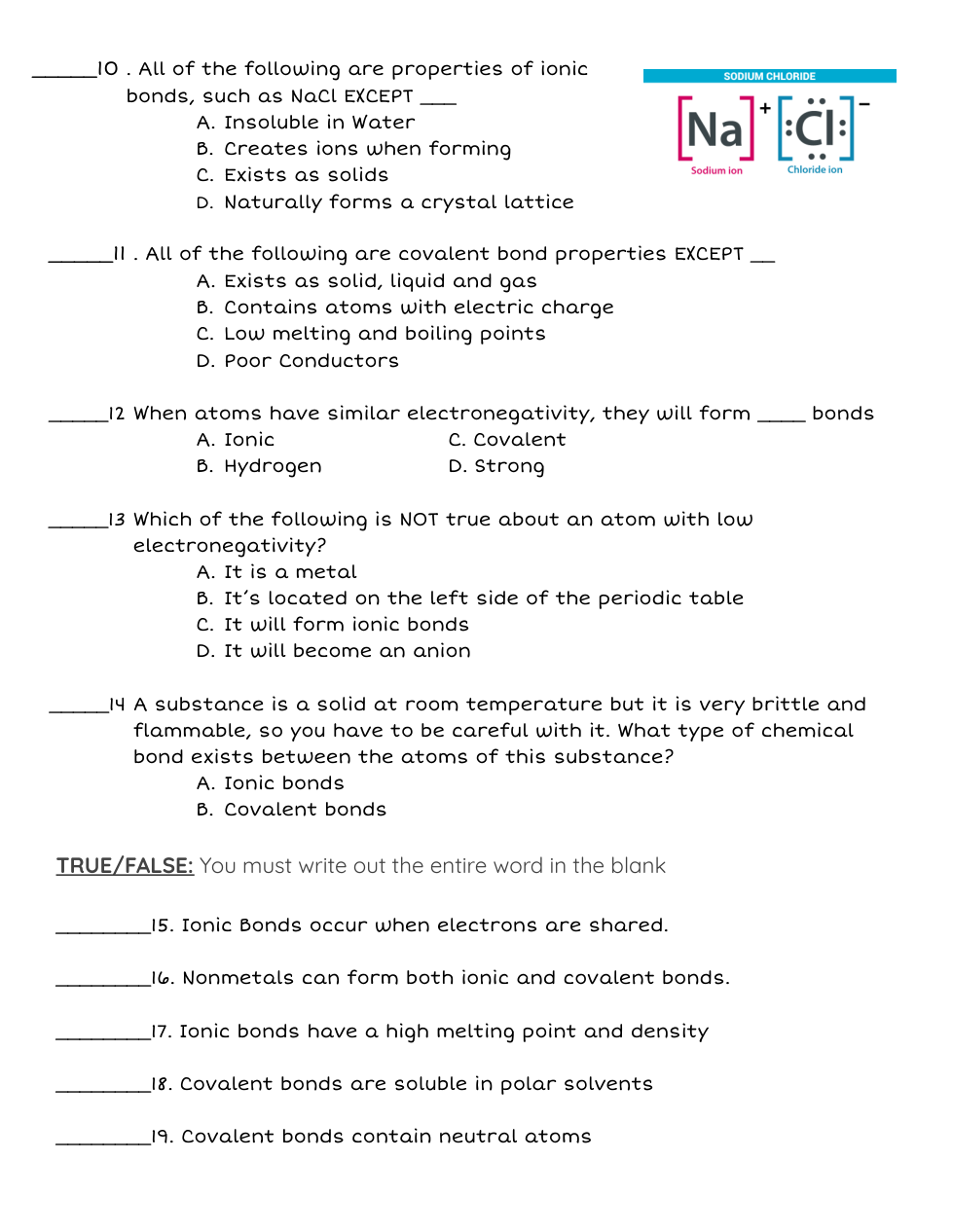
Ionic Bond
EXTRA CREDIT: Explain the three steps required to form an ionic bond. Make sure you state which substances (metals, nonmetals, metalloids) are involved, what happens to the valence electrons (and why) and what this causes the atoms to do.
use the terms high/low electronegativity, cation/anion, opposite attraction
I'm asking if nonmetals are involved in both types of bonds.
Select all the elements that are metals
Which element most likely is a brittle solid that is not malleable or ductile but can conduct moderate amounts of energy?
Which element can form a covalent or ionic bond, depending on the other element it's bonding with?
Which element(s) is most likely to be a poor conductor with a low density and melting point?