1
Asemmisa {{asɛmmisaAhyɛnsode}}
1.
1
Asemmisa {{asɛmmisaAhyɛnsode}}
2.
one of the reasons to use identities is so you can rewrite an equation so that there is only one trig function involved. rewrite this equation so that is is only one trig function
Is the following an identity?
Lets review congruent vs similar triangles - what is the difference?
Lets review congruent triangles: you know two triangles are congruent if
The angles of a triangle add up to

ok, up until know, trig has been all about the right triangles. But we are about to push a little beyond that. This is called the law of sines
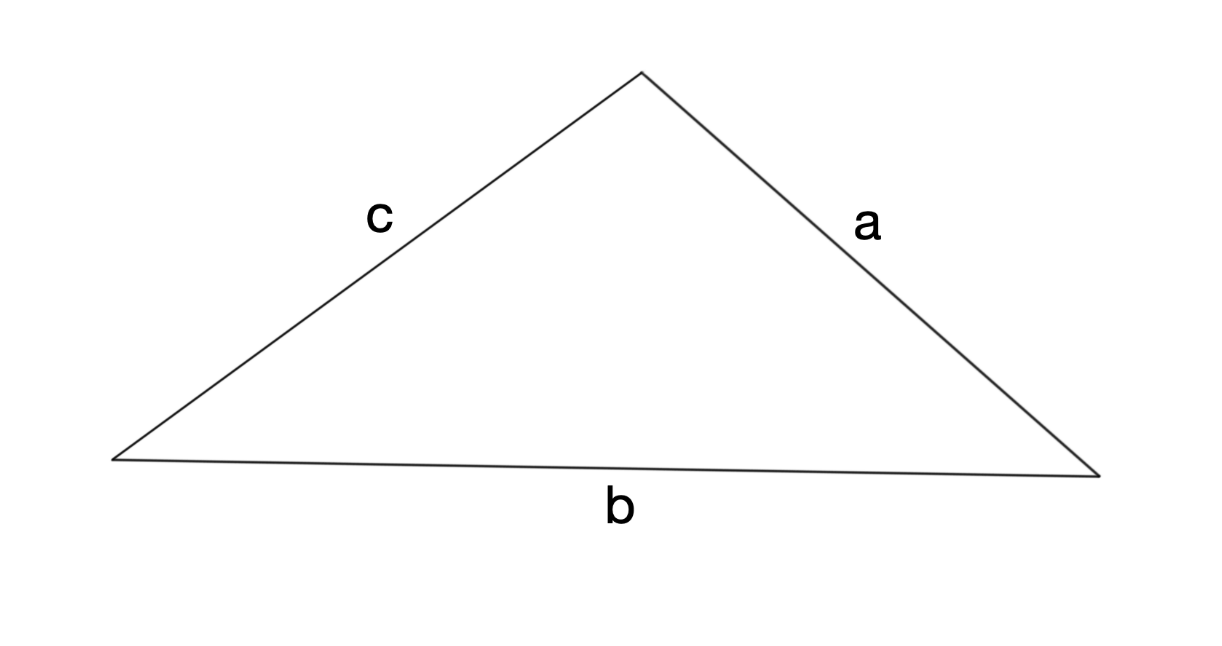
for ANY triangle, where A is the side opposite angle a, B is the side opposite angle b, and C is the side opposite angle C. Given this triangle with sides a, b and c, drag A B and C to their proper angles.
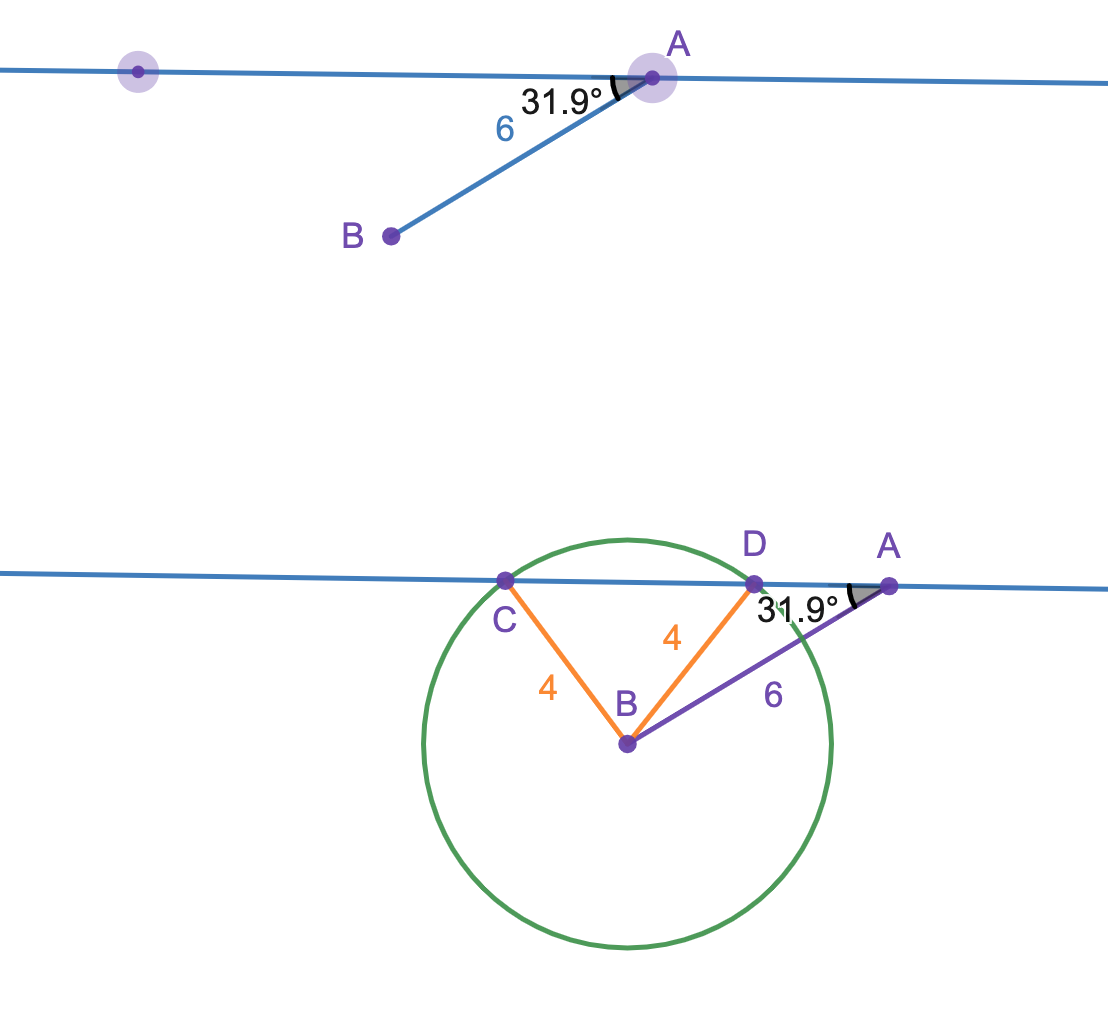
Lets go over why SSA is the "ambiguous case" You will see at the top of this image a line. there is a line segment connected to this line at 31.9°, and the line segment is length 0. So far we do not have a triangle, but we do have
There is also a law of cosines. it is SIGNIFICANTLY uglier
where c is the angle opposite B.
you might want to pause now and go practice law of sines in aleks homework and the modules.
Given the following information about a triangle, which law can you use to find all the other sides?
Side, angle, side
Angle, side, angle
angle, angle, side
side, side, angle
side, side, side
angle, angle, angle
Law of sines
Law of cosines
this does not describe just one triangle
Solve the triangle using Law of Sines.
a=
you will want to solve for angle C first, and round the lengths to the hundreth place. note that C should be in degrees.
solve the triangle using law of cosines
a = 6, b=10, c=11
A=
round to the nearest hundreth,
draw the triangle described above. to find the area of the triangle, you need to find the height, how can you do that?
watching the proofs helps me understand the laws
categorize
what the law of sines is
what the law of cosines is
when to use the law of sines
when to use the law of cosines
how to simplify or rearrange trig expressions using the identities I know
when are triangles congruent
why SSA gives an ambiguous case
how to use the law of sin to find the area of triangle
ive got this
im fuzzy
so confused
These two triangles are congruent by
These two triangles are congruent by
These two triangles are congruent by
These two triangles are congruent by
These two triangles are congruent by
These two triangles are congruent by
I know the second side i want is 4, so to construct my 31.9°, 6,4 triangle, I draw a circle of radius four around my point B. How many times does that circle touch my line?
Name the two triangles in my diagram that have a 31.9° angle, and two sides, 4 and 6 units long
setting up Law of Sine's here, I get
AND
What do you think the relationship is between angle BCD and angle BDA is?
At what angle would the radius of circle B only touch that initial line once?