Week 13 Bellringer - Kinetic energy
star
star
star
star
star
Last updated almost 3 years ago
26 Nsɛmmisa
Monday

Tuesday
2
Wednesday
1
1
Thursday
1
1
What two things does kinetic energy depend on?
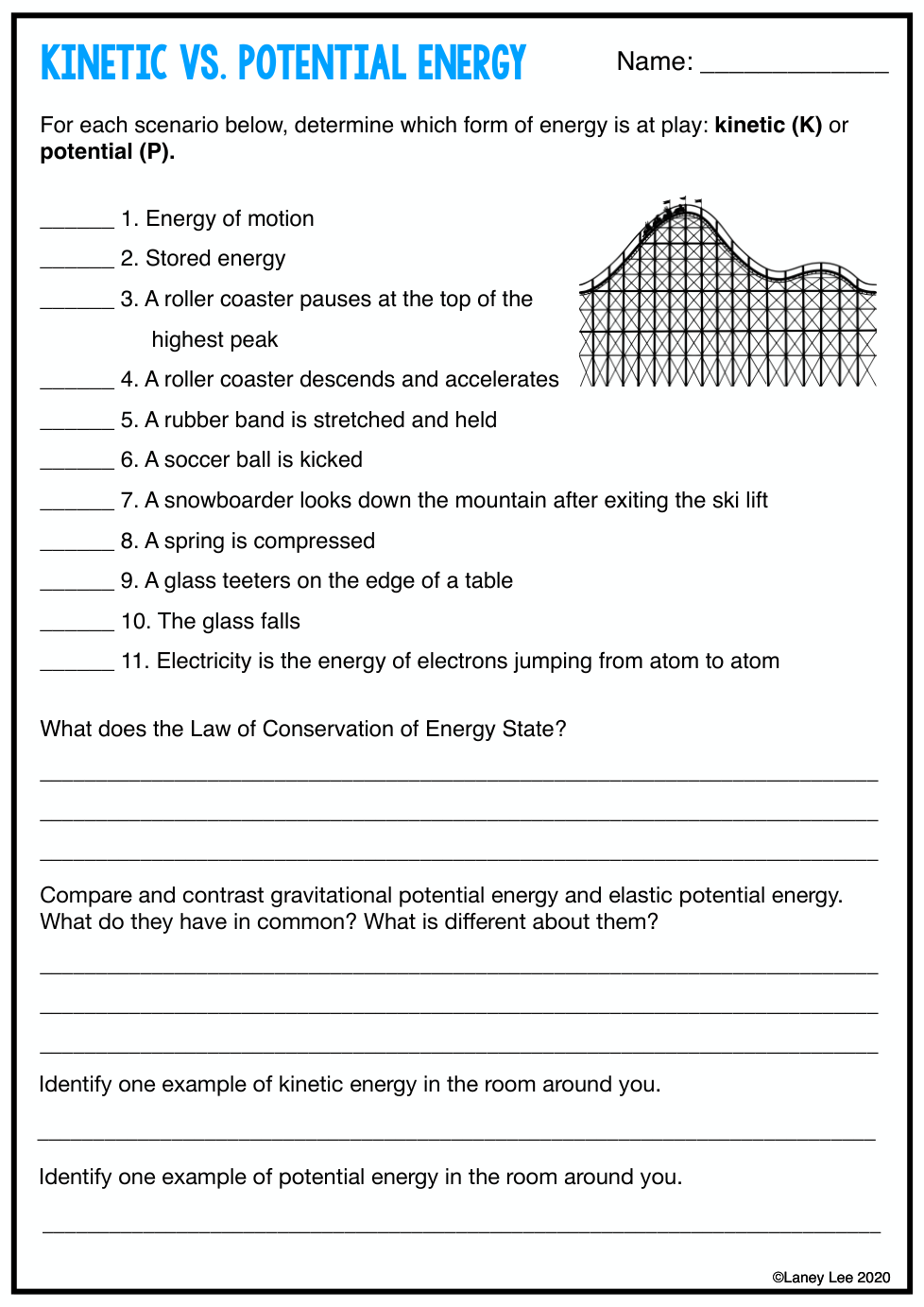
The energy of motion is called potential energy.
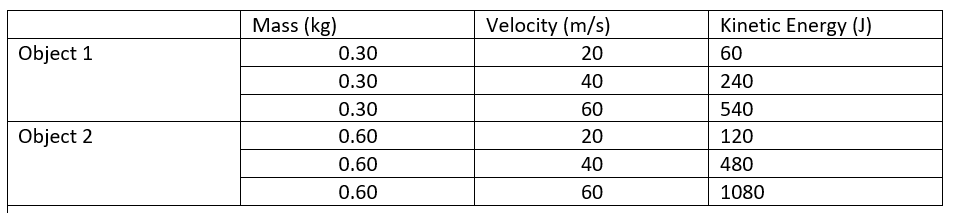
The table shows the mass, velocity, and kinetic energy of two objects.
Based on the data, how does mass relate to kinetic energy?
Match the following vocabulary words to their definition.
| Draggable item | arrow_right_alt | Corresponding Item |
|---|---|---|
Potential energy | arrow_right_alt | the ability to do work |
Joule | arrow_right_alt | energy that an object has due to its motion |
Energy transfer | arrow_right_alt | stored energy that results from the position or shape of an object |
Law of conservation of energy | arrow_right_alt | the movement of energy from one object or place to another |
Kinetic energy | arrow_right_alt | the law that states that energy cannot be created or destroyed but can be changed from one form to another |
Energy | arrow_right_alt | the potential energy of an object due to its height, or its position relative to the earth's surface |
Gravitational potential energy | arrow_right_alt | unit of energy |
How are you doing? Do you have any questions or concerns? If not, tell me something good that is going on with you right now.
Identify one example of kinetic energy in the room around you.
Identify one example of potential energy in the room around you.
A force is a push or pull that acts on an object. Forces are responsible for all of the changes in motion that we see in the world around us. Velocity describes an object’s motion in terms of speed and direction. When any object experiences an unbalanced force, it will accelerate.
Acceleration means that an object’s velocity has changed. The object can either speed up, slow down, or change direction. For example, when a book sits at rest on a table, the forces acting on the book are balanced. The force of gravity pulling down on the book is balanced by the force of the table pushing up on the book. However, if you were to apply a horizontal force to the book, it would accelerate from rest and begin moving across the table. The more mass that an object has, the more force that must be applied to cause the same acceleration of the object. Flicking a small marble could cause it to shoot straight across a room, while the same force would barely cause a chair to move at all.
An object in motion has energy. This energy of motion is called kinetic energy. Because all matter has mass, all moving material objects have kinetic energy. Such examples of kinetic energy would include a football moving through the air, a dancer spinning, or an ant crawling across the floor. From planes and trains to the air moving in and out of our bodies, kinetic energy is constantly flowing through the world around us.
There are many objects in the universe that are too small or too large for us to observe directly, but they also have kinetic energy. For example, Earth is constantly spinning around its own axis, and it is also revolving around the sun. Other extremely large objects are constantly moving in outer space: for example, comets, moons, and distant, swirling galaxies. These large objects have kinetic energy due to their motion. Similarly, all matter is made up of microscopic particles—molecules and atoms—that are in constant motion. Even the particles in solid objects are vibrating on a very small scale. There are also electrons shooting through our electrical wires in the form of electricity. All of these tiny particles are in constant motion and therefore have kinetic energy.
The kinetic energy of the object is dependent on the mass of the object as well as its velocity. If an object has a mass, m, and a velocity, v, then its kinetic energy, KE, is as follows:
KE= 1/2mv2
This equation shows that kinetic energy is proportional to the mass of an object and the square of the velocity. Therefore, if two cars are driving down the street at the same speed, the heavier car will have more kinetic energy. Furthermore, faster-moving objects have more kinetic energy than slower objects have. A small increase in the velocity of an object can cause a large increase in its kinetic energy. Kinetic energy is usually measured in units of joules (J).
A net force acting on an object will change its motion. This means that a net force will change the kinetic energy of an object. The greater the force, the greater the change in motion and the kinetic energy of the object. Objects moving at a constant speed will have a constant kinetic energy. For example, the kinetic energy of a car moving along the highway at a steady speed is constant. If the driver presses down on the gas pedal, more energy flows into the car’s engine. The engine can then supply more force to the axles that turn the car’s wheels. This causes the car to speed up and increases the car’s kinetic energy. Similarly, using the car’s brakes will cause the car to slow and eventually come to rest. Once the car comes to rest, it has no kinetic energy.
Interesting Facts about Kinetic Energy
If you double the mass of an object, you double the kinetic energy.
If you double the speed of an object, the kinetic energy increases by four times.
The word "kinetic" comes from the Greek word "kinesis" which means motion.
Kinetic energy can be passed from one object to another in the form of a collision.
What is responsible for all the changes in motion that occurs in the world?
A boulder has a mass of 50 grams. Another boulder has a mass of 75 grams. Which boulder will take more force to move?
Velocity describes an object's motion in terms of what?
The formula, KE= 1/2mv2, shows that kinetic energy is proportional to the mass of an object and square of the velocity.
A pitcher throws two baseballs. He throws the first baseball at 75 miles per hour. The pitcher throws the next baseball at 70 miles per hour. Which baseball has the most kinetic energy?
A 10 pound bowling ball and a 7 pound bowling ball are both thrown at the same rate of speed. Which ball has more kinetic energy?
A car and a bicycle are traveling at the same speed, which has the most kinetic energy?