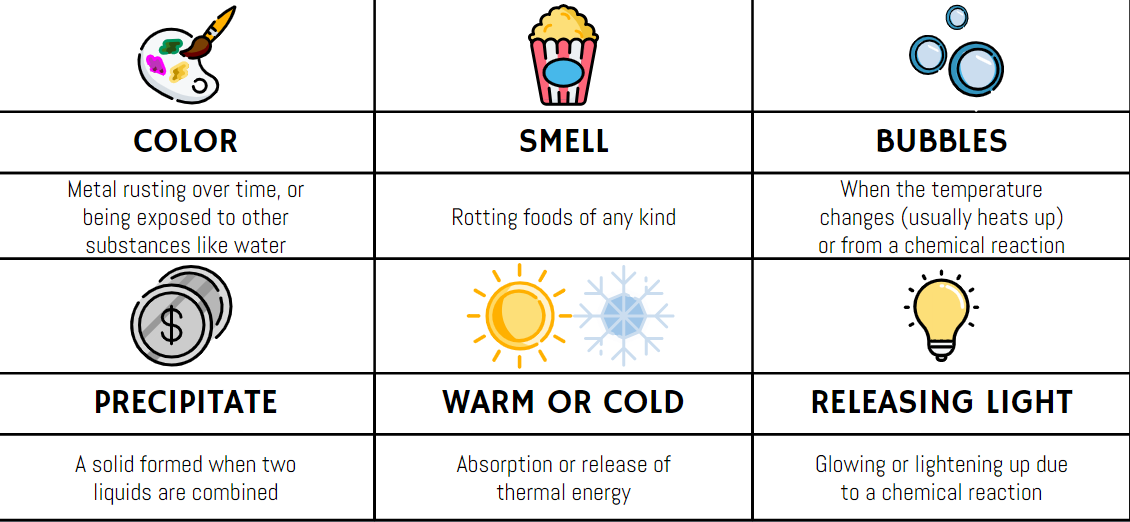
The diagram above shows different kinds of changes in a chemical reaction, and many of these changes can be seen with the human eye. How do we know something is a chemical reaction if we cannot see a change in the substance?
In a chemical reaction, atoms of elements or compounds
Match the four types of chemical reactions to their definition.
| Draggable item | arrow_right_alt | Corresponding Item |
|---|---|---|
Decomposition | arrow_right_alt | A chemical reaction where two or more substances combine to form a single compound. |
Replacement | arrow_right_alt | One compounds breaks down into two or more substances. |
Combustion | arrow_right_alt | Elements or ions switch places with the present elements or ions. |
Synthesis | arrow_right_alt | A substance combines with oxygen and releases energy. |
What is the type of chemical reaction that absorbs thermal energy?
Put the options below in order for the general chemical equation structure.
The
A single-replacement chemical reaction is a reaction where one element replaces another element or compound.
Draw the products of the formula showing a double-replacement chemical reaction.
❤️ 🟩 + 🔷 🟣 -->
What is the Law of Conservation of Mass?
Combining hydrogen and oxygen to form water is an example of which kind of chemical reaction?
The starting substances in a chemical reaction are
Match the definitions of precipitate (verb) and a precipitate (noun).
| Draggable item | arrow_right_alt | Corresponding Item |
|---|---|---|
Precipitate (noun) | arrow_right_alt | clouds becoming too heavy to hold any more water, the the water vapor turns into liquid and falls to the ground. |
Precipitate (verb) | arrow_right_alt | When two liquids combine to become a solid. |
Match the substances to what they are showing, and if it is a single element or a chemical formula.
| Draggable item | arrow_right_alt | Corresponding Item |
|---|---|---|
Au | arrow_right_alt | Element |
Mg(OH)2 | arrow_right_alt | Element |
NaCl | arrow_right_alt | Element |
He | arrow_right_alt | Chemical Formula |
H2O2 | arrow_right_alt | Chemical Formula |
Li | arrow_right_alt | Chemical Formula |
Why do all chemical reactions conserve energy?
Why does a chemical reaction, such as setting off a firework, have a faster reaction rate?
Why is getting sick with the flu bacteria an example of an inhibitor?
Balance this equation, and rewrite the balanced formula in the drawing attached:
FeO2 + Cl --> Fe + Cl4O2
Balance this equation, and rewrite the balanced formula in the drawing attached:
Cu + H2SO4 + Fe3Li --> CuSO4 + H2OLi2 + Fe2
Balance this equation, and rewrite the balanced formula in the drawing attached:
Fe3Ag8 + O2 --> FeO2 + Ag2O
Balance this equation, and rewrite the balanced formula in the drawing attached:
P4O10 + Zn2Xe --> Zn3P + O5 + Xe