Log in
Sign up for FREE
arrow_back
Library

Force & Motion Review

star
star
star
star
star
Last updated almost 2 years ago
21 questions
1
5.6.D
3
5.6.D
1
5.6.D
1
5.6.D
1
5.6.D
1
5.6.D
1
5.6.D
1
5.6.D
1
5.6.D
1
5.6.D
1
5.6.D
1
5.6.D
1
5.6.D
1
5.6.D
2
5.6.D
2
5.6.D
2
5.6.D
3
5.6.D
3
5.6.D
3
5.6.D
3
5.6.D
Question 1
1.

Question 2
2.

Question 3
3.

Question 4
4.

Question 5
5.

Question 6
6.

Question 7
7.

Question 8
8.

Question 9
9.

Question 10
10.

Question 11
11.

Question 12
12.

Question 13
13.

Question 14
14.

Question 15
15.

Question 16
16.

Question 17
17.

Question 18
18.

Draggable itemarrow_right_altCorresponding Item
arrow_right_alt
arrow_right_alt
arrow_right_alt
Question 19
19.

Draggable itemarrow_right_altCorresponding Item
arrow_right_alt
arrow_right_alt
arrow_right_alt
Question 20
20.

Draggable itemarrow_right_altCorresponding Item
arrow_right_alt
arrow_right_alt
arrow_right_alt
Question 21
21.

Draggable itemarrow_right_altCorresponding Item
arrow_right_alt
arrow_right_alt
arrow_right_alt
When pulling a wagon, it is much easier pull it down a hill than to pull the wagon up the hill. What is a likely explanation for this?
Pushing force is more difficult to accomplish than pulling force.
The force of gravity acts against you when you try to pull something down a hill.
The action is less difficult because nothing is pulling the object down the hill.
The force of gravity is pulling the wagon down the hill which makes the action of pulling the wagon down the hill easier to do.
A student wants to create an experiment to test how marbles dropped at different heights will effect the creator size in a bucket of sand. Select all the equipment needed to conduct this experiment.
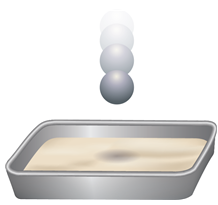
stopwatch for time
meterstick for length
bucket of sand
triple beam balance for mass
marbles
graduated cylinder
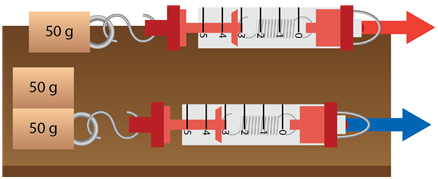
Students are performing the investigation shown below.


Which statement best describes this situation?
The force needed to move the single 50g block is equal to the force needed to move the two 50g blocks.
The force needed to move the single 50g block is greater than the force needed to move the two 50g blocks.
The force needed to move the two 50g blocks is less than the force needed to move the single 50g blocks.
The force needed to move the single 50g block is less than the force needed to move the two 50g blocks.
Students are performing the investigation shown below.


What force is holding the blocks in place on the table?
friction between the blocks and the table caused by gravity
the magnetic force between the blocks and the table
the pulling force caused by the spring scales
the kinetic force caused by the moving block
What does force do to an object's motion?
Increases its weight
Changes its color
Makes it invisible
Changes its speed or direction
If the force acting on a stationary object is increased, what happens?
The object becomes heavier
The object moves faster
The object shrinks
The object changes color
What happens when two forces pull an object in opposite directions?
The object disappears
The object moves in the direction of the stronger force
The object splits in half
The object remains stationary
Which force works in opposition to motion?
Inertia
Gravity
Magnetism
Friction
If you apply force to an object and it doesn't move, what might be a reason?
The object is hot
The object is glowing
There's an equal opposing force
The object is wet
What could we measure to observe how the applied force affects an object's motion?
The object's color
The object's temperature
Distance the object moves
The object's size
What is the effect of a stronger push on a stationary object?
The object remains stationary
The object moves slower
The object changes shape
The object moves faster
If you pull a ball on a smooth surface, which direction will it move?
Opposite to the direction of the pull
In the direction of the pull
It will not move
It will move upwards
What happens when equal pushes are applied on an object from opposite sides?
The object remains stationary
The object will move randomly
The object moves in the direction of the first push
The object moves in the direction of the stronger push
What does a larger force applied on an object result in?
Smaller acceleration
A greater acceleration
Less distance traveled
A slower speed
What actions might demonstrate the effect of force on an object?
Drawing an object
Pulling an object
Watching an object
Pushing an object
What might change about an object when a force is applied?
Its color
Its direction
Its smell
Its speed
What materials could measure force in your experiment?
A stopwatch
A ruler
A calculator
A scale
Match the force application with the potential result in an object
Dropping a ball from a height
The car moves forwards
Pulling a rope attached to a box
The ball falls downwards due to gravity
Pushing a stationary car
The box moves towards you
Match the type of force with its correct definition
Magnetic force
A force that opposes motion
Friction
A force that attracts two bodies toward each other
Gravity
A force exerted by magnets or magnetic fields
Match the action to the type of force it demonstrates
Sliding a book across a table
Magnetic force
Throwing a baseball
Friction
Two magnets sticking together
Gravity
Match the scenario with the correct effect of force
A person pulls on a heavy sled
The ball returns to the ground due to gravity
A person throws a ball upwards
The stroller slows down and stops due to friction
A person stops pushing a stroller
The sled moves in the direction of the pull