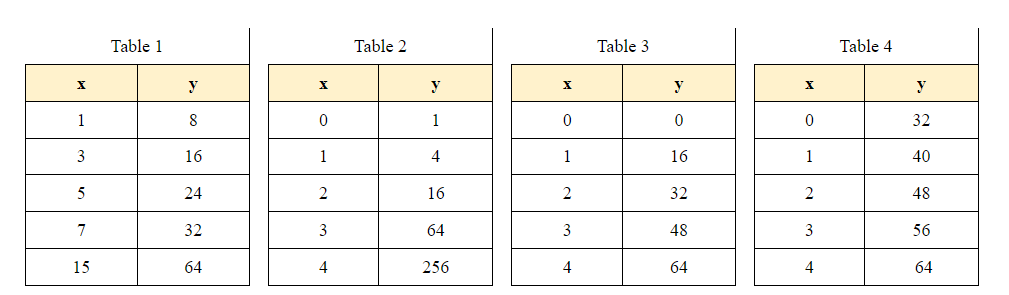
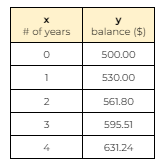
COMPARE: Which One Doesn’t Belong?
Study the tables below to identify patterns, similarities, and differences. Then, answer the question.
OBJECTIVES & STANDARDS
Math Objectives
Recognize that exponential patterns grow by a constant growth factor
Distinguish between exponential and linear functions
Common Core Math Standards
Personal Finance Objectives
Recognize that investments grow exponentially
National Standards for Personal Financial Education
Investing
4a: Describe the impact of inflation on prices over time
4b: Explain the relationship between nominal and real returns.
8-5a: Explain the benefit of compound interest as compared with simple interest.
DISTRIBUTION & PLANNING
Distribute to students
OBJECTIVES & STANDARDS
Math Objectives
Recognize that exponential patterns grow by a constant growth factor
Distinguish between exponential and linear functions
Common Core Math Standards
Personal Finance Objectives
Recognize that investments grow exponentially
National Standards for Personal Financial Education
Investing
4a: Describe the impact of inflation on prices over time
4b: Explain the relationship between nominal and real returns.
8-5a: Explain the benefit of compound interest as compared with simple interest.
DISTRIBUTION & PLANNING
Distribute to students
COMPARE: Which One Doesn’t Belong?
Study the tables below to identify patterns, similarities, and differences. Then, answer the question.
What do you notice about the tables?
1.
2.
3.
Which table doesn’t belong? Explain your reasoning.
MOVE: Exponential Growth
Follow your teacher’s instructions to complete this activity. Then, answer the questions.
In Round 1, how many people stood up with each tap?
In Round 2, how many people stood up with each tap?
Which round did you complete the fastest? Explain why you think that was the case.
Do you think the results would have been different if you did this with a stadium full of people? Why or why not?
Now that you’re familiar with exponential patterns, you’ll explore their different representations with your group. It’s okay if some parts seem new or confusing; it might take some work to figure out. Follow your teacher’s instructions to complete this activity.
CREATE: Exponential Patterns Jigsaw
Let’s explore exponential change using visual patterns. Exponential change happens when you have a starting value that you repeatedly multiply by a certain value, called the growth factor. In this activity, you’ll work with your group to understand one visual exponential pattern and represent it in different ways.
Your teacher will assign you to a group to work on one of the Visual Pattern Cards. Work with your group to complete the table below based on your assigned pattern.
Draw a representation of the next step in the pattern. If the next step has too many pieces, you can draw a partial representation and explain what the complete step would look like.
Describe the way you see the pattern increasing or decreasing. Be sure to identify the growth factor and explain what that means in your pattern.
Note: for Pattern D, it will be called the decay factor.
Create a table representing the pattern with numbers. (draw it in show your work if that is easier)
Level 2:
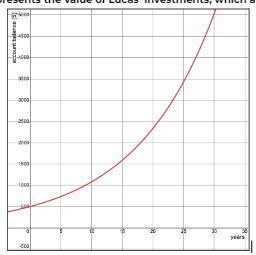
The graph below represents the value of Lucas’ investments, which average 8% annual returns.
a. What was the initial balance in the account?
b. Approximately how much did the value of Lucas’ investments increase in the first 10 years?
c. Is the account growing by the same number of dollars each year? Explain how you know.
At the same time as Lucas, Mikal decides to start saving with an initial deposit of $500 as well. His account doesn’t earn any interest, but he is consistent about making annual deposits.
a. How much does Mikhal need to save each year to have the same amount as Lucas after approximately 30 years?around $
b. How much more did Mikhal end up depositing in total than Lucas?$
c. Graph Mikhal’s account balance on the same coordinate plane. (screen shot graph in show your work)
d. How does the growth of the two account balances compare?
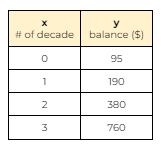
The table below represents the growth of an investment account over 3 decades.
What is the growth factor of this function?
Level 3:
Part 1: Growth Factor
The table below represents the growth of an investment account over 5 years. Complete the table and answer the questions.
a. What is the growth factor of this function?
b. What is the annual rate of return in this account? Hint: By what percentage does this function increase each year?
c. What was the initial value in the investment account?$
Imagine an item that costs $300 today (like 3 concert tickets or a nice winter jacket). The graph below represents the change in the price of that item over time, assuming an average annual inflation rate of 2%.
a. Approximately how much has the price of the item increased after 15 years?$
b. This function has a growth factor of 1.02 and is exponential. Why does it appear almost linear in the graph?
c. This function shows a 2% annual increase in price, using the equation y = 300(1.02)x. Rewrite this equation to instead show the 2% annual decrease in purchasing power of that same $300 over time.
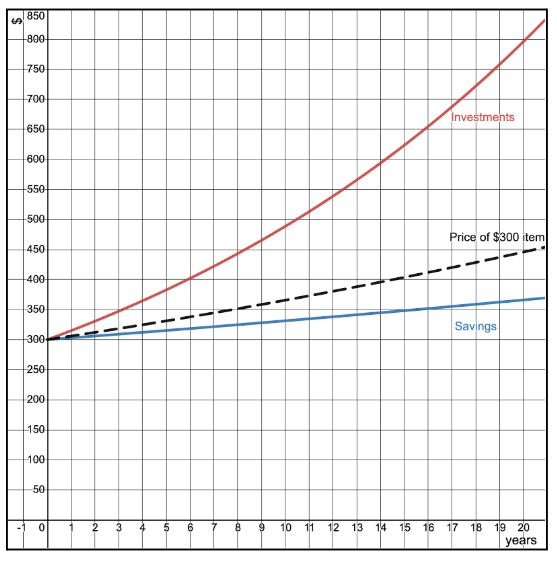
Hadley puts $300 in a savings account earning 1% annual interest and $300 in an investment account that averages 5% annual returns. The graph below shows the balance in those accounts over 20 years. The dashed line reflects the change in price of a $300 item due to 2% annual inflation.
Approximately how much has Hadley’s initial investment grown over 20 years? Include both the dollar value $
Plot the points from the table on the graph to illustrate the pattern. ( you may also screen shot a desmos with the points in the show your work)
The table below represents the growth of an investment account over 4 years.
What is the growth factor of this function?
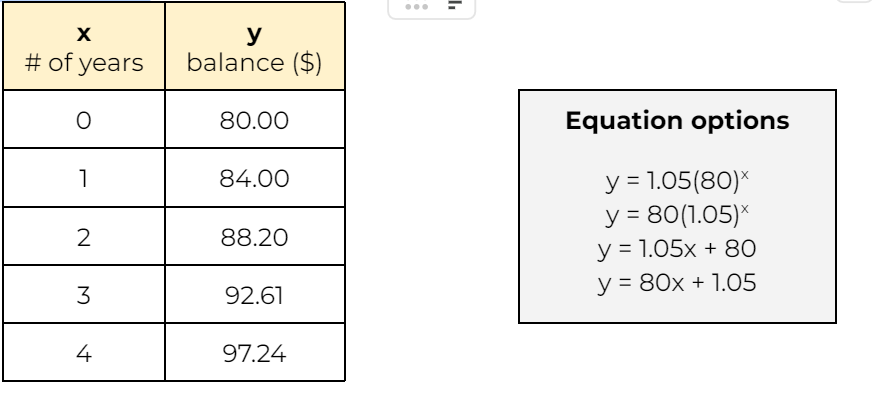
The table below represents the value of an investment account, y, after x years.
Which of the equations options do you think represents the account’s growth? Justify your response using math terms from this lesson.
The real rate of return on an investment is the annual rate of return after taking into account the impacts of inflation. It more accurately reflects the purchasing power of your money. You can calculate it using the formula below, where “nominal rate” is the given rate of return.
a. What is the real rate of return on Hadley’s investments? Refer back to question 18.
b. What is the real rate of return on Hadley’s savings?
c. How does the graph show the impact of inflation on the value of Hadley’s savings over time?
d. Question 4 used the equations
to represent Hadley’s savings and investment balances over time, respectively. Rewrite these equations to represent their account balances based on their real rate of return.
Invetments:
Savings: