OBJECTIVES & STANDARDS
Math Objectives
Recognize and define the parts of an exponential function
Write exponential functions to model a given situation
Evaluate and solve exponential functions
Common Core Math Standards
Personal Finance Objectives
Analyze return on an investment given starting investment, rate of return and time periods
National Standards for Personal Financial Education
Investing
2b: Compare nominal annual rates of return over time on different types of investments, including cash flow and price changes
DISTRIBUTION & PLANNING
Distribute to students
OBJECTIVES & STANDARDS
Math Objectives
Recognize and define the parts of an exponential function
Write exponential functions to model a given situation
Evaluate and solve exponential functions
Common Core Math Standards
Personal Finance Objectives
Analyze return on an investment given starting investment, rate of return and time periods
National Standards for Personal Financial Education
Investing
2b: Compare nominal annual rates of return over time on different types of investments, including cash flow and price changes
DISTRIBUTION & PLANNING
Distribute to students
DISCUSSION PROMPTS: Repeated Doubling
Answer each question using any appropriate math notation.
An exponential function is a function in the form y = ab^x where
a is the starting value of the function
b is the number that is repeatedly multiplied, commonly referred to as the growth or decay factor. Assuming positive numbers, then the following is true:
If b > 1, then the function will grow. This is also referred to as exponential growth
If b is between 0 and 1 (fractions and decimals) then the function will shrink. This is also referred to as exponential decay
If b = 1, then the function will not grow or decay because multiplying by 1 does not change the starting value.
x is the number of times that you will be multiplying by b
*Remember your order of operations!!!!
PEMDAS
Use what you have learned about the parts of exponential functions to write an equation for each of the following situations and answer the questions.
As with other types of equations, you can solve exponential functions for any variable. In this section, we will solve for the exact initial value but only estimate the exponent since solving for exponents is beyond what we have learned so far.
You are given $10,000 that will triple every year for the next 5 years.
Your equation has three numbers: starting value, growth factor, and the exponent. You are allowed to double one of these numbers. Which one do you think will result in the highest outcome? Explain your reasoning.
Think about the change that resulted in the highest return on your investment. What does that represent in the real world context of the original situation?
Level 2:
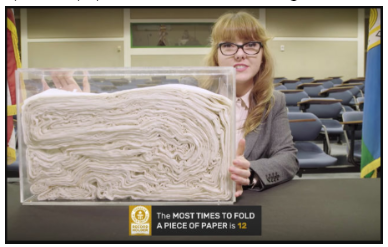
The world record for folding a piece of paper in half over and over again is 12 folds by Britney Gallivan in 2018.
Every time she folded her paper in half, the thickness doubled! Let’s pretend that we can beat Britney’s record and fold a piece of paper as many times as we want.
Complete the table using your equation. As the numbers get larger, you may need to convert millimeters to centimeters, meters, or kilometers. Be sure to include units with your numbers!
Choose any three rows of your table and find an object that exists in the world that is approximately the same size. For example, if your measurement was 7 mm, you could say that an iPhone 13 is about 7mm thick. Write your answers in the space provided below.
Level 3:
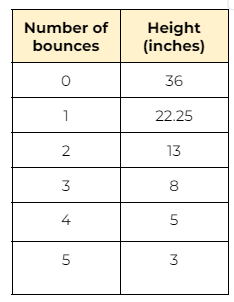
We can represent the motion of a tennis ball bouncing using math. Here’s a graph that lets you see different bounces from different heights. You can move the sliders to adjust the height of the ball and how high each additional bounce will be.
In this video, the initial height of the ball is 36 inches and each bounce is represented in the table below.
Let’s create a decay model to represent the ball’s height after a certain number of bounces.
Calculate the decay factor for each bounce by dividing the second height by the first height, then the third by the second, until you reach the bottom of the table. Make a list of those decay factors in the space below to three decimal places.
What is the average of the 5 decay factors?
Test your function by substituting a value on your table for x and seeing if it is close to the actual height measured in the video. Does your equation appear to be a good representation of the ball’s height?
Which double resulted in the highest return on your investment?
After performing this activity, if you had to give advice to someone making an investment that results in exponential growth, what would you tell them?
Imagine that there was an investment that performed similarly by starting small and doubling after a certain amount of time has passed. What is the best advice that you would give to someone that was holding this investment?
Use your equation to make a prediction about the height of the ball after 7 bounces.