Context 10 - One Good Bounce
star
star
star
star
star
Last updated over 2 years ago
29 Nsɛmmisa
Hyɛ no nsow a efi ɔkyerɛwfo no hɔ:
MMR Resources
1
1
MMR Resources
Sketch a graph to illustrate your prediction of the functional relationship.
Collect your data
Enter your data on stapplet:
https://stapplet.com/quant2v.html?inf=test&authuser=0
Does your prediction match the scatter plot in #2? Mention some things in the prediction that were correct and some things that need revised.
Record the function (equation) of your model.
Using your video or chart on #2, what was the height of the ball 0.1 seconds into the bounce?
Using your video or chart on #2, what was the height of the ball 0.33 seconds into the bounce?
Using your equation from question 5 above, What was the height of the ball 0.1 seconds into the bounce? (Hint: Graph your equation from #5 here and plug 0.1 in for x in the equation)
Using your equation, What was the height of the ball 0.33 seconds into the bounce?
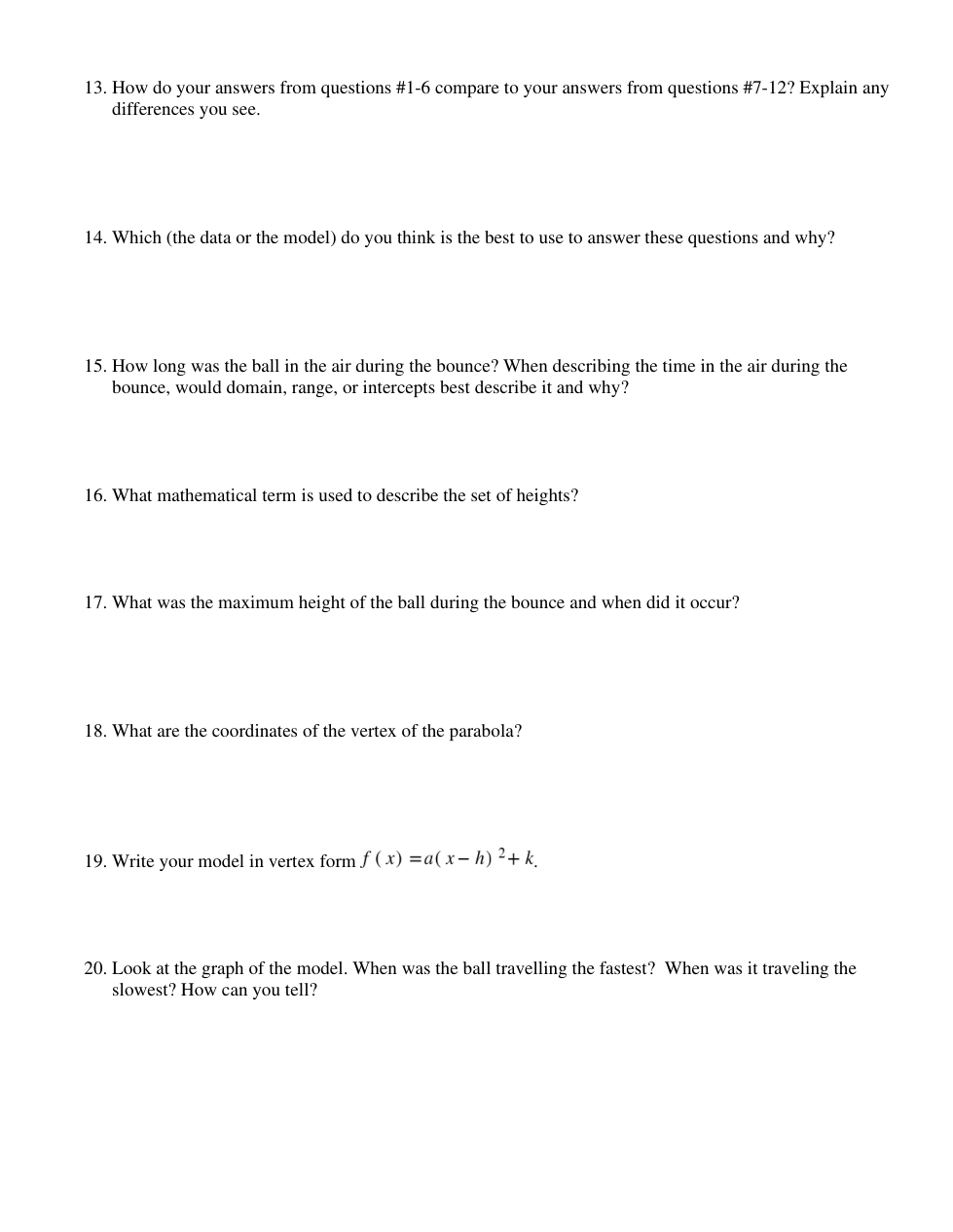
How do your answers from questions #9-14 compare to your answers from questions #15-20? Explain any differences you see.
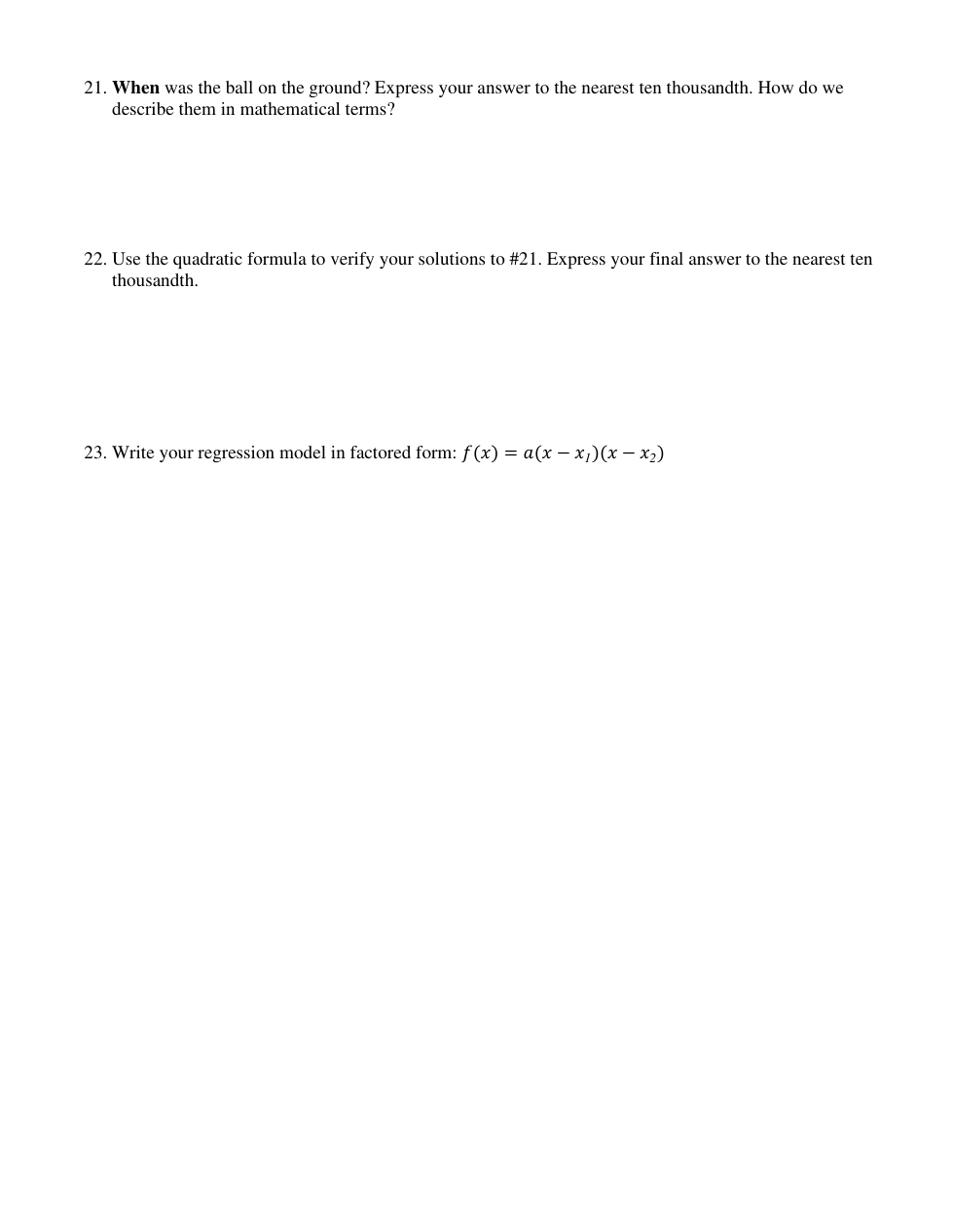
At what time was the ball back on the ground according to the video?
Graph your quadratic equation to verify your solutions to #28. What time does the equation show the ball back on the ground?
What type of a function is your model?
Explain the context of the independent and dependent variables (including units) and the appropriate domain and range for the function.
Screenshot and upload the image of your graph from Stapplet using the image tool or cut and paste.
What mathematical term would describe the shape of the graph of your model?
Using your video or chart on #2, what was the height of the ball 4 seconds into the bounce? (Or did this even happen?)
Using your video or chart on #2, When was the ball at a height of 20 cm? (You may need to convert cm to inches)
Using your video or chart on #2, when was the ball at a height of 6 inches?
Using your video or chart on #2, When was the ball at a height of 12 feet? (You may need to convert feet to inches)
Using your equation, What was the height of the ball 4 seconds into the bounce?
Using your equation, When was the ball at a height of 20 cm? (You may need to convert cm to inches)
(Hint: plug the height in for "y" in the equation)
Using your equation, When was the ball at a height of 12 feet? (You may need to convert feet to inches)
Using your equation, When was the ball at a height of 6 inches?
Which (the video or the equation) do you think is the best to use to answer these questions and why?
How long was the ball in the air during the bounce? When describing the time in the air during the bounce, would domain (x axis), range (y axis), or intercepts best describe it and why?
What mathematical term is used to describe the set of heights?
What was the maximum height of the ball during the bounce and when did it occur?
What are the coordinates of the vertex of the parabola? (Hint: Graph the equation from #5 in Desmos and then click on the vertex aka the highest or lowest point).
Look at the graph of the model. When was the ball travelling the fastest? When was it traveling the slowest? How can you tell?