5.4 Stocks

Last updated 10 months ago
34 questions
Note from the author:
OBJECTIVES & STANDARDS
Math Objectives
  • Compare linear and exponential growth patterns
  • Apply compound interest formula over successive periods
  • Calculate percent growth
Common Core Math Standards
  • Link to all CCSS Math
  • CCSS.PRACTICE.MP4
  • CCSS.HSF.IF.C.8
  • CCSS.HSF.LE.A.1
  • CCSS.HSF.LE.A.3
Personal Finance Objectives
  • Define a stock and describe how it can make money
  • Identify and name trends in the stock market as bullish or bearish
  • Assess the risks of investing in stocks
  • Calculate returns and return on investment
National Standards for Personal Financial Education
Investing
  • 2a: Describe the different types of annual cash flows that can be received by investors
  • 3a: Discuss the advantages and disadvantages of investing in riskier assets.
  • 3b: Investigate the long-run average rates of returns on small-company stocks, large-company stocks, corporate bonds, and Treasury bonds.
  • 5b: Predict what could happen to the price of a stock if new information is reported about the company or its products.
  • 9a: Identify several behavioral biases that can result in poor investment decisions (e.g. loss aversion, investing in employer stock, home bias, mental accounting).
DISTRIBUTION & PLANNING
Distribute to students
  • Student Activity Packet
OBJECTIVES & STANDARDS
Math Objectives
  • Compare linear and exponential growth patterns
  • Apply compound interest formula over successive periods
  • Calculate percent growth
Common Core Math Standards
  • Link to all CCSS Math
  • CCSS.PRACTICE.MP4
  • CCSS.HSF.IF.C.8
  • CCSS.HSF.LE.A.1
  • CCSS.HSF.LE.A.3
Personal Finance Objectives
  • Define a stock and describe how it can make money
  • Identify and name trends in the stock market as bullish or bearish
  • Assess the risks of investing in stocks
  • Calculate returns and return on investment
National Standards for Personal Financial Education
Investing
  • 2a: Describe the different types of annual cash flows that can be received by investors
  • 3a: Discuss the advantages and disadvantages of investing in riskier assets.
  • 3b: Investigate the long-run average rates of returns on small-company stocks, large-company stocks, corporate bonds, and Treasury bonds.
  • 5b: Predict what could happen to the price of a stock if new information is reported about the company or its products.
  • 9a: Identify several behavioral biases that can result in poor investment decisions (e.g. loss aversion, investing in employer stock, home bias, mental accounting).
DISTRIBUTION & PLANNING
Distribute to students
  • Student Activity Packet
Intro/Warm-Up:
QUESTION OF THE DAY: What percent of 18-29 year olds are investing in the stock market?
Write your answer to the question below. Then, compare your answer to the answer and chart on the second slide. Finally, follow your teacher’s directions on how to answer the follow-up questions below.
1
What percent of 18-29 year olds are investing in the stock market?
_______ %
1

Why do you think a higher percentage of those over 29 years old invest in the market compared to those under 29?

1

Using the data table provided, plot the median amount saved vs. age on the graph below

Age Median Amount Saved
25 $7,700
35 $22,000
45 $51,000
55 $80,000
65 $100,000

1

Do these values seem more linear or exponential? Sketch a line and an exponential curve to justify your response.

1

Since exponential growth has the largest gains at the end, which group of current investors is best able to take advantage of the power of compounding?

1

If investment earnings compound exponentially, what are some reasons the median account holdings curve across age groups isn't more of an obvious exponential curve?

Learn It
VIDEO: How The Stock Exchange Works (For Dummies)
INFOGRAPHIC: The Stock Market - Explained
You’ve probably heard about the stock market, but what is it and how does it work? Watch this video and read this infographic to learn what it means to buy a stock. Then, answer the questions.
TEACHERS: The video mentions the DAX, a German stock exchange, rather than US exchanges, but the fundamentals of how stocks and exchanges work are universally applicable.
1

How does a company benefit by having their stock listed on an exchange?

1

As an investor, what are the risks involved with buying a company’s stock?

1

What are the two ways that investors can make money from stocks?

EDPUZZLE: Trends in the Stock Market
As we saw, stocks change prices all the time for a variety of unpredictable reasons. If you’re wanting to follow the age-old advice of “Buy low; sell high,” then you’ll need to pay more attention to the trends in the market. Watch this video to learn more. Then, follow your teacher’s directions to answer the questions either within the EdPuzzle itself or on this document.
1

What is the difference between a BULL and a BEAR market?

1

Which adjective would best describe a BEARish investor attitude?

1

True or False: It is easy to predict trends in the stock market.

GRAPH: S&P 500 Total Index Returns 1958 - June 2022
In the previous game, you experienced long-term stock market trends and considered how they impact your investing approach. Now, you’ll look at how the market has moved since 1957. The S&P 500 measures how the stock market is doing overall, based on the prices of 500 of the biggest companies.
Analyze the graph and answer the questions to learn more about trends in the stock market over time.
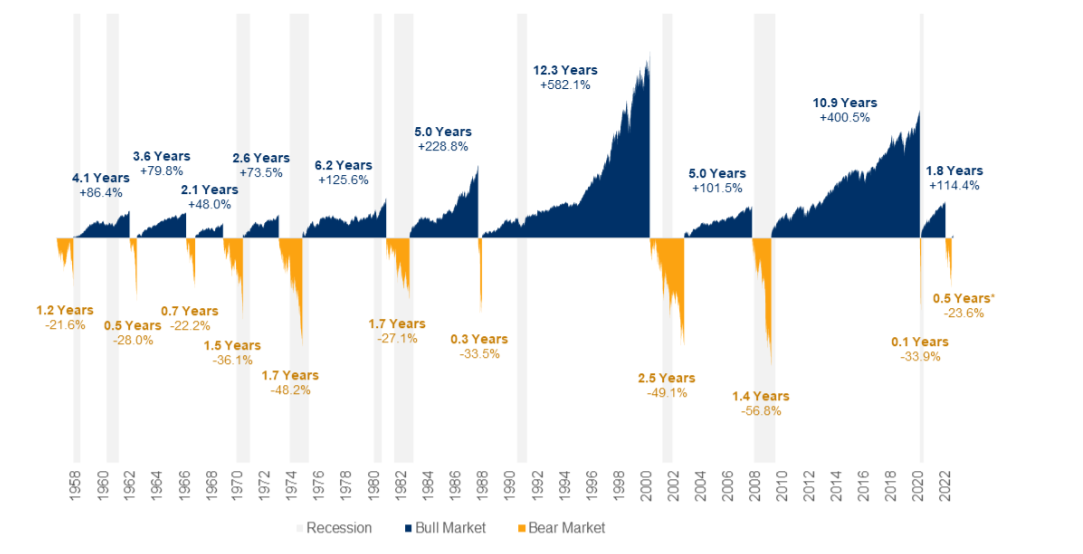
TEACHERS: This graph is set up to highlight bull vs bear markets, so it shows the percent change during each time period. It does NOT show the price of the S&P 500 over time.
1
What were the overall returns during the bull market from 1970 to 1973?_______ %
1
If you invested $100 at the beginning of that market, how much would you have had in 1973?$_______
1
Imagine you invested $1000 at the beginning of the bull market in 1988 and got out right before the dot-com bubble burst in 2000 causing a recession. How much would your portfolio have been worth at that time?_______
INTERACTIVE: Can You Beat the Market?
In the previous video, we learned that it can be difficult to predict trends in the stock market. You’ll now have the opportunity to see why. Play this interactive game, which simulates investing in the stock market over 10 years. Your job is to SELL when you think you should take your money out of the market. Then, BUY back into the market when you think it’s the right time. (Note: You can only sell and buy ONCE.) After playing, answer the questions.
1
  1. Play the game once.
a. Did you beat the market?_______
b. How much did your $10,000 turn into?_______
c. If you hadn’t made any trades at all, how much money would you have had?_______
1
Play the game a second time. Did you alter your strategy? _______ Why or why not?_______
1

What did you notice about the S&P 500 trends overall as you played?

1

Now that you’ve had the chance, do you think it’s easy to ‘time the market’ to avoid losses? How would that change your investing strategy?

INFOGRAPHIC: What Are Dividends?
Buying stocks and selling them for a higher price is just one way to make money with your investments. The other way is through dividends. Examine this infographic about dividends and answer the following questions.
1

What is a dividend payment?

1

Do you think dividends are part of a short-term or long-term investment strategy? Explain your answer.

1

How can you take advantage of the power of compounding with your dividends?

Math Connection
ACTIVITY: Return on Investment
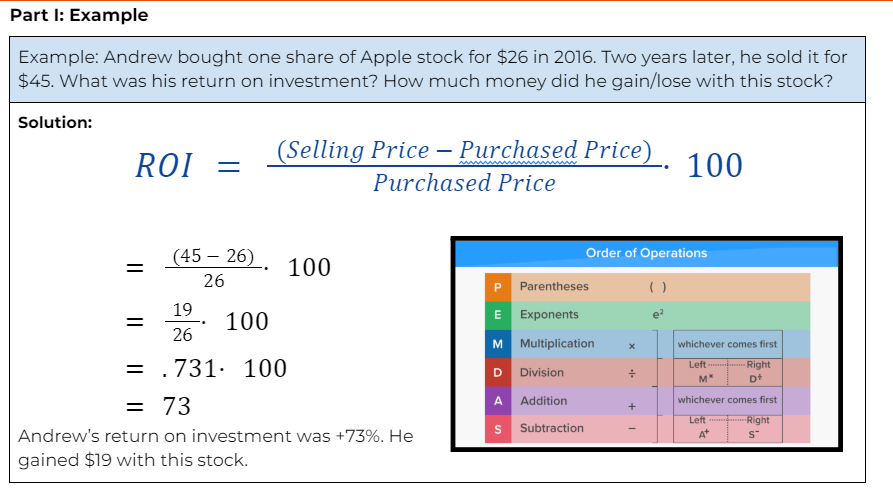
We all have a limited amount of money to invest, and we want to make sure that we’re investing wisely. For example, is it better to invest in a stock that gains $50 from $200 to $250 or a stock that gains $100 from $1000 to $1100? Return on Investment allows us to compare different investment options no matter how large or small they are individually.
MATH: Return on Investment
Return on Investment (ROI), also called percent growth, is a percentage that tells you the relationship between how much you spent on an investment and how much you get back from that investment. Calculating these percentages is helpful in seeing whether or not your investment is worth it! In this activity, you will practice calculating ROIs on investment options by practicing order of operations and interpreting percentages.
Math Topics
Personal Finance Topics
  • Percents
  • Order of Operations
  • Individual Stocks

2
Tori bought one share of Macy's stock on Nov 1, 2016 for $33.38. Four years later, she sold it and the closing price for that day was $5.09.
  1. How much money did she gain/lose with this stock?$_______
  2. What is her rate of return?_______ %
2
Chadwick also bought one share of Macy's stock on Nov 1, 2016, but he sold it three years later for $13.54.
  1. How much money did he gain/lose with this one share?$_______
  2. What is his return on investment?_______ %
2
Tori bought one share of Chipotle stock on Nov 1, 2016 for $396.33. Then, four years later, she sold it at the closing price of $778.38.
  1. How much money did she gain/lose with this stock?$_______
  2. What was Tori’s return on investment?_______ %
4
Chadwick bought 50 shares of Chipotle stock on Nov 1, 2016 for $396.33 per share. He sold the shares four years later for $778.38 per share.
  1. What did Chadwick pay for all of the shares in 2016?_______
  2. What was the value of all of his shares four years later?_______
  3. How much money did he gain/lose with this stock?_______
  4. What is his rate of return on his shares when he sold them?_______
1

Part III: Reflection
Refer back to the ROI formula. Even if there were no parenthesis around the numerator (today’s price - your price), explain why you would still carry out that subtraction first before the division and multiplication.

1

What does it mean if your calculated rate of return is negative?

3

Refer back to Questions 27 and 28.
  1. How does the quantity of shares you own impact your rate of return?
  2. How does the quantity of shares you own impact your dollar gains or losses?
  3. How does the length of time you hold the shares impact your rate of return?

1

What is a potential limitation of using return on investment to measure your investment’s growth over time? Explain your reasoning.

1

Despite the value decreasing, hypothesize why Tori held onto Macy's stock for 4 years when Chadwick sold it after three years.

Exit Tickets
1

Which of these statements about stocks is FALSE?
  1. Owning a stock means you own part of a company
  2. Companies sell stocks to raise money for their business
  3. Stocks are guaranteed to increase in value over time
  4. Stock prices can be affected by things like the news and false rumors

1

Davis is interested in starting to invest and asks their family and friends for tips. Who is providing sound advice on how to invest?
  1. Mom: “You’ve got to time the market. That’s how most people make money investing.”
  2. Franklin: “Trends are hard to predict, and that makes timing the market difficult.”
  3. Grandpa Joe: “You can look at a past trend in a stock and know how it’ll behave in the future.”
  4. Jane: “Always follow market trends - buy in a bull market and sell in a bear market.”

1

If the price of the share grows as the company grows, how does buying shares in a company benefit an investor?
  1. An investor will be able to decide what the company sells and set the price
  2. An investor will be able to sell these shares for a higher price and make a profit
  3. An investor will be able to enjoy free services from the company they bought shares from
  4. An investor will be able to put the company on their resume