Pulse Measurement: Michigan University
star
star
star
star
star
Last updated over 1 year ago
17 questions
Pulse Measurement
Test Overview
Your pulse is the rate at which your heart beats. Your pulse is usually called your heart rate, which is the number of times your heart beats each minute (bpm). But the rhythm and strength of the heartbeat can also be noted, as well as whether the blood vessel feels hard or soft. Changes in your heart rate or rhythm, a weak pulse, or a hard blood vessel may be caused by heart disease or another problem.
As your heart pumps blood through your body, you can feel a pulsing in some of the blood vessels close to the skin's surface, such as in your wrist, neck, or upper arm. Counting your pulse rate is a simple way to find out how fast your heart is beating.
You can check your pulse the first thing in the morning, just after you wake up but before you get out of bed. This is called a resting pulse. Some people like to check their pulse before and after they exercise.
1
Your pulse is the rate at which your __________ beats.
1
Your pulse is a measurement of your heart rate in
1
Changes in your heart rate, pulse, or a hard blood vessel may be caused by heart disease.
1
As your heart pumps through your body, you can feel a pulsing in some of the blood vessels in
1
Your __________ pulse is your heart rate just after you wake up but before you get out of bed
Taking a pulse (Heart Rate)
Your pulse is the rate at which your heart beats. As your heart pumps blood through your body, you can feel a pulsing in some of the blood vessels close to the skin's surface.
The usual resting pulse for an adult is about 60 to 100 beats per minute. Certain illnesses can cause your pulse to change, so it is helpful to know what your resting pulse is when you are well. To find your resting pulse, count your pulse after you have been sitting or resting quietly for at least 5 minutes.
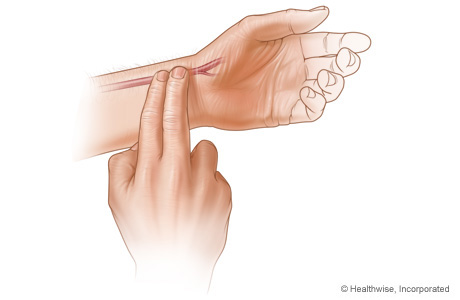
You can easily check your pulse on the inside of your wrist, below your thumb.
- Gently place 2 fingers of your other hand on this artery.
- Do not use your thumb, because it has its own pulse that you may feel.
- Count the beats for 30 seconds, and then double the result to get the number of beats per minute.
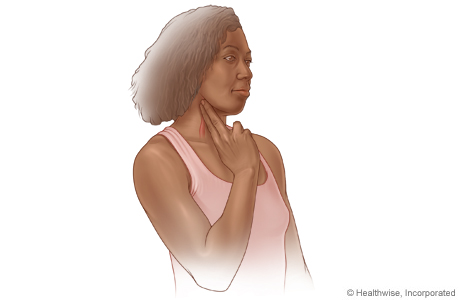
You can also check your pulse in the carotid artery. This is located in your neck, on either side of your windpipe. Be careful when checking your pulse in this location, especially if you are older than 65. If you press too hard, you may become lightheaded and fall.
1
The usual resting pulse for an adult is _______ to _______ beats per minute.
1
To find your resting pulse, count your pulse after you have been __________ for 5 minutes
1
Two places you can easily find your pulse is
1
Identify one reason why taking your pulse with your thumb is incorrect.
Your pulse is checked to:
- See how well the heart is working. In an emergency situation, your pulse rate can help find out if the heart is pumping enough blood.
- Help find the cause of symptoms, such as an irregular or rapid heartbeat (palpitations), dizziness, fainting, chest pain, or shortness of breath.
- Check for blood flow after an injury or when a blood vessel may be blocked.
- Check on medicines or diseases that cause a slow heart rate. Your doctor may ask you to check your pulse every day if you have heart disease or if you are taking certain medicines that can slow your heart rate, such as digoxin or beta-blockers (such as atenolol or propranolol).
- Check your general health and fitness level. Checking your pulse rate at rest, during exercise, or immediately after vigorous exercise can give you important information about your overall fitness level.
1
Which of the following is NOT a reason why you would measure pulse?
Normal resting heart rate
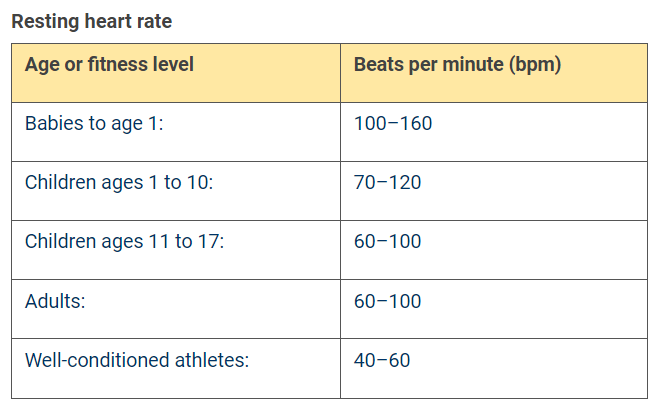
The chart below shows the normal range of a resting heart rate (pulse rate after resting 10 minutes) in beats per minute, according to age. Many things can cause changes in your normal heart rate, including your age, activity level, and the time of day.
Your pulse usually has a strong steady or regular rhythm. Your blood vessel should feel soft. An occasional pause or extra beat is normal. Normally, your heart rate will speed up a little when you breathe deeply. You can check this normal change in your pulse rate by changing your breathing pattern while taking your pulse.
Many conditions can change your pulse rate. Your doctor will talk with you about any abnormal results that may be related to your symptoms and past health.
Fast pulse
A fast heart rate may be caused by:
- Activity or exercise.
- Anemia.
- Some medicines, such as decongestants and those used to treat asthma.
- Fever.
- Some types of heart disease.
- An overactive thyroid gland (hyperthyroidism).
- Stimulants such as caffeine, amphetamines, diet pills, and cigarettes.
- Drinking alcohol.
- Stress.
Slow pulse
A slow resting heart rate may be caused by:
- Some types of heart disease and medicine to treat heart disease.
- High levels of fitness.
- An underactive thyroid gland (hypothyroidism).
Weak pulse
A weak pulse may be caused by:
- A blood clot in your arm or leg.
- Diseases of the blood vessels (peripheral arterial disease).
- Heart disease and heart failure.
1
What is the average resting heart rate for babies?
1
What is the average resting heart rate for children ages 11 to 17?
1
What is the average resting heart rate for well conditioned athletes?
2
List two scenarios/reasons for a fast pulse.
2
List two scenarios/reasons for a slow pulse.
2
List two scenarios/reasons for a weak pulse
Heart rate during exercise
Many people use a target heart rate to guide how hard they exercise.
During exercise, your heart should be working hard enough for a healthy effect but not so hard that your heart is overworked. You benefit the most when your exercise heart rate is within the range of your target heart rate. You can take your pulse rate during or after exercise to see if you are exercising at your target heart rate.
Or you can wear a heart rate monitor during exercise so you do not have to take your pulse. A heart rate monitor shows your pulse rate continuously, so you see how exercise changes your heart rate.
To check your heart rate while exercising:
- After exercising for about 10 minutes, stop and take your pulse. Measure your heart rate by placing two fingers gently against your wrist (don't use your thumb). If it is hard to feel the pulse in your wrist, find the artery in your neck that is just to either side of the windpipe. Press gently. Count the beats for 15 seconds. Multiply the number of beats by 4. This is your beats per minute.
- Make changes in how hard you exercise so that your heart rate stays within the range of your target heart rate.
Target heart rate is only a guide. Everyone is different, so pay attention to how you feel, how hard you are breathing, how fast your heart is beating, and how much you feel the exertion in your muscles.
1
When measuring your heart rate during exercise, you should count the beats for __________ and multiply by __________