Log in
Sign up for FREE
arrow_back
Library

Egypt Unit Test

star
star
star
star
star
Last updated over 2 years ago
20 questions
Required
1
Required
1
Required
1
Required
1
Required
1
Required
1
Required
1
Required
1
Required
1
Required
1
Required
1
Required
1
Required
1
Required
1
Required
1
Required
1
Required
5
Required
10
Question 1
1.

The pyramids in Egypt were built during what time period in Egyptian history?

Question 2
2.

Before Egypt was one kingdom, it used to be 2 kingdoms. Which one was near the Nile Delta in the Northern part of Egypt?

Question 3
3.

What was the name of the area in Egypt given to the land where crops could grow and flourish?

Question 4
4.

Egypt saw an increase in art, literature, and music during what time period in Egyptian history?

Question 5
5.

The Great Pyramids and the Sphinx are located in which Egyptian city?

Question 6
6.

What was the name of the highest ruler in Egypt?

Question 7
7.

What area of Egypt was dry and had a lot of mountains?

Question 8
8.

What was the name of the person in charge of the government bureaucracy and different departments of the Egyptian government?

Question 9
9.

The pharaohs took a more active role in leading and made Egypt an empire through expansion and conquest were built during what time period in Egyptian history?

Question 10
10.

The area in Egypt that was dangerous, desert area surrounding the Nile was given what name by the Egyptians?

Question 11
11.

Who was the pharaoh that united Upper and Lower Egypt?

Question 12
12.

Who was a female pharaoh that cared more about trade and having good relationships with other nations instead of going to war?

Question 13
13.

Which pharaoh did not accomplish much while alive, but is best known for his well preserved tomb?

Question 14
14.

Which pharaoh changed Egypt's religion to worshiping one god instead of the multiple gods they were used to?

Question 15
15.

During the mummification process, internal organs were removed from the bodies and put into canopic jars. Which of the following was not an organ put into canopic jars?

Question 16
16.

Bodies had to be dried out during the mummification process. About how many days did it take for a human body to dry out?

Question 17
17.

The pyramids built by the Egyptians were large tombs built for the burial of pharaohs. These projects took a long time, a lot of resources, and required many people doing different jobs. Put the steps of the pyramid building process in order below. Drag the

  • Workers decorated the pyramid by covering it in polished limestone.
  • Egyptians constructed ramps as the pyramid ascended.
  • Architects designed the pyramids, planned where to build, and decided on necessary materials.
  • Workers supplied the blocks, and dragged them on sleds or brought them by boat.
  • Workers positioned the blocks using ramps, pulleys, and water to reduce friction.
  • Step #1
  • Step #2
  • Step #3
  • Step #4
  • Step #5
Question 18
18.

Match the name of the god/goddess on the left with what they were the god/goddess of in Egyptian society. Grab the dots of the name of the god and move it up or down to match their role.

Draggable itemarrow_right_altCorresponding Item
Ra
arrow_right_alt
Goddess of Fertility
Seth
arrow_right_alt
Goddess of Love
Isis
arrow_right_alt
God of Death
Osiris
arrow_right_alt
God of Chaos
Ma'at
arrow_right_alt
God of the Sky
Horus
arrow_right_alt
God of the Underworld
Anubis
arrow_right_alt
Goddess of Order
Bastet
arrow_right_alt
God of Life
Hathor
arrow_right_alt
God of the Sun
Amun
arrow_right_alt
Goddess of Health
Required
2
Question 19
19.

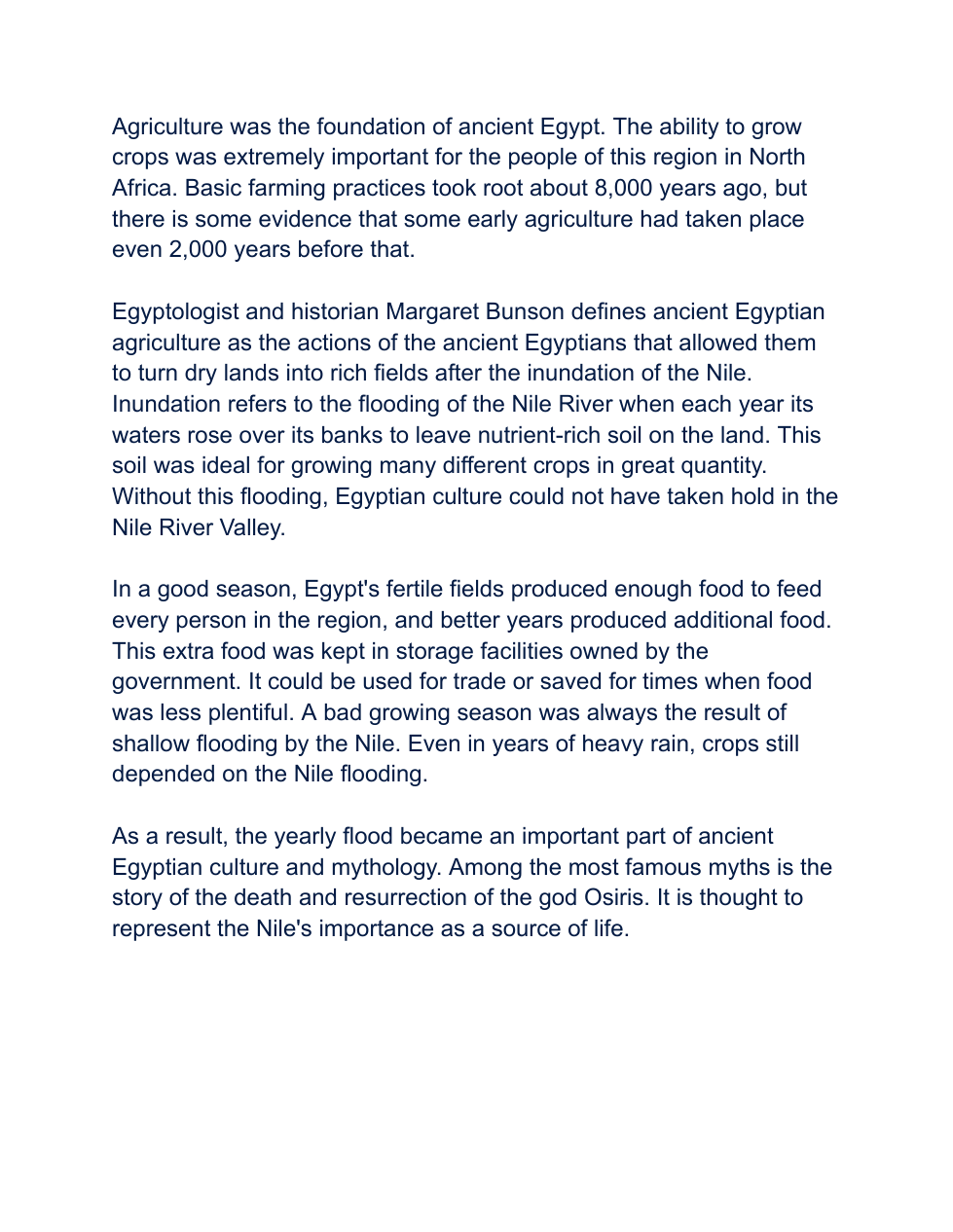
After reading this passage about Egyptian agriculture, what is the one sentence that summarizes the main idea of the passage? Type that sentence word for word.

Required
1
Question 20
20.

What sentence is evidence that supports the main idea of this passage? Type your sentence word for word from the passage.