Preskoči na glavni sadržaj
Prijava
Sign up for FREE
arrow_back
Biblioteka

5.5 Exponential Change

star
star
star
star
star
Posljednje ažuriranje over 1 year ago
26
Napomena autora:
Intro/Warm-Up:

REVIEW: Calculating Percent Change

Let’s review percent increase and decrease. Try to perform each of the following calculations in one step.

1
1
Learn It
Practice It
ACTIVITY: MATH: Exponential Decay in Purchasing Power
APPLICATION: Analyze Investments for Exponential Change

OBJECTIVES & STANDARDS

Math Objectives

  • Write percent change exponential functions given the necessary values

  • Model a real world situation using exponential functions

  • Find the rate of growth and decay given the equation

Common Core Math Standards

  • Link to all CCSS Math

  • CCSS.PRACTICE.MP2

  • CCSS.PRACTICE.MP4

  • CCSS.HSF.LE.A.1.C

  • CCSS.HSM

Personal Finance Objectives

  • Analyze return on an investment given starting investment, rate of return and time periods

  • Explain what inflation is and how it affects purchasing power and investments

  • Explain how depreciation affects the value of a car

National Standards for Personal Financial Education

Investing

  • 2b: Compare nominal annual rates of return over time on different types of investments, including cash flow and price changes

  • 4a: Describe the impact of inflation on prices over time

DISTRIBUTION & PLANNING

Distribute to students

  • Student Activity Packet

  • Application Problems

OBJECTIVES & STANDARDS

Math Objectives

  • Write percent change exponential functions given the necessary values

  • Model a real world situation using exponential functions

  • Find the rate of growth and decay given the equation

Common Core Math Standards

  • Link to all CCSS Math

  • CCSS.PRACTICE.MP2

  • CCSS.PRACTICE.MP4

  • CCSS.HSF.LE.A.1.C

  • CCSS.HSM

Personal Finance Objectives

  • Analyze return on an investment given starting investment, rate of return and time periods

  • Explain what inflation is and how it affects purchasing power and investments

  • Explain how depreciation affects the value of a car

National Standards for Personal Financial Education

Investing

  • 2b: Compare nominal annual rates of return over time on different types of investments, including cash flow and price changes

  • 4a: Describe the impact of inflation on prices over time

DISTRIBUTION & PLANNING

Distribute to students

  • Student Activity Packet

  • Application Problems

Pitanje 1
1.
Pitanje 2
2.

Exponential Growth and Decay using Percents

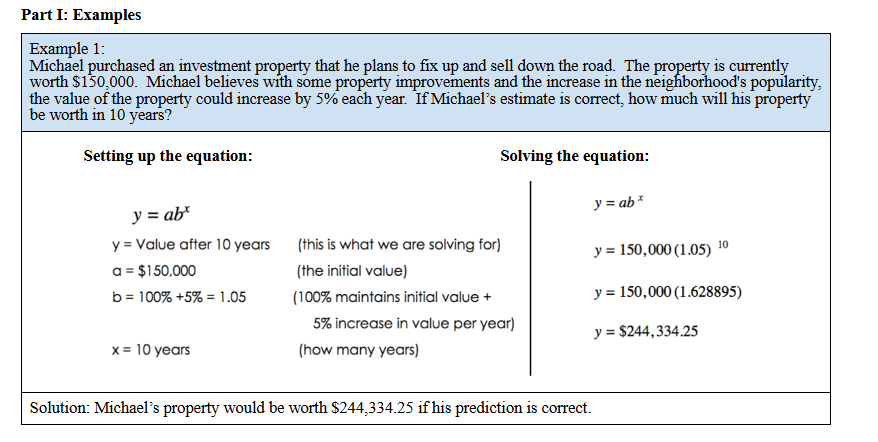
Remember that the b value in the general form

 represents the growth or decay of the initial value.  If the b value is 1, then no growth or decay happens.

If you are told that the initial value changes by a percent, then we can represent the b value as growth or decay where:

  • Growth is 1 + r

  • Decay is 1 - r

  • r is the decimal form of the percent

1
Pitanje 3
3.
1
Pitanje 4
4.

Use what you know about writing exponential functions with percent growth or decay to complete the following problems.

1
Pitanje 5
5.
1
Pitanje 6
6.

2
Pitanje 7
7.
2
Pitanje 8
8.
2
Pitanje 9
9.
5
1
1

Now that we know how to use 1 + r and 1 - r to write percent growth and decay equations, we can use this to determine the rate of change of a given equation.

1
Pitanje 13
13.
1
Pitanje 14
14.

You make an investment of $250 and know that it has an average annual growth rate of 7%. Let’s do an analysis to see how much money you’ll have over a period of time and how much that return has grown from your initial investment, assuming your growth rate remains unchanged.

1
Pitanje 15
15.

Review

To calculate return on investment, use the formula:

8
Pitanje 16
16.
4
Pitanje 17
17.
1
Pitanje 18
18.

After seeing the growth of this investment over 4 ten year periods, what conclusion can you draw about how time affects an investment with an exponential rate of growth?

Level 2 *DESMOS**

There are several factors to consider when deciding what investment is best for you. Let’s analyze three investments with different starting values, growth rates, and investment periods.

You can make one of the following investments:

  1. Option 1: $50 initial investment with an average annual growth rate of 9% starting at age 30

  2. Option 2: $50 initial investment with an average annual growth rate of 8% starting at age 20

  3. Option 3: $100 initial investment with an average annual growth rate of 7% starting at age 25

0
Pitanje 19
19.

Before we do an analysis, which option do you think will have the greatest return after

a. 10 years?

b. 20 years?

c. 30 years?

0
Pitanje 20
20.
0
0
0

Level 3 -BONUS

Every investment that we’ve seen so far involved making a one time deposit and then letting your investment grow.  What if we wanted to keep contributing to the investment account every month like many people do for retirement? In this scenario, the initial value will be changing every year so it’s easier to use a spreadsheet.

You are going to invest $1200 at the start of every year into an account that has an annual rate of return of 3%.

0
Pitanje 24
24.

  1. Make a copy of this spreadsheet

  2. Complete column C for each year.  The initial value will be the total amount in the account from the previous year plus any additional deposits that you’ve made.  Think carefully about what the exponent should be for this calculation.

  3. Complete column D by subtracting the total account investment (the money that you deposited) from the total in the account to find how much interest you’ve earned on your investment.

  4. Share and Paste a copy of your spread sheet (and screen shot)

0
Pitanje 25
25.

Why are you not able to use an exponent of 10 in this situation?

0
Pitanje 26
26.

How would you change this situation if you wanted to use one exponential equation with an exponent of 10?

Pitanje 10
10.
Pitanje 11
11.

Refer back to questions 7 and 8. Plot the value of Sara’s ROTH at age 68 when she invested $500 and $1,000 to start.  Pick one additional initial investment amount and add that to your graph then draw a curve to represent the exponential growth.

Pitanje 12
12.

Your friend is considering how much he should invest in his new IRA.  He is debating if he should invest the full $800 he was planning to or just $400 and use the extra money to buy a couple of pairs of sneakers he had been eyeing.  What advice would you give?  Use math to justify your answer.

Pitanje 21
21.

Which investment option made the most money after 10 years?

A. Option 1

B. Option 2

C. Option 3

Pitanje 22
22.

Which option yielded the most total money by the time you were 60 years old?

Pitanje 23
23.

After seeing the growth of these investments over time, what is one piece of advice you would give to a friend who is making a long-term investment like this?
