5.6 Bonds, Allocation, Diversification

Last updated 10 months ago
38 questions
Note from the author:
OBJECTIVES & STANDARDS
Math Objectives
  • Compare linear and exponential growth patterns
  • Apply compound interest formula over various time periods
  • Calculate percent growth
Common Core Math Standards
  • Link to all CCSS Math
  • CCSS.PRACTICE.MP1
  • CCSS.PRACTICE.MP4
  • CCSS.HSA.SSE.A.1
  • CCSS.HSF.IF.B.4
  • CCSS.HSF.IF.C.7
  • CCSS.HSF.LE.B.5
Personal Finance Objectives
  • Define bonds and learn how they produce a return on investment
  • Explain the inverse relationship between bond yield and interest rates
  • Learn the importance of diversification and asset allocation for spreading risk
  • Explain the difference between individual bonds and bond funds
National Standards for Personal Financial Education
Investing
  • 1b: Discuss how a person’s risk tolerance influences their investment decisions
  • 2a Describe the different types of annual cash flows that can be received by investors
  • 2b: Investigate the long-run average rates of returns on small-company stocks, large-company stocks, corporate bonds, and Treasury bonds
  • 5d: Explain why the market price of some assets, such as bonds and real estate, increase when interest rates decrease
  • 6a: Recommend portfolio allocation between major asset classes for a short-term goal versus a long-term goal.
DISTRIBUTION & PLANNING
Distribute to students
  • Student Activity Packet
OBJECTIVES & STANDARDS
Math Objectives
  • Compare linear and exponential growth patterns
  • Apply compound interest formula over various time periods
  • Calculate percent growth
Common Core Math Standards
  • Link to all CCSS Math
  • CCSS.PRACTICE.MP1
  • CCSS.PRACTICE.MP4
  • CCSS.HSA.SSE.A.1
  • CCSS.HSF.IF.B.4
  • CCSS.HSF.IF.C.7
  • CCSS.HSF.LE.B.5
Personal Finance Objectives
  • Define bonds and learn how they produce a return on investment
  • Explain the inverse relationship between bond yield and interest rates
  • Learn the importance of diversification and asset allocation for spreading risk
  • Explain the difference between individual bonds and bond funds
National Standards for Personal Financial Education
Investing
  • 1b: Discuss how a person’s risk tolerance influences their investment decisions
  • 2a Describe the different types of annual cash flows that can be received by investors
  • 2b: Investigate the long-run average rates of returns on small-company stocks, large-company stocks, corporate bonds, and Treasury bonds
  • 5d: Explain why the market price of some assets, such as bonds and real estate, increase when interest rates decrease
  • 6a: Recommend portfolio allocation between major asset classes for a short-term goal versus a long-term goal.
DISTRIBUTION & PLANNING
Distribute to students
  • Student Activity Packet
Intro/ Warm-Up
ACTIVITY: PLAY: Roll with the Market
Now that you’ve learned how the market works, it’s time to start investing! Follow your teacher’s directions to play this market investing game. Then answer the reflection questions from the game below.
1

Describe the range of emotions you experienced as you played the game.

1

How did your strategy evolve over each round? What factors influenced your strategy?

1

What did you learn about yourself and your tolerance for risk with this game?

1

This game illustrates some of the ups and downs of stock market trends. Depending on how big or little they are, it might make you nervous about putting money into the market. What kind of investment trend might make you feel better about your investment portfolio?

Learn It
EDPUZZLE: Bond. Savings Bond.
When investing, it can be good to have something other than just stocks in your portfolio. This is where bonds come in. Watch this video to learn more about how bonds work and why they could be a useful choice to include in your investments. Then, follow your teacher’s directions to answer the questions either within the EdPuzzle itself or on this document.
NOTE: EdPuzzle videos shuffle answer choices and do not always match the order provided in the lesson.
1

Select the best definition of a bond.
a. A bond is ownership in a company.
b. A bond is a sum of money paid regularly to its shareholders by a company.
c .A bond is an FDIC insured investment account.
d. A bond is a loan to the government or a company that pays investors a fixed rate of return over a specified period of time.

1

What does the term coupon mean (when related to bonds)?
  1. The timeframe of the bond
  2. The annual interest rate paid on a bond
  3. The face value of the bond
d. The discounted rate of the bond when purchased

1

Which is the highest bond rating?
  1. AAA
  2. BBB
  3. CCC
  4. DDD

1

Why would someone invest in a bond with a low rating?
  1. Lower rated bonds typically have a higher coupon
  2. Lower rated bonds typically have a lower coupon
  3. Lower rated bonds are typically less expensive
  4. Lower rated bonds are typically more expensive

1

What is a bond fund?
  1. A bond issued by a corporation to raise funds for a variety of reasons
  2. A bond that does not pay interest but is sold at a discount
  3. A mutual fund that invests in a variety of bonds
  4. A mutual fund that mimics a particular market index

1

True or False: Bonds have less risk than stocks, but more risk than a savings account.

INFOGRAPHIC: The Bond See-Saw
Credit risk describes the risk that the borrower defaults and you lose your principal investment. The other risk factor with bonds is the fixed interest rate. Examine the second page of this article addressing interest rate risk and answer the questions.
1

This image is referred to as the “bond see-saw.” What does it show about the relationship between a bond’s price and the overall interest rates of the market?

1

Explain in your own words why that relationship exists.

Apply It
Imagine you have a bond with ten years left until maturity, a face value of $1000 and a 4% coupon rate. Interest rates recently rose to 6% and you want to figure out how it might impact the price of your bond. We will do some simple calculations, ignoring inflation, to see what might change.
1
How much would this bond pay you back in principal at the end of the 10 years?_______
1
How much would you be paid total in interest over the next ten years of holding the bond?_______
1
What is the total value of the bond (principal + interest) if you hold it to maturity?_______
1
If you bought a new $1000, 10-year bond at today’s higher 6% coupon rate, how much would that bond be worth in total, including both principal at maturity and interest along the way?_______
1
Ignoring inflation, how would you need to discount your bond for it to provide the same as a new one?You would need to decrease the price by $_______ .
Learn It
VIDEO: The Power of Diversification
One of the most popular investing strategies is diversification, or the spreading of risk. Watch this short video about diversifying your investments to learn more about how it works. Then, answer the questions.
1

What is meant by “asset allocation?”

1

After allocating assets, what’s the next level of diversifying you should do within asset classes?

ARTICLE: Buying Bonds vs Buying Bond Funds
You know that investing in bonds can be a smart way to diversify your portfolio and reduce overall risk, but what’s the difference between an individual bond and a bond fund? Read this article just through the third section on bond funds, then answer the questions below.
1

How can bond funds help with portfolio diversification more than individual bonds?

1

What is one way investing in a bond fund is like investing in an individual bond?

1

What is one way investing in a bond fund is like investing in the stock market?

MATH CONNECTION - Evaluating Asset Classes
9

INTERACTIVE: Exploring Asset Classes
Interactive: Novel Investor's Asset Class Returns
We all know that putting all your investment money into one company’s stock would be pretty risky. But, by choosing an entire asset class instead, would you be minimizing your risk and creating a winning strategy? Let’s find out.

Part I: Define the Asset Classes
An asset class is a grouping of investments that have similar characteristics, behave similarly in the market, and follow the same rules and regulations. Really common asset classes are stocks, bonds, and cash, but there are others as you’ll see below.
Use your prior knowledge, educated guesses, or internet research to match the asset class to its proper description.

Draggable itemCorresponding Item
Sm Cap: Small cap stocks
International companies in countries with established industry, widespread infrastructure, and secure economies
Cash: Cash
Bonds with lower credit ratings and a greater chance of default, often issued by startups or struggling businesses
Lg Cap: Large cap stocks
Cash or cash equivalents like Treasury bills backed by the federal government
HY Bnd: High yield bonds
A diversified portfolio made up of 15% large cap, 15% international, 10% small cap, 10% emerging markets, 10% REITs, 40% high-grade bonds, and annual rebalancing
AA: Asset Allocation Portfolio
Largest US companies, which have a market cap over $10 billion
HG Bnd: High grade bonds
Smaller US companies, which have a market cap between $300 million and $2 billion
EM: Emerging market stocks
International companies in countries with still developing capital markets and less stable economies
REIT: Real estate investment trusts
Bonds with high credit ratings and lower risks of default, usually issued by stable companies
Int’l Stk: International developed stocks
Companies that own, operate, or finance income-generating real estate
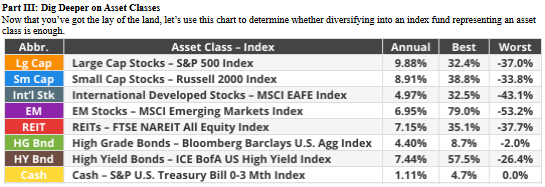
In the chart under the interactive, each Asset Class is listed next to an Index. Index funds are what enable you to own many investments in that asset class. For example:

1

What does the “Annual” column of the chart measure?

1

What does it mean when an asset class has “Best” and “Worst” percentages that are spread very far apart?

1

As an investor, you want to buy low and sell high. But, when an asset class has a bad year, such as International Stocks in 2014, why might it be hard to “hold on” without selling?
Part II: Learn to Read the Chart
Interactive
As you hover over a box, such as a dark green one for International Stock, the dark green box for each year will remain highlighted while all other boxes fade to the background. The next few questions will help you learn to read the chart.
1
Which asset class performed better in 2018 -- High Grade Bonds or Small Cap Companies?_______
1
What was the annual return for Small Cap Stocks in 2009?_______
1

Look at the annual return for Small Cap Stocks in 2010. If the 2010 return is LOWER than it was in 2009, why is Small Cap Stock higher on the list in 2010?

Part III: Dig Deeper on Asset Classes
Now that you’ve got the lay of the land, let’s use this chart to determine whether diversifying into an index fund representing an asset class is enough.

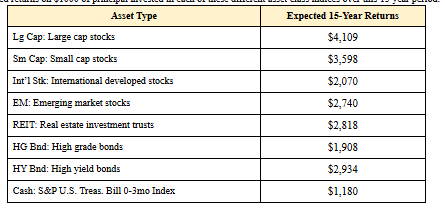
We’ve used the annual returns of each asset class from the chart and the compound interest formula, Value = P(1+i)t , to calculate the expected returns on $1000 of principal invested in each of these different asset class indices over this 15 year period.

1

Let’s look at cash first. It never has a negative year. Does that make Cash Equivalents a good investment? Why or why not?

1

Although all investments are risky because you’re never guaranteed a positive return, bond funds are considered somewhat safer because bonds are less volatile than stocks and a fund means it owns many different bonds, rather than just one. Look at the index fund of High Grade Bonds in this chart. What would be some PROS and some CONS of investing in this bond index fund?

1
What is the range in 15-year returns on the $1000 investment for these asset types?$_______
6
Now look just at Lg Cap, REIT, and HG Bnd and use the compound interest formula, Value = P(1+i)t , to calculate expected returns for 30 and 40 years, too.
Asset Type
a. 15 year Avg. Annual Return
b. 30-Year Returns
c. 40-Year Returns
Lg Cap: Large cap stocks
a. $4,109 b. _______c. _______
REIT: Real Estate Investment Trusts
a. $2,818 b. _______ c. _______
HG Bnd: High grade bonds
a. $1908 b. _______ c. _______
1
What is the range in 40-year returns on the $1000 investment for these three asset types?_______
1

Do you personally think investing in an asset class is enough to minimize risk and create a winning strategy? Justify your answer.

Exit Ticket
1

What are the three common assets considered in asset allocation?
  1. Stocks, bonds, and bond funds
  2. Stocks, bond funds, and mutual funds
  3. Stocks, real estate, and cryptocurrency
  4. Stocks, bonds, and cash

1

The annual interest rate of a bond is called the ______ rate.
  1. Face value
  2. Coupon
  3. Maturity
  4. Discount

1

All of the following are true about diversification EXCEPT...?
  1. Diversification minimizes the risk of one investment failing and ruining your whole portfolio
  2. Diversification ensures that if some investments are going down, others will be going up
  3. Diversification smooths out the volatility of stocks in an investing portfolio
  4. Diversification helps you adjust your investments to fit your changing life needs