Log in
Sign up for FREE
arrow_back
Library
Unit 2 Summative Assessment
By Jovana Menkevich
star
star
star
star
star
Share
share
Last updated over 2 years ago
14 questions
Add this activity
1
1
1
1
1
1
1
1
1
1
1
1
1
zoom_in
zoom_in
Question 1
1.
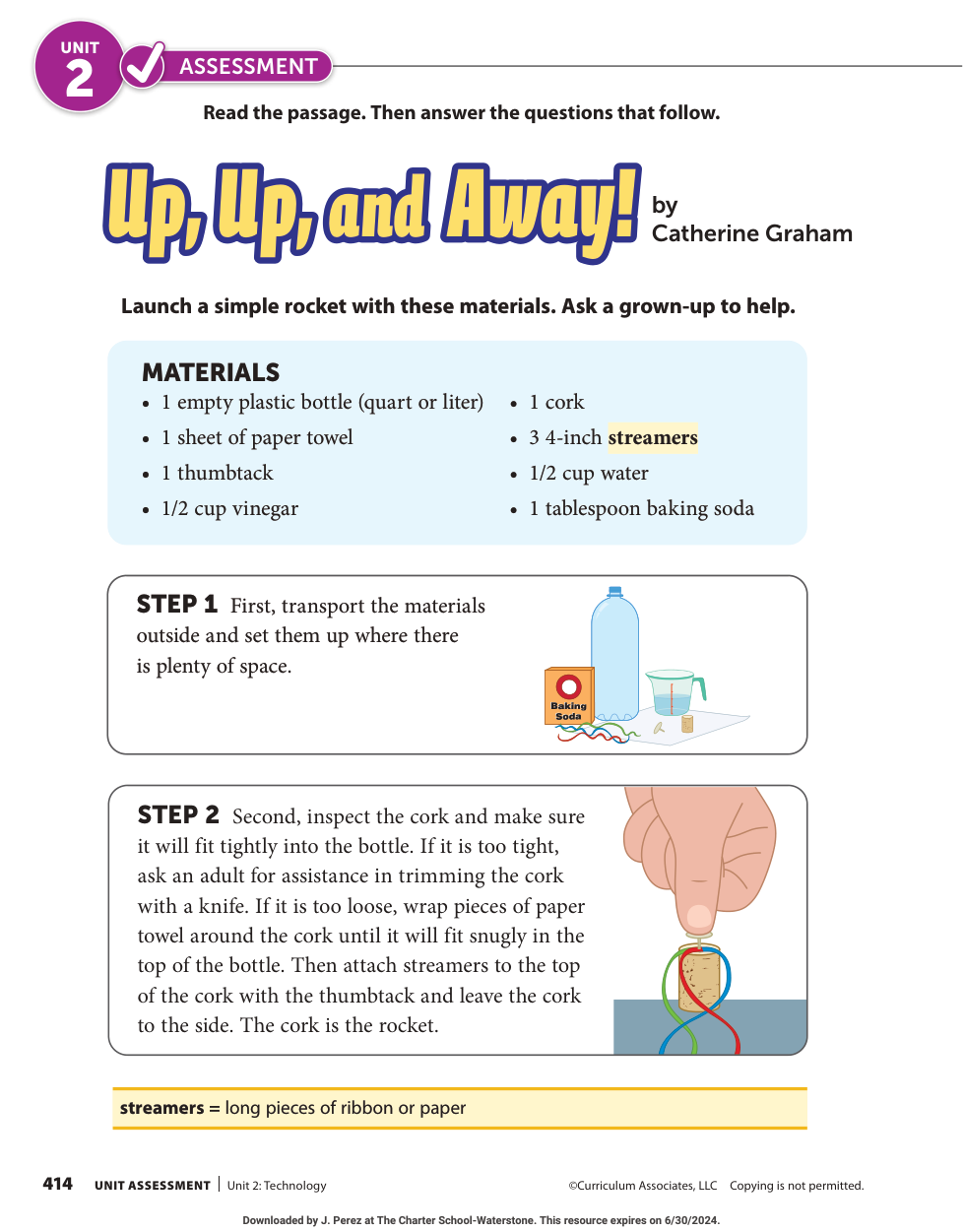
Read the sentence from Step 1.
"First,
transport
the materials outside and set them up where there is plenty of space."
Using knowledge of word parts, what is the meaning of
transport
?
keep
gather
make new
carry across
Question 2
2.
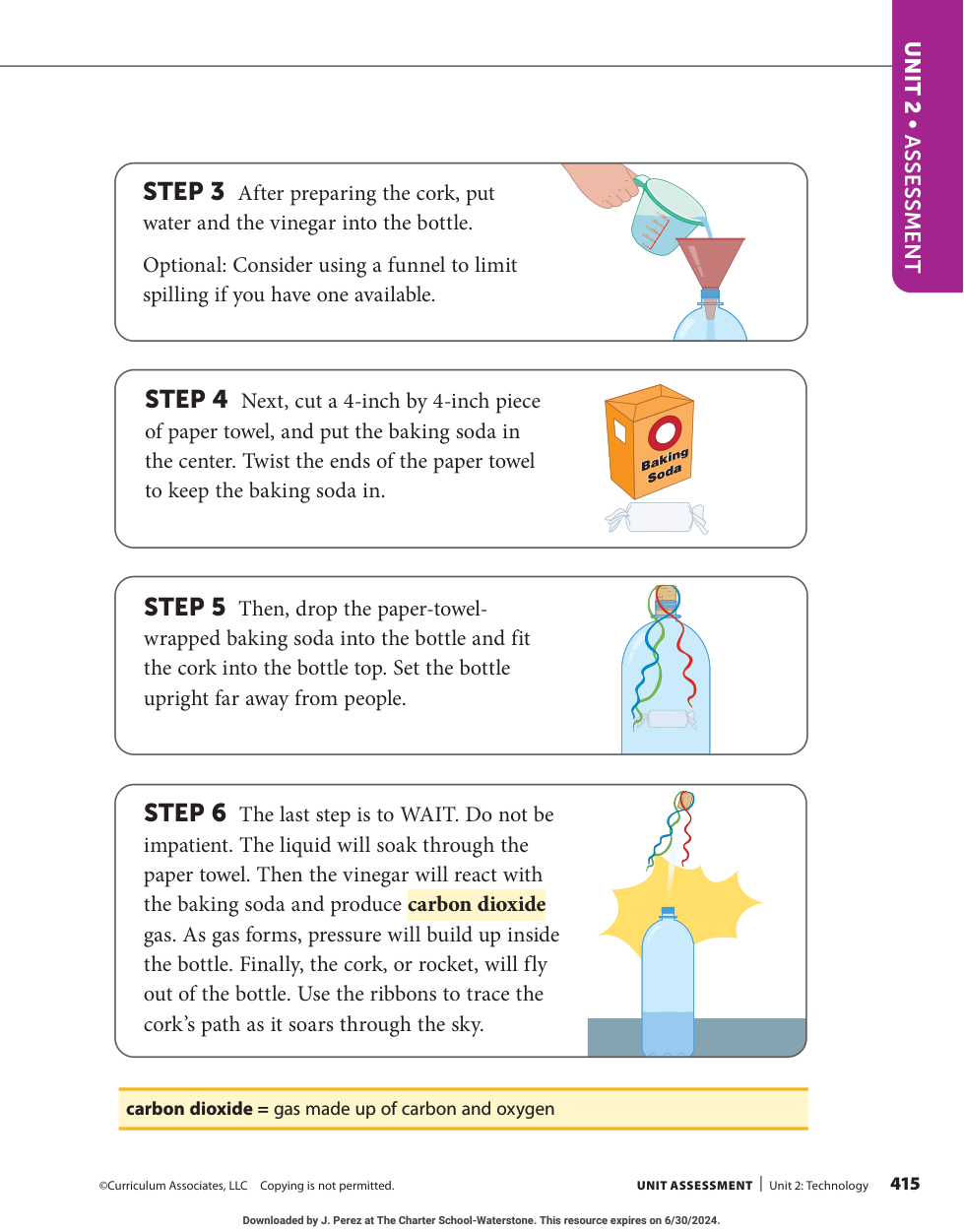
Why does Step 5 suggest setting the bottle "upright far away from people"?
to make sure the vinegar does not spill
to make it easier to take a good picture
to stop the cork from hitting someone
to let air flow around and into the bottle
Question 3
3.
The word
impatient
in Step 6 has the prefix
im-
and the base word
patient.
Based on the word parts, what does
impatient
most likely
mean?
willing to wait
waiting for a long time
not willing to wait
making someone wait
Question 4
4.
What is the meaning of the word
soars
as it is used in Step 6?
flies or glides
drops
explodes
draws a line
Question 5
5.
Which
best
describes the structure of this passage?
sequential text structure
descriptive text structure
problem-and-solution text structure
compare-and-contrast text structure
Question 6
6.
Which sentence contains a signal word or phrase that
best
supports the answer to question 5?
"If it is too tight, ask an adult for assistance in trimming the cork with a knife." (Step 2)
"Next, cut a 4-inch by 4-inch piece of paper towel, and put the baking soda in the center." (Step 4)
"Twist the ends of the paper towel to keep the baking soda in." (Step 4)
"Use the ribbons to trace the cork's path as it soars through the sky." (Step 6)
Question 7
7.
How does the text structure add to the meaning of the passage?
It provides examples of the central idea.
It describes details about a topic.
It tells what to do in a certain order.
It shows how a problem was solved.
zoom_in
1
Question 8
8.
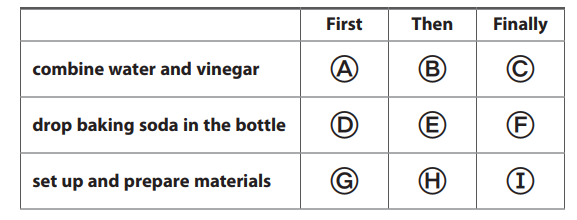
Chose the answers to show the order of the action.
C,E,G
B,F,G
A,H,F
D,B,I
Question 9
9.
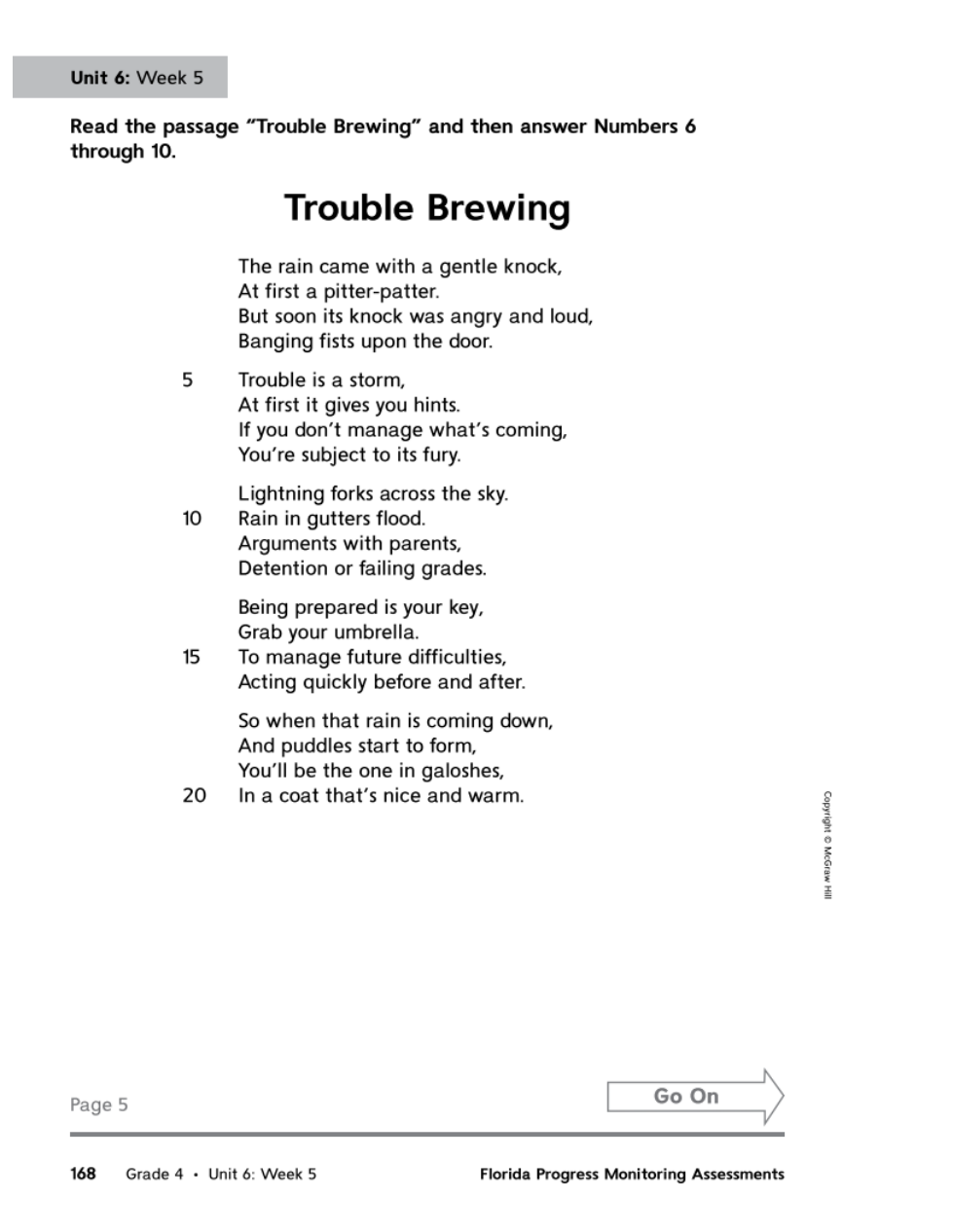
Read these lines from the poem.
"Trouble is a storm,
A first it gives you hints.
If you don't manage what's coming,
You are subject to its fury." (lines 5-8)
What does the metaphor "Trouble is a storm" mean?
Storm and trouble can come out of nowhere.
Like storms, people should avoid getting into trouble.
Trouble often starts small, but it can get out of control over time.
Storms can cause a lot of trouble, like damage, to people's property.
Question 10
10.
Which word from the stanza supports the answer in question 9?
"first"
"hints"
"manage"
"subject"
Question 11
11.
Read the lines from the passage.
"The rain came with a gentle knock,
At first a pitter-patter.
But soon its knock was angry and loud,
Banging fists upon the door." (lines 1-4)
What does the personification help readers understand?
It compares different types of rainstorms.
It shows how the harshness of the rain changes.
It explains that someone is knocking on the door.
It describes how people behave when they are upset.
Question 12
12.
Read the line from the passage.
"Being prepared is your key," (line 13)
What are
two
reasons the poet compares "Being prepared" to a "key"?
to describe how people can be more prepared.
to explain how the speaker feels about being unprepared.
to stress the dual meaning of the word "key" in the poem.
to show that the people should always have the right tools.
to suggest how being prepared is a way out of a bad situation.
Question 13
13.
Read the lines from the passage.
"Lightning forks across the sky.
Rain in gutters flood.
Arguments with parents,
Detention or failing grades." (Lines 9-12)
Which phrase is an example of imagery?
"Lightning forks"
"Across the sky"
"Arguments with parents"
"Failing grades"
Question 14
14.
Why does the poet use imagery in the stanza?
to compare the relationships families have with storms
to highlight how the poet feels about families and schools
to draw a parallel between parts of a storm and one's troubles
to describe how lightning and rain can cause problems at home