Log in
Sign up for FREE
arrow_back
Library

LT 2.4 Cell Transport Quiz

star
star
star
star
star
Last updated over 1 year ago
10 questions
Required
1
2.4a
Required
1
2.4a
Required
1
2.4a
Required
1
2.4a
Required
1
2.4a
Required
1
2.4c
Required
1
2.4c
Required
1
2.4c
Required
1
2.4c
Required
1
2.4c
Question 1
1.

Question 2
2.

Question 3
3.

Question 4
4.

Question 5
5.

Question 6
6.

Question 7
7.

Question 8
8.
Question 9
9.

Question 10
10.

A and B in the diagram below represent two different slide preparations of elodea leaves.  Elodea is a plant found in freshwater streams and ponds. Elodea cells normally contain 1% salt. The salt solution concentrations for A was 1% and B was 6%.
After the slides were prepared, a student using a compound light microscope to observe the cells in leaves A and B would most likely see:

Water had moved out of the cells of the leaf on slide B
Salt had moved out of the cells of the leaf on slide B
Water had moved out of the cells of the leaf on slide A
Salt had moved into the cells of the leaf on slide A
A person with swollen gums rinses his mouth with warm salt water, and the swelling decreases. Which of the following has occurred?
The water in the gums has moved out due to the high concentration of salt in the solution
The salt in the solution has moved against the concentration gradient
The swollen gums have absorbed the saltwater solution.
The saltwater solution lowers the temperature of the water in the gums
The cell membrane controls movement of materials into and out of the cell. A type of particle is moving from high concentration to low concentration and is using a carrier protein. How would you describe this type of movement across the membrane?
simple osmosis
active transport
facilitated diffusion
simple diffusion
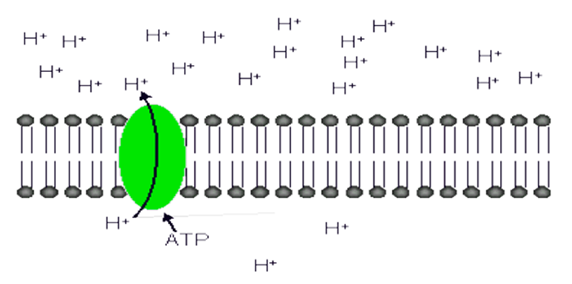
Look at the cross section of a cell membrane of a eukaryotic cell in which H+ ions are being pumped across the cell membrane.

How do you describe this type of transport across the cell membrane?
facilitated diffusion
active transport
passive transport
co-transport
Each shows a beaker containing a solution with various sugar concentrations. Small and permeable bags are placed in each of the beakers, each bag contains a 25% sugar solution. The bags remained in the beakers for 20 minutes before the mass of each bag was measured. Which bag should show the greatest change in mass?
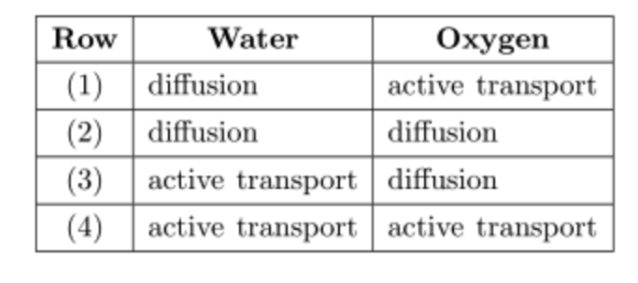
The diagram below represents a specialized cell located in the root of a plant.  The arrows in the diagram indicate the movement of molecules of oxygen and water into the cell. Which row in the chart correctly identifies the process responsible for the movement of each type of molecule represented in the diagram?


row 1
row 4
row 3
row 2
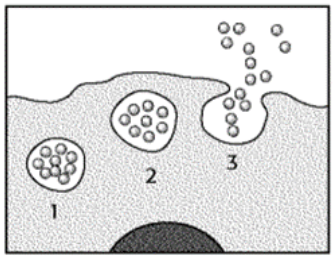
The illustration shows which process taking place?

Exocytosis
Endosymbiosis
Endocytosis
Symbiosis
endocytosis
diffusion
molecules move from low to high concentration
uses energy
osmosis
molecules move from high to low concentration
exocytosis
does not use energy
Passive Transport
Active Transport
Which diagram below represents the use of a protein pump?
A substance moving through a protein from high concentration to low concentration is _____________________________; whereas a substance moving through a protein from low concentration to high concentration is ________________. The biggest difference is the first ________________ while the second ______________.
active transport; facilitated diffusion. needs energy; does not need energy
active transport; facilitated diffusion. does not need energy; needs energy
facilitated diffusion; active transport. needs energy; does not need energy
facilitated diffusion; active transport. does not need energy; needs energy