Log in
Sign up for FREE
arrow_back
Library

5.0 Unit 5 Exam

star
star
star
star
star
Last updated over 1 year ago
25 questions
Note from the author:
3
3
3
3
3
3
3
3
3
3
3
3
3
3
3
3
3
3
3
5
20
5
5
https://www.desmos.com/scientific to use for calculations
Question 1
1.

Question 2
2.

Question 3
3.

Question 4
4.

Question 5
5.

Question 6
6.

Question 7
7.

Question 8
8.

Question 9
9.

Question 10
10.

Question 11
11.

Question 12
12.

Question 13
13.

Question 14
14.

Question 15
15.

Question 16
16.

Question 17
17.

Question 18
18.

Question 19
19.

4
4
Question 22
22.

You currently have $5,500 that you would plan to deposit into an investment account that has an anticipated growth factor of 1.032 per year. Use guess and check to estimate the number of years that it will take for this investment to grow to $10,000. Show your work.

Question 23
23.
You can model a particular stock investment using the formula $15000(1.07)^x where x represents the number of years that you have held your investment. Round to the nearest penny.
Years Invesement Balance
3 $_______
5 $_______
10 $_______
20 $_______

What was your total return on investment (ROI) after 20 years? _______ % (round to the nearest whole percent) Show your work (Screen shot Desmos) for full credit.
Question 24
24.
Alec’s portfolio includes a bond fund that has an average annual growth of 3.5% per year.  If he invests $165, what will his investment balance be after 25 years?_______ Show your work AND EQUATION USED (Desmos Screenshot) for full credit.
Question 25
25.
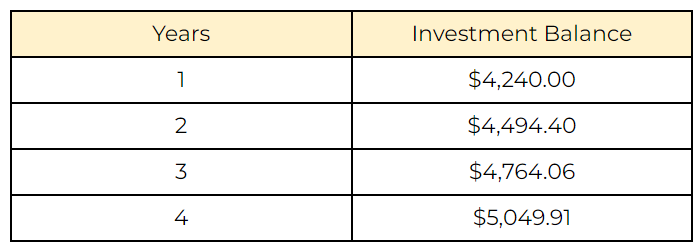
You modeled the growth of your investment using the following table.  What is the growth rate each year?_______ %

How can compounding increase your investment’s growth?
By reinvesting your earnings to gain additional returns
By reducing the risk of investing
By investing in different assets to diversify your portfolio
By increasing the impact of inflation over time
What statement accurately describes the historical trends of the stock market since its inception?
The value has gone up and down a lot, but overall has increased over time
The value has increased constantly and slowly since the stock market opened
The value increased a lot in its early days, but has since stayed relatively constant
The value has gone up and down a lot, but overall has decreased over time
If the one-day performance of Super Duper Stock shows a -11.4% return, what can you assume about the longer-term historical performance of their stock?
One-day returns are far too short a time frame to make any assessment about past or future performance of Super Duper
Historically, Super Duper must have been much more successful or their shares wouldn’t even be eligible to trade on the stock market
Super Duper has likely been struggling financially for months or even years
Share prices for Super Duper fluctuate regularly and and only high risk investors should have this company anywhere in their portfolio
If you want to maximize your investment returns, which of these suggestions would be the WORST advice?
Make frequent trades and withdraw your short-term earnings
Start to invest early for the long-term
Reinvest earnings
Use diversification and allocation to minimize risk
How does a bond differ from a stock in your investment portfolio?
Bonds typically have higher returns and lower risk than stocks
Bonds typically have lower returns and lower risk than stocks
Bonds typically have higher returns and higher risk than stocks
Bonds typically have lower returns and higher risk than stocks
When it comes to investing in the stock market, which of the following statements is TRUE?
There is little to no risk to investing in the stock market
It is easy to make money by timing the market to buy/sell stocks
t is better to wait until retirement age to begin investing in the stock market
The whole stock market value can go up even if some stock values go down
In 2018, Agatha set up a spreadsheet with a list of 10 stocks and 4 bond funds she’d just purchased for her investment portfolio. She recorded her purchase price per share and the number of shares she’d bought of each asset. She hasn’t bought or sold any shares since that day. She’s interested to know how much money she’d gain or lose if she sold all the shares today. What new data would she need in order to determine the return on investment for her entire portfolio?
The number of shares other investors have purchased over that same time frame
The price per share for each of her investments today
The total returns of the US stock market over that same time frame
The federal interest rate, minus inflation since the day she purchased the shares
What does it mean to have an investing portfolio that is diversified?
Investing in different assets to spread out the risk to different markets
Using a variety of sources to do research on what stocks to buy
Making sure that your investments are different from those of your friends and family
Never buying the same stock more than once
What is a dividend?
A dividend is the difference between the purchase price and selling price of a stock
A dividend is a payment a company makes periodically to owners of its stock
A dividend is a payment you make to keep a stock on loan from a company
A dividend is the tax you pay in order to buy and sell stocks
Which of the following is TRUE about investing?
It can help you grow your money through the power of compounding
It involves little risk because your returns are insured up to $250,000
It guarantees a high rate of return over a short period of time
It is meant for short-term needs like your emergency fund, not saving for retirement
Which of these terms regarding bonds is NOT correct?
Price: the cost of the bond if you were to purchase it in the market at that moment
Maturity: The recommended age a buyer should be when they purchase a given bond
Coupon Rate: the annual interest rate paid to the holder of the bond
Face Value: the value of the bond that will be paid out at the end of the bond’s life
Trevor has saved $500 in a savings account that earns 0.5% interest annually. What will most likely happen to the purchasing power of his savings over time?
His purchasing power will INCREASE because the interest rate is higher than the historical rate of inflation
His purchasing power will INCREASE because the interest will compound faster than the historical rate of inflation
His purchasing power will DECREASE because the interest rate is lower than the historical rate of inflation
His purchasing power will remain the SAME because the interest rate is the same as the historical rate of inflation
Colin is working to complete a spreadsheet to track his investment portfolio. Here’s where he’s gotten so far:
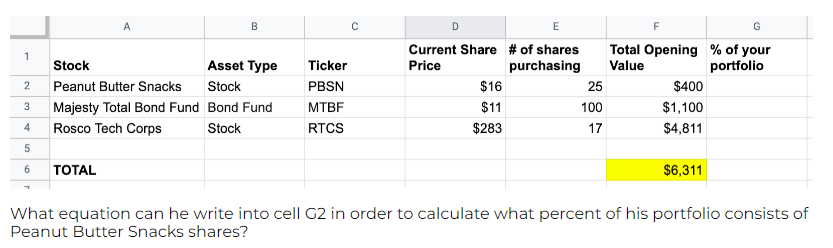
=E2/142*100
=(F6-F2)*100
=D2*E2/F2
=F2/F$6*100
Which of the following accurately describes the "bond see-saw"?
The value of bonds goes up and down all the time like a see-saw
When you buy bonds, their value decreases, and it increases when you sell them
If you buy more bonds, then you have to buy fewer stocks and vice versa
When interest rates rise, the value of bonds falls and vice versa
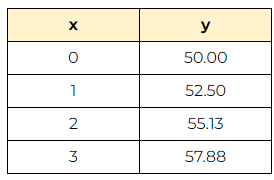
What is the growth factor of the function represented by this table? Note: y-values are rounded to two decimal places.

50
1.05
0.05
2.5
Emile has $300 to deposit in an investment account that will double every decade. How much money will Emile have in 3 decades?
$600
$1,200
$2,400
$3,600
You’ve set a goal of having $10,000 after 15 years. If you estimate that your investment account will have an average yearly growth factor of 1.09, which equation could be used to calculate how much you should invest today?
y = 10000(1.09)^15
y = 10000(0.09)^15
10000 = x(1.09)^15
10000 = x(0.09)^15
You work at a company as an accountant. You are calculating the value of the company’s assets after a 4% per year depreciation. If the initial value of the assets was $204,500 and it has been 5 years since they were purchased, what is the value of these assets today?
$196,320.00
$166,743.72
$212,680.00
$248,805.52
You model your investment account using the formula y = 20000(1.035)x where x represents the number of years and y represents the account balance after x years. What is the growth rate of your investment?
0.35%
3.5%
35%
350%
Question 20
20.

Question 21
21.

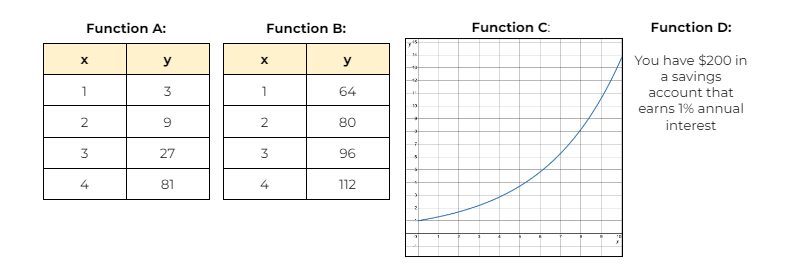
Identify whether each function is linear or exponential.
Linear
Exponential
Function A
Function B
Function C
Function D
Which function has the greatest growth factor? Justify your response in show your work.
A
B
C
D