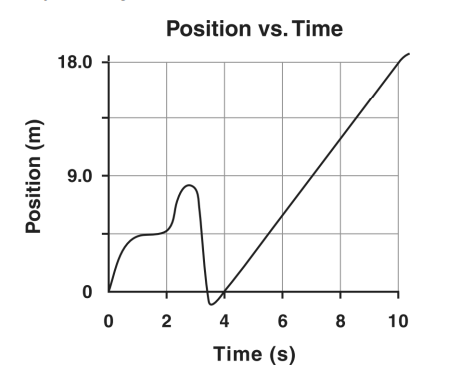
The graph shows how the position of an object changes over time. What is the velocity of the object during the time interval from 4 seconds to 10 seconds?
1 point
1
Question 2
2.
A student attempts to measure the mass of a brick by measuring the force required to accelerate it at 1 m/s2 on a level surface. The force required is 2 N, and the student concludes that the brick has a mass of 2 kg. A balance shows that the mass of the brick is really 1.5 kg. The experimental error is most likely due to
1 point
1
Question 3
3.
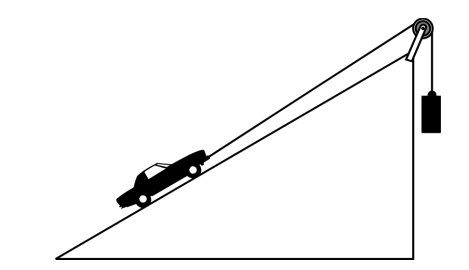
This diagram shows a ramp with a toy car at the bottom. A string is attached to the front of the car and the string goes over a pulley at the top of the ramp. A weight is attached to the other end of the string, and the car is pulled up the ramp. What is the relationship between the force of gravity on the weight and the force of tension on the weight?
Driving Home Newton's Laws of Motion
Automobiles, baseballs, skateboards and bicycles --the world is full of things that are in motion. Centuries ago the British physicist Sir Isaac Newton stated three laws that describe the ways in which things move. These are Newton's three laws of motion:
The first law: Unless acted upon by an outside force, a body at rest tends to stay at rest, and a body in motion tends to stay in motion.
The second law: Acceleration is equal to the net force acting on a body divided by its mass.
The third law: For every action force there is an equal and opposite reaction force.
A driver starts her car and steps on the gas pedal. The car gradually accelerates to 50 km/hr. A few minutes later, the driver suddenly slams on the brakes to avoid hitting a box in the road. As the car comes to a stop, the driver's body appears to lurch forward in the seat until it is restrained by the seatbelt.
1 point
1
Question 4
4.
What law best explains why the driver's body appears to lurch forward when the brakes are suddenly applied?
1 point
1
Question 5
5.
A student is driving her car when an insect strikes her windshield. Which of the following statements best describes the forces in this situation?
1 point
1
Question 6
6.
A ball is dropped from the top of a tall building. As the ball falls, the upward force of air resistance becomes equal to the downward pull of gravity. When these two forces become equal in magnitude, the ball will
1 point
1
Question 7
7.
A small stone is shot straight up in the air. The figure shows a plot of the stone's position vs. time (air resistance is ignored). When is the stone moving the fastest?
1 point
1
Question 8
8.
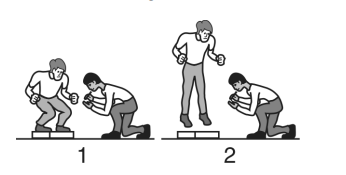
A student in a lab experiment jumps upward off a common bathroom scale as the lab partner records the scale reading. What does the lab partner observe during the instant the student pushes off?
1 point
1
Question 9
9.
When a 12-newton horizontal force is applied to a box on a horizontal tabletop, the box remains at rest. The force of friction acting on the box is
1 point
1
Question 10
10.
A skydiver with a mass of about 80 kg experiences air resistance equal to half his weight before he deploys his parachute. Which free body diagram best shows this situtation?
1 point
1
Question 11
11.
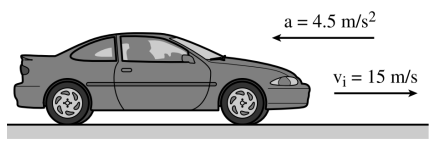
The illustration shows a car slowing down. The car was initially traveling at 15 m/s. The car slows with a negative acceleration of 4.5 m/s2 . How long does it take the car to slow to a final velocity of 4.0 m/s?
1 point
1
Question 12
12.
A 13-N east horizontal force acts in the same direction as a 6.4-kg block as it slides 2.5 m/s on a frictionless, horizontal surface for 2.1 s. What is the speed of the block after force is applied?
1 point
1
Question 13
13.
A student on roller skates throws a basketball forward. How does the momentum of the student on skates compare to the momentum of the basketball?
1 point
1
Question 14
14.
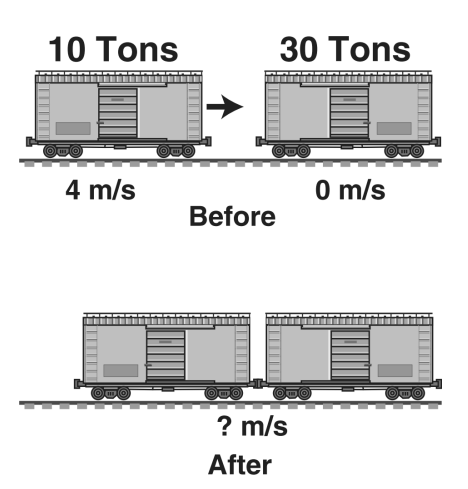
When these two freight cars of different mass collide and couple, what will be their resultant velocity?
1 point
1
Question 15
15.
A temporary force acting on a 2-kg object traveling at a velocity of 5 m/s causes the object to slow to a velocity of 2 m/s . What was the decrease in momentum of the object?
1 point
1
Question 16
16.
An air bag is used to safely decrease the momentum of a driver in a car accident. The air bag reduces the magnitude of the force acting on the driver by
1 point
1
Question 17
17.
Which situation will produce the greatest change of momentum for a 1.0-kilogram cart?
1 point
1
Question 18
18.
An object has a mass, m, and a velocity, v. Which change would make its momementum become one-fourth as much?
1 point
1
Question 19
19.
A 0.025 kg bullet is fired from a rifle by an un balanced force of 200 N. If the force acts on the bullet for 0.1 sec, what is the maximum speed attained by the bullet?
1 point
1
Question 20
20.
A constant braking force of 10 N applied for 5 seconds is used to stop a 2.5 kg cart traveling as 20 m/s. What is the magnitude of the impulse applied to the cart?