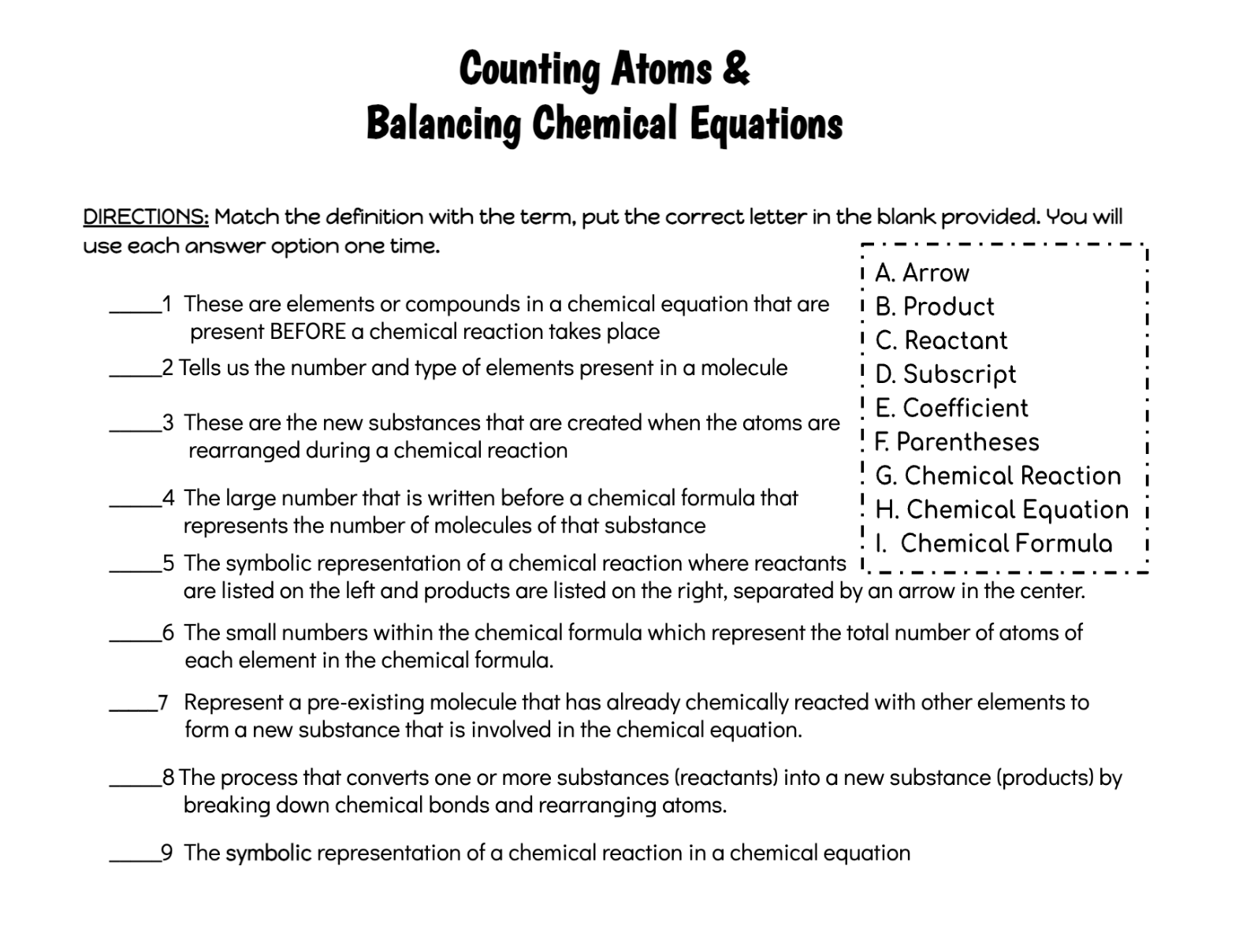
Ɛhia
1
Ɛhia
1
Ɛhia
1
Ɛhia
1
Ɛhia
1
Ɛhia
1
Ɛhia
1
Ɛhia
1
Ɛhia
1
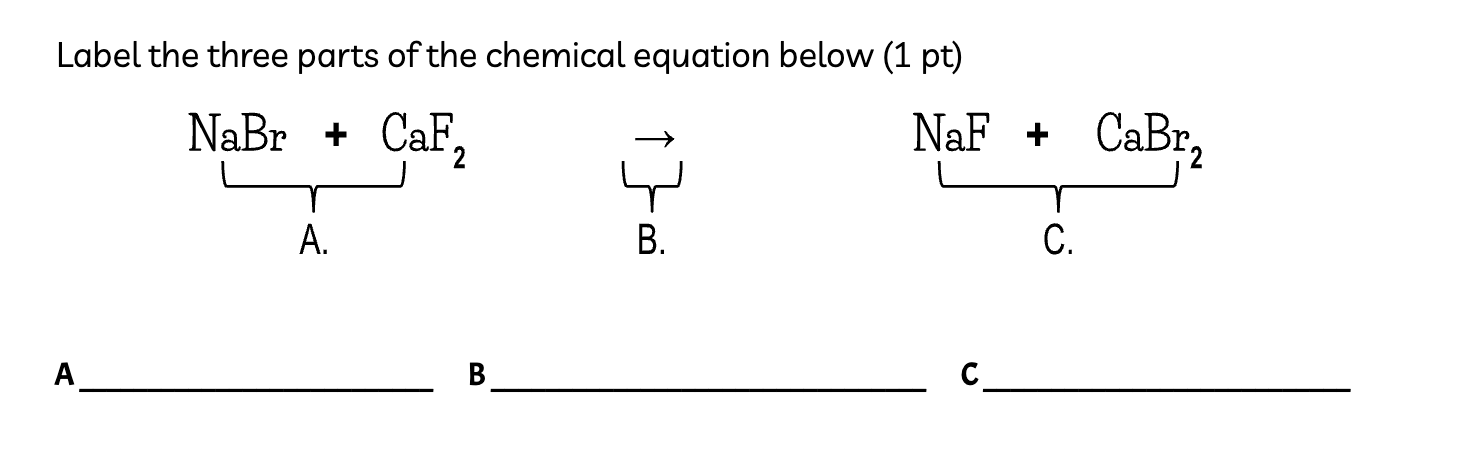
This part of the chemical equation is called the
The arrow in part B symbolizes that a
The right side of the chemical equation is called the
In a chemical formula, such as 3C(H2O)4 , atoms inside the parentheses represent pre-existing molecule(s) of H2O that bonded with carbon.
In the chemical formula 3C(H2O)4 ,
4 is the coefficient
The chemical formula for Sucrose (which is a sugar molecule) is C12H22O11.
What does the "3" at the beginning of the chemical formula tell us? 3C12H22O11
COUNTING ATOMS: Answer the next 4 questions below for the chemical equation
Total number of atoms on the PRODUCT side of the equation above

Total number of Hydrogen atoms on the reactant side of the equation above

How many pre-existing molecules of (OH) did Lead (Pb) bond to?
The law of conservation of matter states that
" Matter be or . It can only

Deposition is caused by a rapid in thermal energy.
Which is the most dense state of matter (density refers to how tightly the particles are packed.
Put the state of matter in order from greatest to least based on the Kinetic Energy Levels.
HINT: Put the state of matter with the greatest amount of kinetic energy on top, then the next highest underneath it, and so on..
Liquid
Solid
Plasma
Gas
Which phase of matter has the following properties:
- Volume/Shape changes to FILL its container
- widely spaced particles that zoom around at high speed
Which phase of matter has the following properties:
- Fixed Volume
- Fixed Shape
- No space between the particles
- Particles vibrate in a fixed position
Which phase change is dew (found on the grass in the morning) an example of?

Which phase change is steam an example of?

Which phase change is dry ice an example of?

Dry Ice is frozen/super-cooled carbon dioxide that instantly turns into a gas when it comes into contact with room temperatures
Which phase change occurs when heat enters a liquid and the particles start to move quickly until they are spaced far apart and moving freely,
This phase change occurs when a solid is exposed to enough heat and/or the pressure is decreased so that the particles spread out enough to begin to slide past each other at a moderate speed.
Which phase change is frost an example of?

All is made up of that are in . The of the particle's and the amount of between them will determine the substance's
The word motion is listed twice.
**Make sure you use the "Motion(1)" option BEFORE you use "Motion(2)" in the phrase above. Otherwise, it will count it wrong.
Type the letter representing the correct answer in the blank.
ONLY TYPE THE CAPITAL LETTER
Type the letter representing the correct answer in the blank.
ONLY TYPE THE CAPITAL LETTER
Type the letter representing the correct answer in the blank.
ONLY TYPE THE CAPITAL LETTER
Type the letter representing the correct answer in the blank.
ONLY TYPE THE CAPITAL LETTER
Type the letter representing the correct answer in the blank.
ONLY TYPE THE CAPITAL LETTER
Type the letter representing the correct answer in the blank.
ONLY TYPE THE CAPITAL LETTER
Type the letter representing the correct answer in the blank.
ONLY TYPE THE CAPITAL LETTER
Type the letter representing the correct answer in the blank.
ONLY TYPE THE CAPITAL LETTER
Type the letter representing the correct answer in the blank.
ONLY TYPE THE CAPITAL LETTER
Arrow #20 - Solid to liquid phase change _________
Arrow #21 - liquid to gas phase change
Arrow #22 - solid to gas phase change
Arrow #23 - gas to liquid phase change
Arrow #24 - liquid to solid phase change
Arrow #25 - gas to solid phase change