Please round numeric answers to the nearest 2 decimal place.
1 point
1
Question 1
1.
How many gallons of FR is pumped on a substage that lasted 10 mins with a proppant concentration of 1.25 ppg, an average rate of 80 bpm, and an FR loading setpoint of 0.65 gpt?
1 point
1
Question 2
2.
Assuming a steady rate of 56 bpm, determine the loading setpoint of each chemical if the following volumes were pumped in 3.5 mins period.
FR: 6.5 gal
Surf: 2.3 gal
Clay Stabilizer: 0.9 gal
1 point
1
Question 3
3.
Find the chemical rates (gal/min) for the following substages assuming the slurry rate is constant at 80 bpm and chemical loading is 1.00 gal/1000.
(1) West TX 100 mesh at 1.0 ppg
(2) West TX 40/70 at 1.50 ppg
1 point
1
Question 4
4.
Determine the flowrates (gal/min) of the following chemicals with their respective loading setpoints, assuming the clean rate is constant at 65 bpm
FR: 0.75 gpt
Surf: 0.5 gpt
Scale: 0.15 gpt
1 point
1
Question 5
5.
A customer has 318 gal of FR on location for the 95 bpm (clean rate) stage design that is expected to last 1.2 hours. Assuming a perfect stage, what loading (gpt) would you recommend the customer to run the FR at to use all the FR?
1 point
1
Question 6
6.
What should the RPMs of each of the 3 screws be if we have a slurry rate of 110 bpm with a concentration of 2.00 ppg? Treater is running his PPRs at 28 lbs/rev.
Assuming the 3 screws are set to be running at the same RPM.
1 point
1
Question 7
7.
What should the treater set his PPR at if the auger (assuming perfect shape) has a diameter of 7-in and a pitch of 12-in?
1 point
1
Question 8
8.
What is the maximum rate (bpm) that can be pumped if there are 3 iron lines going to the wellhead? ID of iron pipes is 3.97-in
1 point
1
Question 9
9.
We are setting up a job that has max rate of 105 bpm and max sand concentration of 2.00 ppg. There will be 2 blenders, how many discharge and suction hose will be needed. Assuming 2 extra hoses for each.
1 point
1
Question 10
10.
The HHP is estimated to be 15,000 hhp. The well has TVD of 4,000 ft and we are pumping freshwater on pad. The BHTP is estimated to be 8,000 psi. What is the rate (bpm)?
1 point
1
Question 11
11.
What # gel system would have if gel loading setpoint is 3.75 gpt?
1 point
1
Question 12
12.
What should the loading setpoint (gpt) be if the design calls for a 20# gel system?
1 point
1
Question 13
13.
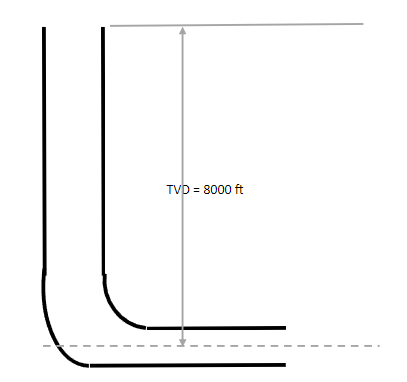
We just staged up from 1.75 ppg to 2.00 ppg sand 30 seconds ago, the rate remains constant at 110 bpm. Assume we are using produced water with SG of 1.007, casing type is 17# J-55 (CCF: 0.0232). Find the hydrostatic pressure (psi) at TVD of 8000 ft.
1 point
1
Question 14
14.
When the treater cuts 2.00 ppg sand to go on flush, do you expect to see surface pressure (STP) increase or decrease initially?
How much pressure change should you expect on flush if your TVD is 8500 ft?
Assuming the change in BHTP is negligible.
1 point
1
Question 15
15.
Given the perforation interval [top, bottom] = [5600, 5800] ft, and ISIP = 2300 psi, what is the frac gradient? Use mid-perf for this calculation.
1 point
1
Question 16
16.
If you have a BHP of 8,982 psi, a TVD of 9,658 ft, and a frac gradient of 0.93. What is the ISIP (psi)?
1 point
1
Question 17
17.
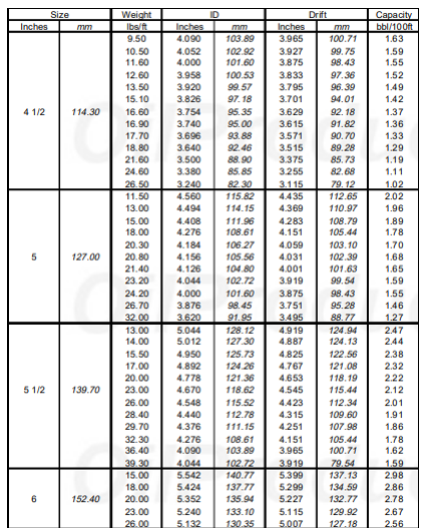
Find flush volume needed to bottom perf (no overflush) if the first 8,290' is using #20 5.50" casing. Then from 8,290' to 12,677' the #21.60 4.50" casing is used.
The bottom perforation for Stage 4 is 12,030'.
1 point
1
Question 18
18.
What is the bottom hole pressure if you are on 1.75 ppg and the pressure measured at the wellhead is currently at 8,788 psi? TVD of the well is 9,647 ft.
1 point
1
Question 19
19.
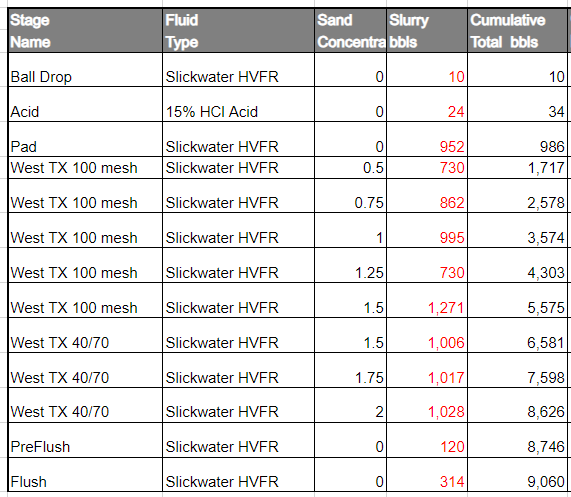
Given the following table, find stage proppant pumped during {West TX 100 mesh, 1.25 ppg} step.
1 point
1
Question 20
20.
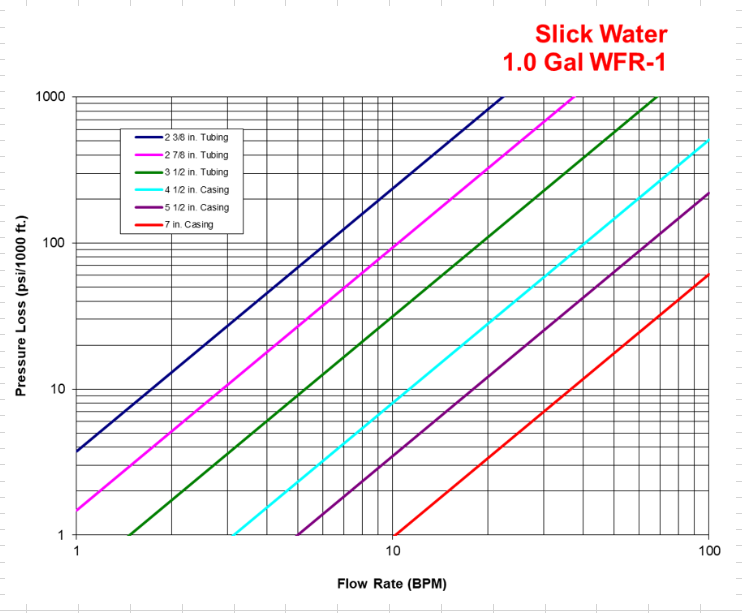
Given the following figure, what is the friction pressure at 100 bpm in 4.5in casing with TVD of 6,147 ft?
1 point
1
Question 21
21.
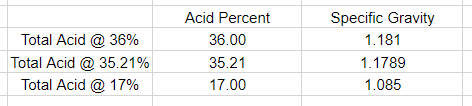
If we order 8,000 gal of 35.21% HCl acid, and dilute it to 17%, how many gals of 17% HCl do we have?
1 point
1
Question 22
22.
If we need 10,000 gal of 15% HCl to finish the job, how many bbls of water do you need to order to dilute the needed amount of 35.21% HCl to make the solution?
1 point
1
Question 23
23.
What is the difference between Pressure A and Pressure B?
1 point
1
Question 24
24.
Which iron rating is needed for a job that calls for 10,500 psi max treating pressure?
1 point
1
Question 25
25.
What is the size of a standard plastic chemical tote?
1 point
1
Question 26
26.
What is the conversion factor used at AST for converting cu.ft to lbs capacity on our sand kings?
1 point
1
Question 27
27.
How do you get straps when using sand kings?
1 point
1
Question 28
28.
How many compartments do AST sand kings normally have?
1 point
1
Question 29
29.
There are 2 sand kings rigged up for a job, how do you label these best to communicate with the treater?
1 point
1
Question 30
30.
Briefly explain what the PPR is.
Can the PPR be changed physically?
Why do treater discuss changing PPR when he needs to adjust how to run sand?
1 point
1
Question 31
31.
What are the two engines on a frac blender? What are the main functions?
1 point
1
Question 32
32.
What equipment is used to measure sand concentration at the blender? Where is this equipment measuring the sand concentration at?
1 point
1
Question 33
33.
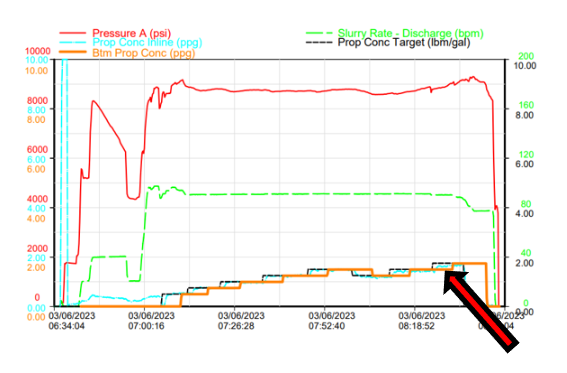
Why would the inline be lower than target at this point (at the Red arrow)?
1 point
1
Question 34
34.
When strapping chemical from a standard plastic tote, 1 inch is corresponding how many gallons?
1 point
1
Question 35
35.
What does it mean when a pump has lost its prime?
1 point
1
Question 36
36.
Which of the following best describes the process of cavitation?
1 point
1
Question 37
37.
Which one is the correct lubricant type for frac pump plunger at AST?
1 point
1
Question 38
38.
Please put the following in the correct installation order of a packing?
Brass ring
Two pressure ring
Latern ring
Header ring
1 point
1
Question 39
39.
What should the slurry flow rate be set at in order to fill up a 1 gallon bucket in 1 minute with a chemical setpoint of 1 gpt, when calibrated correctly?
1 point
1
Question 40
40.
Which of the following best describes the cause of a discharge hose sanding off?
1 point
1
Question 41
41.
What typically causes circular cracks to form around the threaded areas on the front face of fluid ends?
1 point
1
Question 42
42.
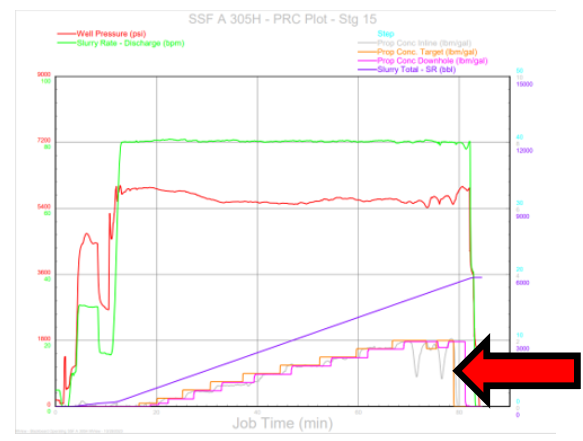
What part of operations could cause a drop in the inline such as in the plot below?
1 point
1
Question 43
43.
What does a high decay rate of a water hammer pressure pulse often indicate about a hydraulically fractured well?
1 point
1
Question 44
44.
What is the most likely cause of a washout occurring behind or underneath a valve seat?
1 point
1
Question 45
45.
Why would a gel fluid system typically have higher friction pressure than a non-gel system at the same flow rate?
1 point
1
Question 46
46.
What are the two main reasons companies choose to use produced water over freshwater for hydraulic fracturing? Choose the best answer
1 point
1
Question 47
47.
Why is it important to flush equipment that handles produced water?
1 point
1
Question 48
48.
When is ISIP typically measured during a hydraulic fracturing operation?
1 point
1
Question 49
49.
Why does shutting down pumps after hydraulic fracturing allow measurement of Instantaneous Shut-In Pressure (ISIP)?
1 point
1
Question 50
50.
What are the three main purposes of fracturing fluid during a hydraulic fracturing operation?
1 point
1
Question 51
51.
What are the three main categories of biocides used in hydraulic fracturing fluids?
1 point
1
Question 52
52.
What causes a pressure drop when there is formation breakdown?
1 point
1
Question 53
53.
How does acid breakdown differ from hydraulic formation breakdown?
1 point
1
Question 54
54.
What directly causes the pressure drop seen during acid breakdown?
1 point
1
Question 55
55.
What are the three main types of polymeric friction reducers used in hydraulic fracturing?
1 point
1
Question 56
56.
Which type of friction reducer typically performs better under high total dissolved solids (TDS) conditions in hydraulic fracturing operations?
1 point
1
Question 57
57.
Which of the following statements is true when compares anionic and cationic friction reducers?
1 point
1
Question 58
58.
What is the primary difference in size between nano surfactants and micro surfactants?
1 point
1
Question 59
59.
What effect do surfactants have on liquids when added?
1 point
1
Question 60
60.
Which of the following describes the impact of surfactants on fluid behavior?
1 point
1
Question 61
61.
What action is advised after maintaining the pumping rate for at least 5 minutes in a step-down test?
1 point
1
Question 62
62.
Which parameter is recommended to be plotted against the rate after the steps down to 0 bpm in step-down test?
1 point
1
Question 63
63.
In the context of a step-down test, what does a concave down friction pressure plot indicate about the friction pressure profile?
1 point
1
Question 64
64.
In the context of the step-down test, what type of friction is indicated when the friction pressure plot has upward concavity?
1 point
1
Question 65
65.
In the context of a step-down test, what information can be derived from analyzing the shape of a graph depicting friction pressure?
1 point
1
Question 66
66.
What is the primary objective of conducting a step-down test?
1 point
1
Question 67
67.
How does the step-down test contribute to understanding near-wellbore friction?
1 point
1
Question 68
68.
Which frictional type does the step-down test primarily aim to distinguish between?
1 point
1
Question 69
69.
How are pumping rates increased during a step-up test?
1 point
1
Question 70
70.
What is the fundamental procedure involved in a step-up test during wellbore operations?
1 point
1
Question 71
71.
How is each step managed in a step-up test scenario?
1 point
1
Question 72
72.
What is the key outcome sought after conducting a step-up test?
1 point
1
Question 73
73.
Why is it essential to hold each step until pressure equalizes during a step-up test?
1 point
1
Question 74
74.
What is the primary objective behind conducting step-up tests in hydraulic fracturing operations?
1 point
1
Question 75
75.
What can be found at the point where the slope decreases on the graph obtained from a step-up test?
1 point
1
Question 76
76.
At which stage of a step-up test is the fracture extension pressure observed on the graph?
1 point
1
Question 77
77.
What crucial event does the fracture extension pressure represent in hydraulic fracturing?
1 point
1
Question 78
78.
What is the initial step in conducting a minifrac test in hydraulic fracturing operations?
1 point
1
Question 79
79.
During a minifrac test, what action follows after reaching the designed rate with the frac fluid?
1 point
1
Question 80
80.
What purpose do the sand slugs serve during a minifrac test?
1 point
1
Question 81
81.
How does acid fracking differ from proppant fracking?
1 point
1
Question 82
82.
In acid fracking, what is the role of the acid in the formation?
1 point
1
Question 83
83.
What is the main objective of using acid etching in the acid fracking process?
1 point
1
Question 84
84.
What are the primary classifications of proppants used in hydraulic fracturing?
1 point
1
Question 85
85.
What distinguishes man-made ceramic/bauxite proppants from naturally occurring sands?
1 point
1
Question 86
86.
Why might engineers prefer ceramic or bauxite proppants in certain fracturing operations?
1 point
1
Question 87
87.
What drove the innovation and development of resin-coated proppants?
1 point
1
Question 88
88.
What is the primary purpose of the resin coatings applied to proppants?
1 point
1
Question 89
89.
How do resin-coated proppants typically perform in comparison to uncoated proppants under elevated confining stress?
1 point
1
Question 90
90.
Besides enhancing strength, what additional benefit do resin-coated proppants offer?
1 point
1
Question 91
91.
What problem does resin coating specifically address in sand proppants?
1 point
1
Question 92
92.
To increase the burning rate of sand in a screw conveyor, what should be done to the PPR (pounds per revolution)?
1 point
1
Question 93
93.
Which of the following statements is true about the relationship between PPR and RPM in a screw conveyor?
1 point
1
Question 94
94.
What is the effect of reducing PPR when sand burning is required?
1 point
1
Question 95
95.
What is the primary purpose of decreasing/increasing PPR parameter?
1 point
1
Question 96
96.
What is the common SG (specific gravity) of frac proppant?
1 point
1
Question 97
97.
Which characteristic of proppant grain size is most relevant to fracture conductivity?
1 point
1
Question 98
98.
How does proppant grain size selection differ for tighter formations compared to more permeable formations?
1 point
1
Question 99
99.
What is the primary method for measuring and characterizing proppant grain size?
1 point
1
Question 100
100.
What is the primary reason why proppant bulk density is an important parameter in hydraulic fracturing?
1 point
1
Question 101
101.
Which factors typically influence the bulk density of proppant?
1 point
1
Question 102
102.
Why are smaller grained sands often pumped first in hydraulic fracturing?
1 point
1
Question 103
103.
Which property of smaller grained sands makes them more suitable for penetrating narrow fractures?
1 point
1
Question 104
104.
What does it mean to "ball out"?
1 point
1
Question 105
105.
How much time (hours) does it take to empty a full silo?
Assuming 75 mins cycle time, each stage calls for 120000 lbs of 100 mesh and 120000 lbs of 40/70, an average truck load is 47500 lbs and 8 loads per silo.
1 point
1
Question 106
106.
You are pumping 300,000 lbs stages (150,000 lbs 100 Mesh, 150,000 lbs of 40/70). Cycle time of 1.5 hours and silos both start at 98%.
Determine:
a. Silo percentage after 2 stages
b. Projected sand weight in each silo after 2 stages
c. Time duration to empty silos (hours)
1 point
1
Question 107
107.
What are the well-specific changes that need to be manually inputted after importing the .inp files? (Circle all that apply)
1 point
1
Question 108
108.
What is the general FIELDPRO setup workflow?
1 point
1
Question 109
109.
Which of the following eFieldPro dashboards AST field engineer use to check whether frac plots and chems & sand straps are uploaded correctly?
1 point
1
Question 110
110.
What is the key significance of having an updated Data 2 tab?
1 point
1
Question 111
111.
For jobs with Sand Kings, what additional tab needs to be filled out?
1 point
1
Question 112
112.
At the end of the job, on what documents should the total sand used be the same?
1 point
1
Question 113
113.
Describe the difference between slickwater and gel fracs.
1 point
1
Question 114
114.
When should you schedule ISO pickup?
1 point
1
Question 115
115.
Which of the following must be done when ending a job? Select all that applies?
1 point
1
Question 116
116.
According to engineering SOP, when should field engineers have the job folder uploaded to the AST's company drive?
1 point
1
Question 117
117.
Why is it important equalize the line before opening the well to frac?
1 point
1
Question 118
118.
Where is a check valve located on a frac pump? What is the purpose?
1 point
1
Question 119
119.
What are the potential consequences of a malfunctioning check valve on a frac pump?
1 point
1
Question 120
120.
How many pressure transducers can be found on the fluid end of a frac pump
1 point
1
Question 121
121.
In Channel Identification, where should you import the CID file from?