6.1 Investing in Funds

Last updated 10 months ago
17 questions
Note from the author:
OBJECTIVES & STANDARDS
Math Objectives
  • Write exponential functions that model the growth of investments
  • Recognize how fees impact the growth rate of an exponential investing model
Common Core Math Standards
  • Link to all CCSS Math
  • CCSS.HSF.IF.C.8.B
  • CCSS.HSF.LE.A.1.B
  • CCSS.HSF.LE.A.2
Personal Finance Objectives
  • Simulate how overall returns vary depending on whether your portfolio contains one, a few, or many investments
  • Explain how a mutual fund investment works
  • Differentiate between active and passive investing
National Standards for Personal Financial Education
Investing
  • 1b: Discuss how a person’s risk tolerance influences their investment decisions
  • 6b: Discuss the pros and cons of investing in a diversified mutual fund versus investing in a small number of individual stocks
  • 7a: Discuss how the expenses associated with buying and selling investments can impact rates of return and investment outcomes
  • 7c: Explain why an actively managed mutual fund usually has a higher expense ratio than an index fund
  • 13a: Explain why investors often compare portfolio performance to a benchmark such as the S&P 500 Index
  • 13b: Research the composition of the most popular benchmark indices and compare their recent performance
  • 13c: Discuss the advantages of investing in an exchange traded fund (ETF) that tracks a market index rather than investing in actively managed mutual funds or individual stocks and bonds
DISTRIBUTION & PLANNING
Distribute to students
  • Student Activity Packet
OBJECTIVES & STANDARDS
Math Objectives
  • Write exponential functions that model the growth of investments
  • Recognize how fees impact the growth rate of an exponential investing model
Common Core Math Standards
  • Link to all CCSS Math
  • CCSS.HSF.IF.C.8.B
  • CCSS.HSF.LE.A.1.B
  • CCSS.HSF.LE.A.2
Personal Finance Objectives
  • Simulate how overall returns vary depending on whether your portfolio contains one, a few, or many investments
  • Explain how a mutual fund investment works
  • Differentiate between active and passive investing
National Standards for Personal Financial Education
Investing
  • 1b: Discuss how a person’s risk tolerance influences their investment decisions
  • 6b: Discuss the pros and cons of investing in a diversified mutual fund versus investing in a small number of individual stocks
  • 7a: Discuss how the expenses associated with buying and selling investments can impact rates of return and investment outcomes
  • 7c: Explain why an actively managed mutual fund usually has a higher expense ratio than an index fund
  • 13a: Explain why investors often compare portfolio performance to a benchmark such as the S&P 500 Index
  • 13b: Research the composition of the most popular benchmark indices and compare their recent performance
  • 13c: Discuss the advantages of investing in an exchange traded fund (ETF) that tracks a market index rather than investing in actively managed mutual funds or individual stocks and bonds
DISTRIBUTION & PLANNING
Distribute to students
  • Student Activity Packet
Intro/Warm-Up
COMPARE: Jelly Bean Options
Let’s assume you LOVE these JellyBelly flavors: Sour Apple and Juicy Pear. And you HATE these JellyBelly flavors: Buttered Popcorn, Top Banana, Very Cherry, and Sizzling Cinnamon. You’re indifferent to the other flavors. I’ve got a huge jar and make you a deal that you can have some for free, but you have to agree to eat all the ones you grab. Would you rather choose 1, 10, 20, or 50 jelly beans? Why?
1

Would you rather choose 1, 10, 20, or 50 jelly beans? Why?

1

Pretend you select 10 jelly beans and you get one Juicy Pear, nine random jelly beans, and none of the ones you hate. I offer that you can choose again. How many would you select – 0, 1, 10, 20, or 50 jelly beans? Why?

1

Given you have to eat all the jelly beans you take, how worried are you about the flavors you hate?

Explore It
ACTIVITY: MOVE: Let’s Make a Mutual Fund
We’ll come back to the jelly beans in a minute. In the meantime, follow your teacher’s instructions to complete this activity about stocks. Then, answer the reflection question.
1

What does choosing a mutual fund have in common with choosing my 50-JellyBelly offer?

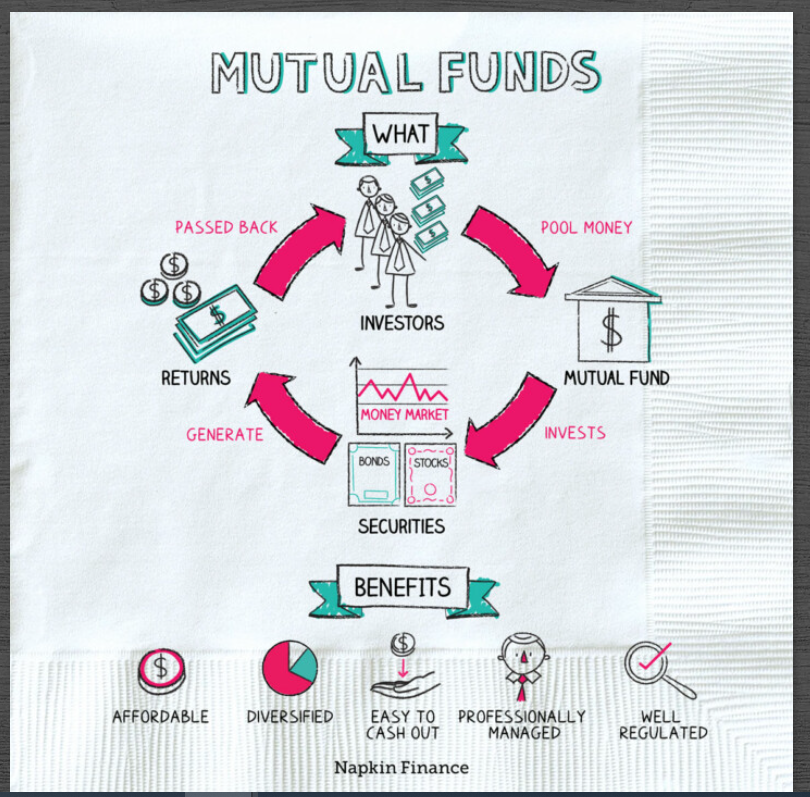
ARTICLE: Mutual Funds | Napkin Finance
Review the napkin illustration at the top of the page, and then read the article underneath, stopping after the “Drawbacks” portion.
6
Using the provided word bank, fill in the blanks with an appropriate word or phrase for this paragraph:
As an investor, you can buy shares in a mutual fund by using an online _______ or a financial _______ . Your investment is pooled with other investors’ money, and the fund buys a _______ . The fund’s investments are selected by a _______ , who tries to forecast and pick the most profitable stocks, bonds, or other assets for inclusion. You earn money through _______ , interest, or gains, and you can either cash-out or
_______ those earnings.
Word Bank:
advisor
broker
dividends
manager
portfolio of investments
reinvest
1

Now that you’ve read the benefits and the drawbacks, do you think you would make mutual funds part of your investment strategy? Why or why not?

FINCAP FRIDAY: When the Mean Is Nice
One type of mutual fund is an index fund. As your teacher progresses through the slides, answer these questions, just writing A, B, C, or D for questions 1-5.
1
One type of mutual fund is an index fund. As your teacher progresses through the slides, answer these questions, just writing A, B, C, or D for questions 1-5.
  1. Question 1:_______
  2. Question 2:_______
  3. Question 3:_______
  4. Question 4:_______
  5. Question 5:_______
1

How does an index fund differ from an actively managed mutual fund?

INTERACTIVE: FinViz S&P 500 Map
This map shows every single company in the S&P 500, a popular index of the US’s largest 500 publicly traded companies, divided here into sectors. Hovering over a rectangle will show you the company’s name as well as a list of the other companies in that sector.
1

What does the size of each rectangle represent? *Hint: The answer is ON the interactive’s screen near the top.

1

What does the color and shading of each rectangle represent? *Hint: The answer is ON the interactive’s screen near the bottom.

1

On the left side of the screen under “MAP FILTER” cycle through each available time frame – 1 Day, 1 Week, 1 Month, and so on. Typically, sound investing advice says you should invest and then hold onto your investments for a long time, rather than buying and selling often. What specific data from this interactive supports that strategy?

1

Sound investing advice also recommends you create a diversified portfolio. Buying an index fund, such as one tracked to the S&P 500, is one way to diversify. What specific data from this interactive supports the idea that a fund with all 500 of these companies is better than selecting just a few?

VIDEO: What is Active and Passive Investing?
In the investing world, you’ll hear about active versus passive investing. But what do those two terms mean? Watch the video to find out.
1

Complete the Table in the Drawing AND on your Paper.

1

Form a hypothesis: When using active investing, how does a 2% fee become FAR LARGER than a 2% loss of your earnings?

DESMOS: The Impact of Investing Fees on Exponential Growth
Many funds have fees, and it's important to understand those fees before investing. Follow your teacher’s instructions to complete this Desmos activity.
Exit Ticket
1

The individual assets contained in an actively mutual fund are selected by…
1. The pool of investors
2. The investor who owns the most shares of the fund
3. An automated computer program
4. A professional fund manager

1

Which is the best description of an index fund?
1. A mutual fund that tracks the performance of a specific market benchmark
2. A retirement fund for employees over age 50
3. An index made up exclusively of government bonds
4. A safe investment product that guarantees a high rate of return

1

One downside of active investing is that…
1. You must have a license, certification, or college degree to make these types of investments
2. You must buy and sell each day in order for it to work correctly
3. You are paying a fund manager who charges fees that will eat into your potential returns
4. You cannot diversify your portfolio using this strategy