6.2 Types of Funds
star
star
star
star
star
Last updated 10 months ago
21 questions
Note from the author:
OBJECTIVES & STANDARDS
Math Objectives
- Write and solve exponential functions using function notation
- Use exponential functions to analyze the long-term impact of investing fees
Common Core Math Standards
- Link to all CCSS Math
- CCSS.HSF.LE.A.2
- CCSS.HSF.LE.B.5
Personal Finance Objectives
- Identify different types of funds, including ETFs and TDFs
- Consider the advantages and disadvantages of investing with robo-advisors
- Analyze how an investor shifts their portfolio allocation over time
National Standards for Personal Financial Education
Investing
- 6d: Explain how target date retirement funds reallocate investments over time to meet their investment objective
- 7a: Discuss how the expenses associated with buying and selling investments can impact rates of return and investment outcomes
- 11a: Discuss how the development of financial technology has made it easier for people of all income and education levels to participate in financial markets
- 11c: Identify the advantages and disadvantages of robo advising and other investment-related financial technologies
- 13c: Discuss the advantages of investing in an exchange traded fund (ETF) that tracks a market index rather than investing in actively managed mutual funds or individual stocks and bonds
DISTRIBUTION & PLANNING
Distribute to students
- Student Activity Packet
- Scavenger Hunt Cards
OBJECTIVES & STANDARDS
Math Objectives
- Write and solve exponential functions using function notation
- Use exponential functions to analyze the long-term impact of investing fees
Common Core Math Standards
- Link to all CCSS Math
- CCSS.HSF.LE.A.2
- CCSS.HSF.LE.B.5
Personal Finance Objectives
- Identify different types of funds, including ETFs and TDFs
- Consider the advantages and disadvantages of investing with robo-advisors
- Analyze how an investor shifts their portfolio allocation over time
National Standards for Personal Financial Education
Investing
- 6d: Explain how target date retirement funds reallocate investments over time to meet their investment objective
- 7a: Discuss how the expenses associated with buying and selling investments can impact rates of return and investment outcomes
- 11a: Discuss how the development of financial technology has made it easier for people of all income and education levels to participate in financial markets
- 11c: Identify the advantages and disadvantages of robo advising and other investment-related financial technologies
- 13c: Discuss the advantages of investing in an exchange traded fund (ETF) that tracks a market index rather than investing in actively managed mutual funds or individual stocks and bonds
DISTRIBUTION & PLANNING
Distribute to students
- Student Activity Packet
- Scavenger Hunt Cards
Intro/Warm-Up
QUESTION OF THE DAY: Over a recent 20 year period, what percent of pros investing in large companies "beat the market?"
Write your answer to the question below. Then, compare your answer to the answer on the second slide.
2
Over a recent 20 year period, what percent of pros investing in large companies "beat the market?"
Your guess:_______
Answer (from 2nd slide): _______ %
Learn It
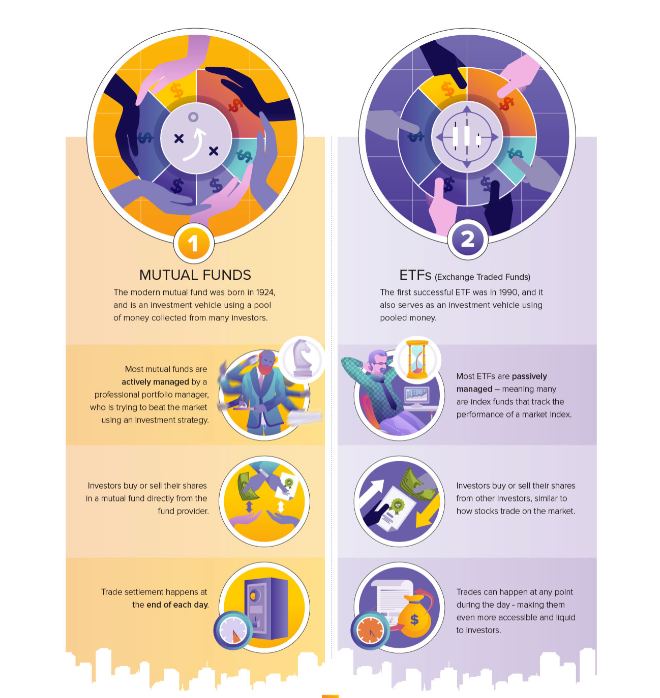
NFOGRAPHIC: The Difference Between Mutual Funds and ETFs
You’ve learned about mutual funds and index funds, now let's learn about another investment vehicle: exchange-traded funds (ETFs). Like a mutual fund, an ETF pools together different investments, but there are a few key differences. Examine the infographic and answer the questions.
1
Identify whether each of the following statements describes a mutual fund (M) or ETF (E). Circle or highlight your answers. Be careful - some statements may describe both or neither!
3
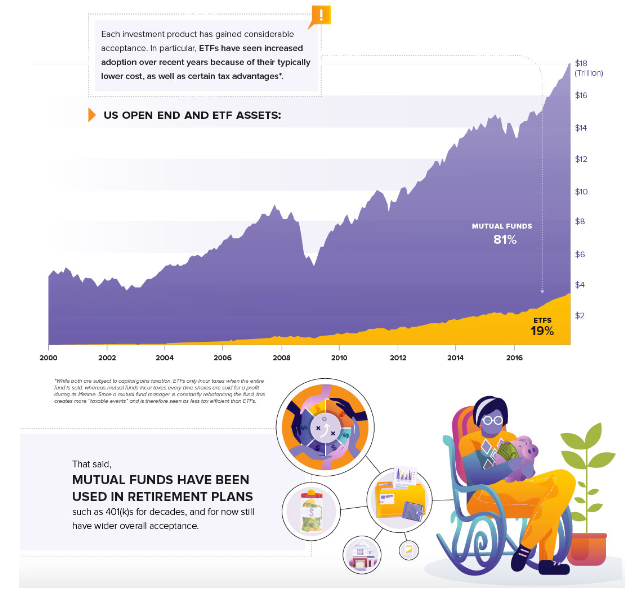
In 2002, there was $102 billion under management by ETFs in the US. ETF assets have grown approximately 25% annually since then.
a. Write a function f(x) to model the predicted value of ETF assets, in billions of dollars, after x years._______
b. What is f(14)?$ _______ What does that represent in this context?_______
1
Make a prediction: do you think the assets managed by ETFs will continue to grow at such a fast rate? Why or why not?
VIDEO: Choosing the Right Target Date Fund
Another type of fund you can invest in is a target date fund (TDF), which is commonly used to invest for retirement. Watch the video and answer the questions.
Note: This video mentions the 9 TDFs within a specific retirement plan; however, there are many different TDFs offered by different providers that you can choose from.
2
What two factors influence which target date fund you should choose?
_______ _______
1
If you want to retire at age 67, what year will it be?_______ What is the closest TGF to that date?_______ (every 5 years)
1
Why are target date funds considered a good introductory investment option for people who don’t want to choose individual investments?
1
How would a 2030 fund likely differ from a 2060 fund?
1
Sarah is 31 and plans on retiring in 2053. She is willing to accept slightly more risk in her investments. Which of the following TDFs should she pick: 2045, 2050, 2055, 2060? Why?
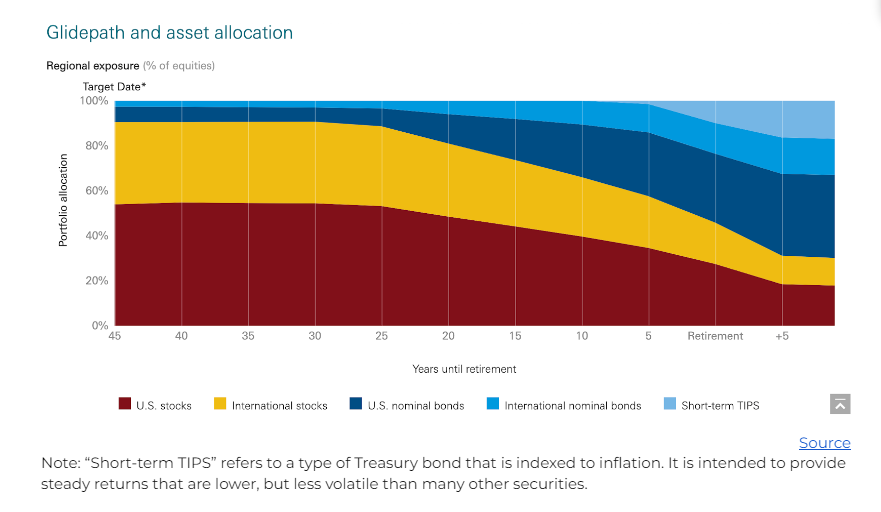
GRAPH: TDF Glide Path
One way to analyze a TDF is to look at its glide path, which tells you how the fund allocates your portfolio over time. Study the graph for an example 2065 TDF and answer the questions.
2
Assuming a retirement age of 65, what age range might consider investing in this fund? Someone retiring_______ years from now, so someone who is _______ years old.
1
Approximately what percentage of the fund is invested in stocks, compared to bonds, when it is 20 years before retirement?_______ % (hint red and yellow combined)
1
How do the amounts invested in stocks, bonds, and other securities change as you get closer to retirement? Why?
ARTICLE: Robo-Advisor
As you’ve seen, TDFs are a popular option for beginner investors who don’t want to pick individual investments. Robo-advisors serve a similar purpose by automating the investing process for you. Robo-advisors are not a type of fund; they act more like a financial advisor and generally invest in a portfolio of low-cost index funds and ETFs.
1
Would you feel comfortable having an algorithm make your investing decisions? Why or why not?
1
The article describes a robo-advisor’s advice as “unbiased and objective”. Do you think that’s a fair description? Why or why not?
1
Robo-advisors often have lower account minimums than traditional advisors, so you can start investing with less money. Make an inference: What do you think could be the impact of making investing more accessible?
Practice It
ACTIVITY: MOVE: Follow the Funds
It’s time to use your knowledge of funds and exponential functions to solve a series of scavenger hunt clues. Follow your teacher’s instructions to complete this activity.
On paper * If absent,, here are the problems
30
Write down your answer order here for full credit: (Letter you started with to letter you ended with: Example: A, B, C, )
DESMOS: Comparing Funds Using Compound Annual Growth Rate
One way we can measure a fund’s performance, and compare it to other funds, is by calculating the compound annual growth rate (CAGR) for that investment over a specific period of time. Follow your teacher’s instructions to complete this Desmos activity.
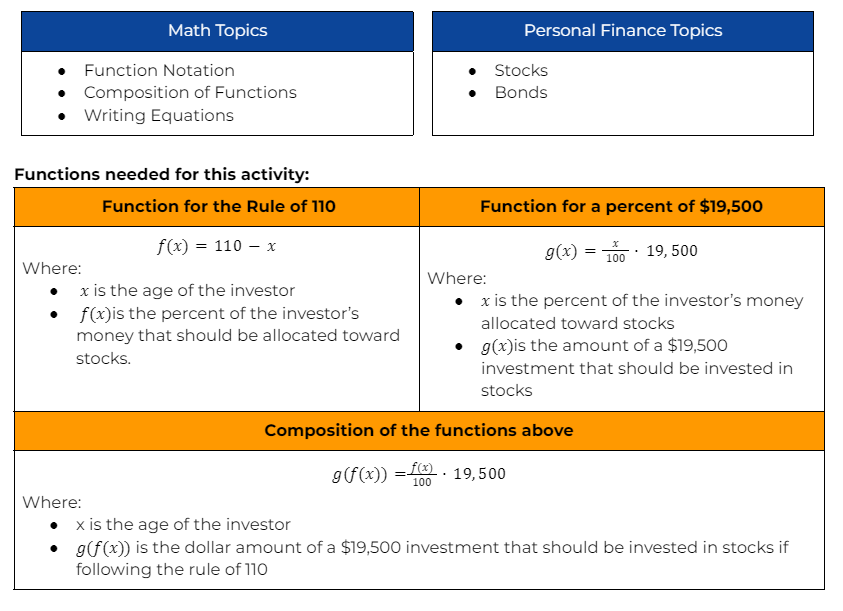
Math: Rule of 110 and Function Composition
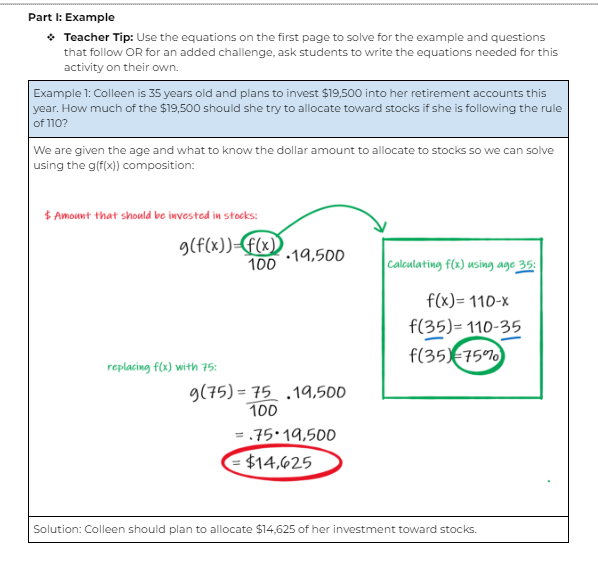
Based on your age, you can use the Rule of 110 to estimate how to split your investments between stocks and bonds.
percent of investments allocated to stocks = 110 - investor’s age
This rule is helpful because as investors get older, they generally want less risky investments like bonds. Younger investors have more time until retirement and therefore can withstand more risk. They tend to invest more heavily in stocks, which may have higher long-term returns. However, all investors have different risk tolerances regardless of age, so the rule of 110 may not be right for everyone.
1
MATH: Rule of 110 and Function Composition
Part II: Practice Problems
Complete the following practice problems and show your work in the space provided. Then, write your final solution in the answer boxes.
Leon is 55 years old and plans to contribute $19,500 to his retirement account this year. About how much of this money should Leon allocate to stocks if he is using the Rule of 110?
$_______
3
Marco is 23 years old and plans to invest $5,500 into his newly opened retirement account.
- How would the g(x) equation from Question 15 need to change to fit Marco’s situation? _______ Write the new g(x) equation in function notation._______
- Use this new equation to determine how much of Marco’s $5,500 should go towards stocks based on the Rule of 110.$_______
Exit Ticket
1
All of the following are true about target date funds (TDFs), EXCEPT…1. TDFs automatically reallocate your investments over time2. TDFs are a good investment option for hands-off investors3. TDFs track the performance of a particular market index4. TDFs are invested in primarily in stocks when the target date is far in the future
All of the following are true about target date funds (TDFs), EXCEPT…
1. TDFs automatically reallocate your investments over time
2. TDFs are a good investment option for hands-off investors
3. TDFs track the performance of a particular market index
4. TDFs are invested in primarily in stocks when the target date is far in the future
1
How is an exchange traded fund (ETF) different from a mutual fund?1. An ETF can be traded throughout the day and bought from other investors, like a stock2. An ETF can only be bought at the end of the day from the fund provider3. An ETF is usually actively traded and has higher expense ratios4. An ETF is a pooled investment that uses funds from many different investors
How is an exchange traded fund (ETF) different from a mutual fund?
1. An ETF can be traded throughout the day and bought from other investors, like a stock
2. An ETF can only be bought at the end of the day from the fund provider
3. An ETF is usually actively traded and has higher expense ratios
4. An ETF is a pooled investment that uses funds from many different investors
1
What is a robo-advisor?1. A security algorithm used by some fund managers to protect your investments2. An investment management service that uses a computer program to manage assets3. A financial manager who provides specialized advice about technology funds4. A popular type of exchange traded fund (ETF) with a low minimum investment
What is a robo-advisor?
1. A security algorithm used by some fund managers to protect your investments
2. An investment management service that uses a computer program to manage assets
3. A financial manager who provides specialized advice about technology funds
4. A popular type of exchange traded fund (ETF) with a low minimum investment