OBJECTIVES & STANDARDS
Math Objectives
Identify and graph asymptotes for exponential functions
Describe end behavior from a graph, function, or table
Understand how changing coefficients changes the graph of an exponential function
Understand how changing the base changes the graph of an exponential function
Understand how adding constants changes the graph of an exponential function
Graph exponential functions from equations and tables
Common Core Math Standards
Link to all CCSS Math
Personal Finance Objectives
Compare the growth of savings and investment accounts by looking at their graphs
Predict anticipated compound growth from a graph
Understand the concept of annualized rate of return on investments
National Standards for Personal Financial Education
Investing
3b: Investigate the long-run average rates of returns on small-company stocks, large-company stocks, corporate bonds, and Treasury bonds
7b: Compare the expense ratios for several mutual funds
DISTRIBUTION & PLANNING
Distribute to students
OBJECTIVES & STANDARDS
Math Objectives
Identify and graph asymptotes for exponential functions
Describe end behavior from a graph, function, or table
Understand how changing coefficients changes the graph of an exponential function
Understand how changing the base changes the graph of an exponential function
Understand how adding constants changes the graph of an exponential function
Graph exponential functions from equations and tables
Common Core Math Standards
Link to all CCSS Math
Personal Finance Objectives
Compare the growth of savings and investment accounts by looking at their graphs
Predict anticipated compound growth from a graph
Understand the concept of annualized rate of return on investments
National Standards for Personal Financial Education
Investing
3b: Investigate the long-run average rates of returns on small-company stocks, large-company stocks, corporate bonds, and Treasury bonds
7b: Compare the expense ratios for several mutual funds
DISTRIBUTION & PLANNING
Distribute to students
Predicting the graph
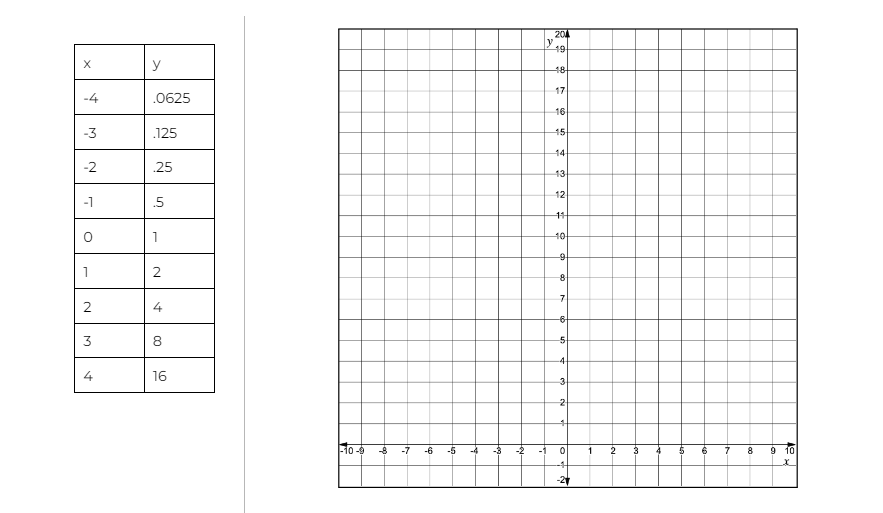
Use the data table to answer the questions.
Plot the points on the graph. Use Desmos and Screen shot your answer in the show your work here and in question 3.
Would a linear function be a good fit for these points? Why or why not?
Sketch a smooth curve that best fits the data.(screen shot question 1 desmos here, then sketch over plotted points).
Describe the shape of the sketch and how it is different from a straight line.
DESMOS: Marbleslides: Exponentials
An exponential function has the general form y = abx +c Manipulating these variables will alter the function graph. Follow your teacher’s instructions to complete this exploratory Desmos activity. Then, answer the summary questions.
How does the graph change as the base, b, increases above 1?
How does the graph change when the base, b, decreases below 1 but above 0?
How does the graph change when you add or subtract a constant in the exponent, x?
Asymptotes
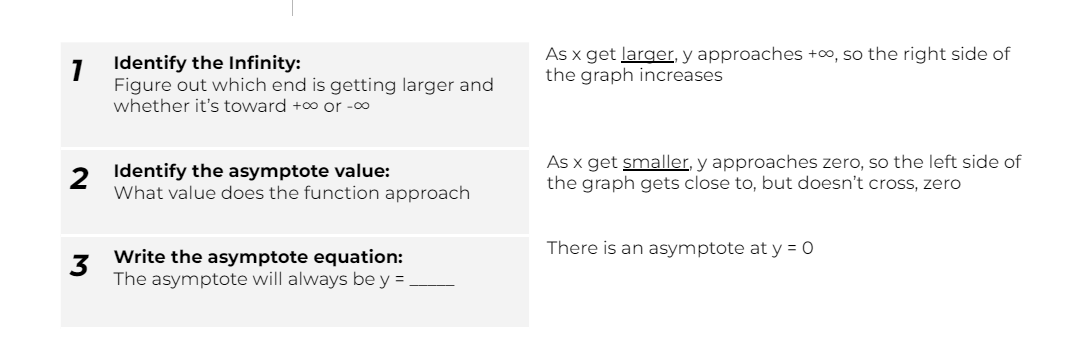
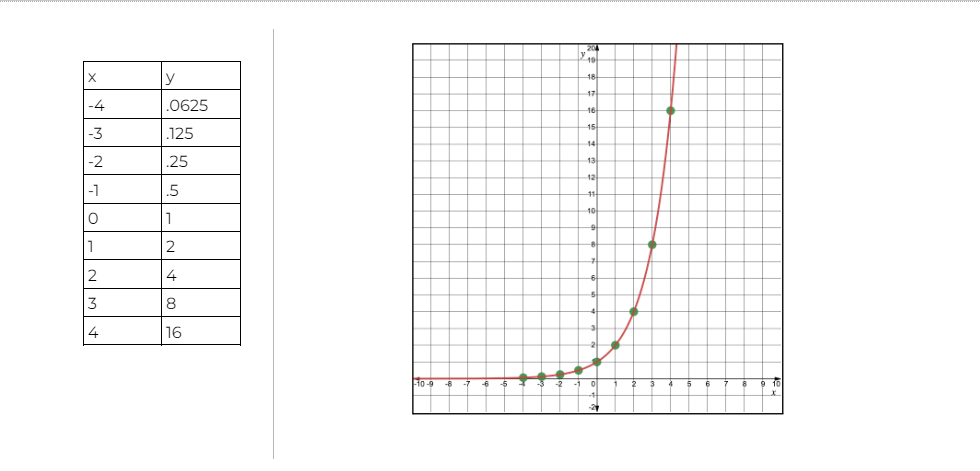
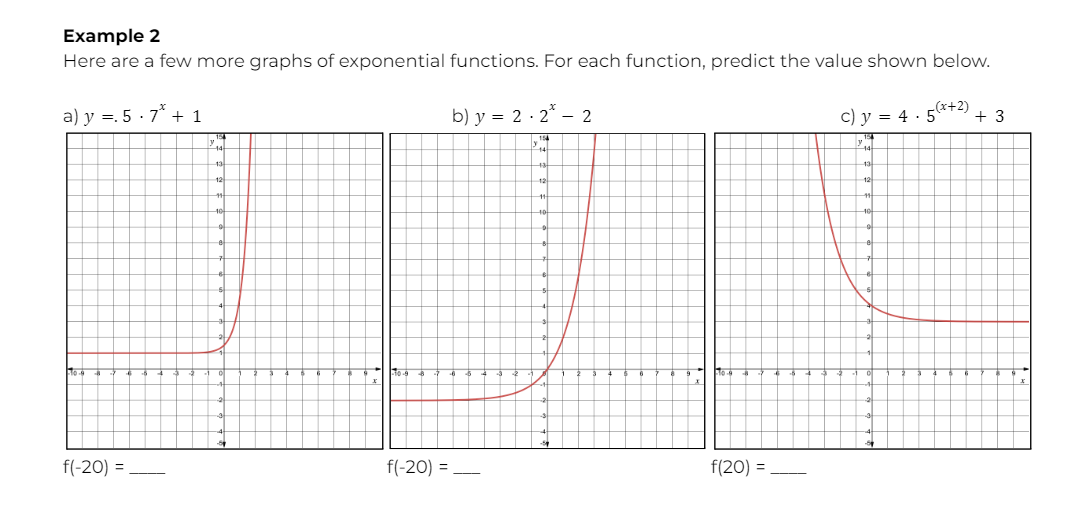
You likely have noticed some similarities in all of the exponential graphs you looked at in that activity. One unique feature is that for every exponential graph, one end will go on toward positive or negative infinity and the other end will approach, but not cross a certain, specific y value. This value that the function approaches is called an asymptote. In the case of exponential functions, they will have a horizontal asymptote (y = some value).
Example 1
Let’s take a look back at the problem from the intro to explain some key features. The data was from the function y = 2x. You can get this information from either the table or the graph of an exponential function. Oftentimes you can use the information about the asymptote to sketch a more accurate graph!
Coefficient and the constant terms
Changing the constant term affects the y-intercept of an exponential function, just as it does a linear function. You may have noticed that changing the coefficient changes the y-intercept as well. This is because b0 is always 1, so the function at x = 0 becomes y = a + c.
The coefficient is important in another way though! You can tell the value of the asymptote because it is the same value as the constant term that is added. For example, in the equation y = 3x - 4, the asymptote would be at y = -4. Take a look at the previous three examples and their equations to see how the constant term matches your predicted asymptotic values.
5-Point Practice: Writing an Exponential Equation From a Table
Complete any number of problems that add up to 5 points. Identify how the graph behaves when x is very large and when x is very small: does it approach ∞, -∞, or a specific value. Then give the equation of the asymptote.
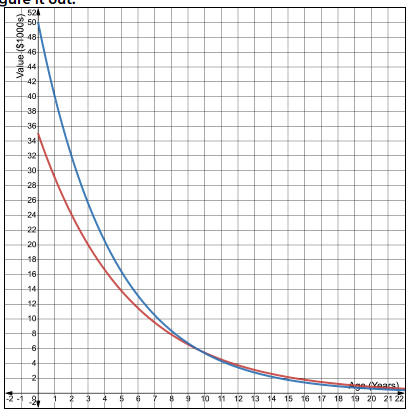
Jerry bought a brand new car at the dealership one year ago for $35,000. The value of his car depreciates and is worth 20% less every year.
How long do you predict it will take for the car’s value to drop to $1000?
Level 2:
Although the prices of stocks and bonds fluctuate constantly, you can model the growth by using an exponential function that approximates the growth as if it were the same year after year. This growth is called the annualized rate of return, and you can use it as the base in an exponential function model.
Let’s say Jenny and Sarah are both gifted $5,000 when they were born and they are 16 years old now. Jenny’s money is invested in an S&P Index Fund with 7.5% average annualized returns while Sarah’s is invested in a bond fund with 3.5% average annualized returns.
The Power of Time
Shandra took a finance class in high school , and her twin brother Abdul did not. So when they both started working full-time jobs at the age of 25, Shandra invested in a retirement account right away. She put in $5,000 the first year in an account that has an average annual rate of return of 6%. Abdul waited 5 years until he was 30 before doing the same. In reality, they would both continue investing, but we will look at the growth of just this FIRST $5,000.
What do you predict the function value to be when x=-100? When x=-1000? Why do you say this?
In Desmos, plot the value of Jerry’s car under this model over the first 20 years of its life. Screen shot your answer in the drawing. windows+shift+s
How long does it take for the value to drop to about $1000? About ______ years.
In Desmos or below, make a graph of both of their investments from birth until age 30. Label who’s function is whose.
What part of the function caused Jennie's graph to go up faster?
Graph and label both equations. What did your change in the exponent do to the graph? Screen shot your desmos graph in the show your work.