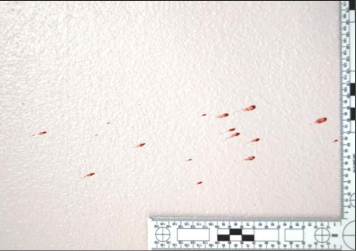
Which direction was the blood traveling in the following photo?
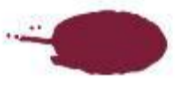
Which direction was the blood traveling in the following photo?
A is an example of an injury that would likely cause high-velocity blood spatter.
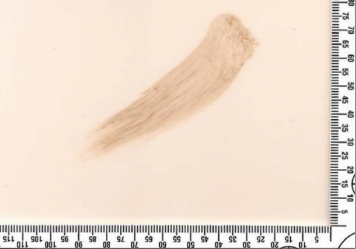
A bloodstain pattern is a lateral transfer of wet blood caused by bloody hair being dragged across the floor.
evidence is collected in clean, unused plastic sealed containers at the crime scene.
Confirmation of is performed by conducting an ELISA test.
Which direction was the blood traveling in the following photo?
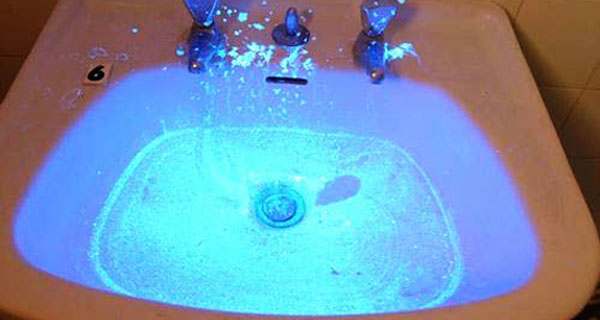
Blood that was once present in the sink and washed away can be detected using _____________.
When blood molecules are attracted to the surface they come into contact with, this is known as .
Identify and match the forces affecting blood spatter to their proper descriptions.
| Draggable item | arrow_right_alt | Corresponding Item |
|---|---|---|
gravity | arrow_right_alt | the attraction between molecules of like substances; gives blood a domed shape when resting on a surface |
cohesion | arrow_right_alt | the attraction between molecules of unlike substances; causes blood to cling to porous surfaces |
adhesion | arrow_right_alt | the force of attraction between the earth and another object; gives falling liquids a tear-dropped shape |
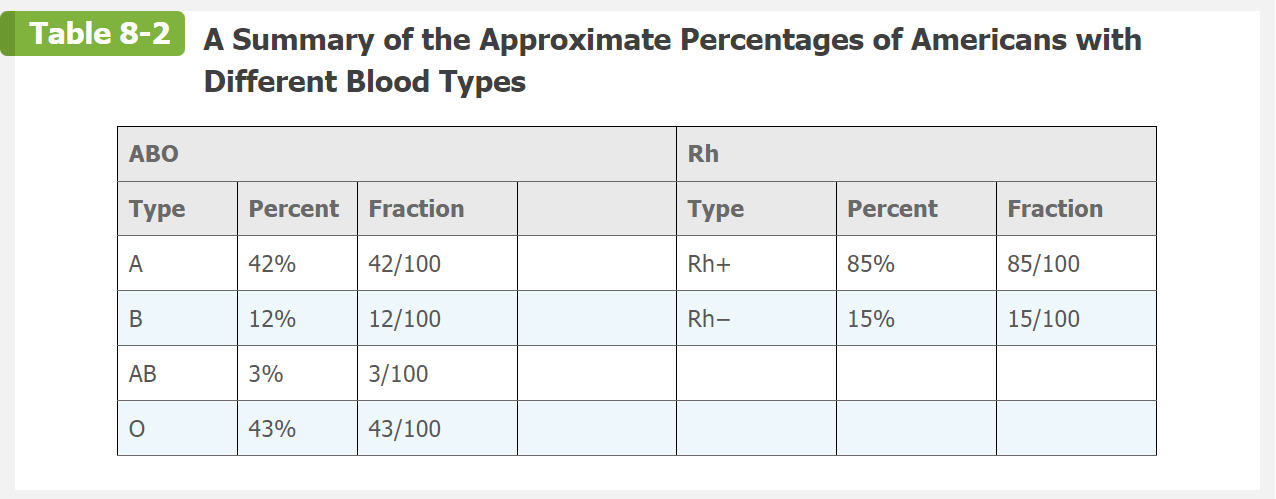
Calculate the percentage of the American population that has O+ blood type:
Identify the various bloodstain patterns shown in the photograph.

To prevent agglutination, blood must be tested for the presence of .
Satellites occur when a droplet of blood strikes a surface, _____.
During the walk-through of a crime scene, an investigator would consider the possibility that _____.
Blood consists of two components of circulating connective tissue, red blood cells and white blood cells, suspended in plasma.
Storage of liquid blood in plastic must be less than two hours to prevent contamination.
Hemoglobin is found in .
A drop of blood that falls at a 90-degree angle from a wound is a(n) .
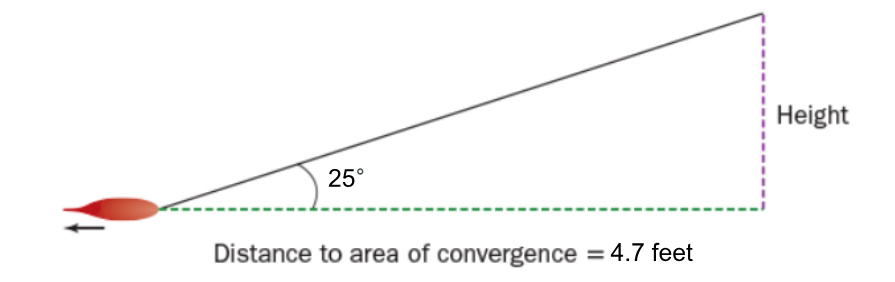
Calculate the height of the area of origin in the following diagram. Show your work and round to 2 decimal places.
height =
Place the items in the proper evidence collection procedure categories.
liquid blood evidence
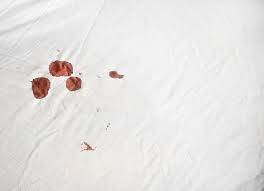
wet bloodstain on a pillowcase
why would you package any blood evidence in a plastic bag. that's indecent
(drag this item to the plastic bag category)
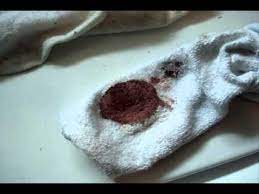
dried blood on a sock
sealed plastic container
paper bag
plastic bag
Calculate the missing values in the data table. Round to 1 decimal place.
angle of impact =
height of area of origin =
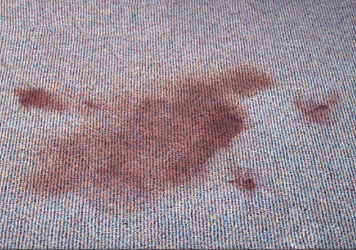
Match the blood spatter/nonspatter photos to their correct names.
| Draggable item | arrow_right_alt | Corresponding Item |
|---|---|---|
| arrow_right_alt | cast-off | |
| arrow_right_alt | saturation | |
| arrow_right_alt | void | |
| arrow_right_alt | drip trail | |
| arrow_right_alt | swipe |
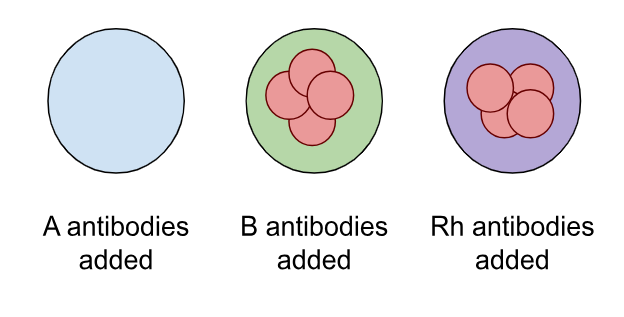
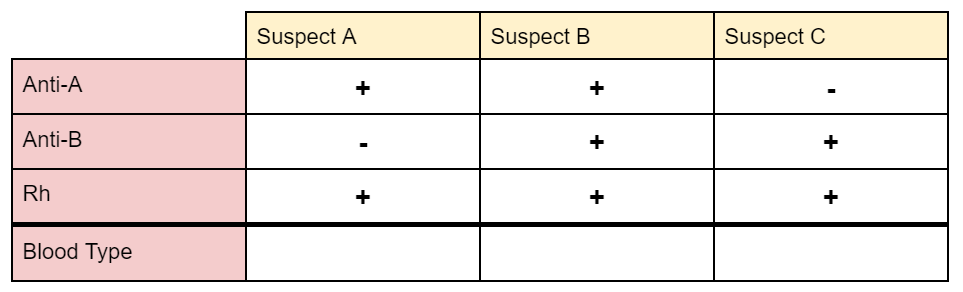
CSIs performed an antibody test on liquid blood recovered from a crime scene. The results are shown below:
3 suspects were taken in for questioning and each provided a sample of blood. The results are shown in the table below:
Suspect A has blood type.
Suspect B has blood type.
Suspect C has blood type.
Which suspect should the police continue investigating as potential owners of the crime scene blood?
Round all calculated answers to 1 decimal place.
width of blood droplet 2:
length of blood droplet 2:
Calculate the impact angle of blood droplet 2.
distance from edge of blood droplet 2 to center of area of convergence:
Using the scale 1mm = .2 feet, convert the above distance to feet:
Use your answer from the previous question to calculate the height of the area of origin. Round to 1 decimal place:
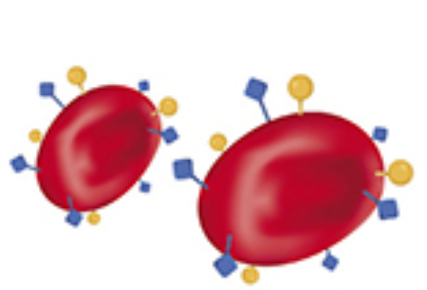
Answer the following question based on the following illustration:
The surface of red blood cells have different . Judging by the 2 different types of symbols shown, this individual would most likely have type blood.
White blood cells are responsible for the antigen-antibody response.
Blood consists of three components of circulating connective tissue, red blood cells, white blood cells, and platelets suspended in plasma.
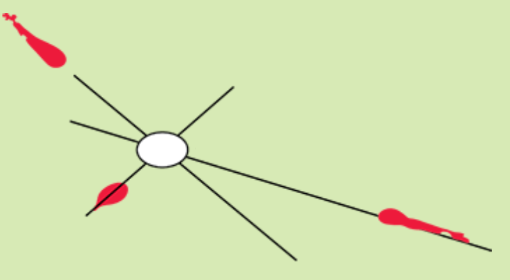
CSI's utilize the string method in order to estimate the area of convergence.
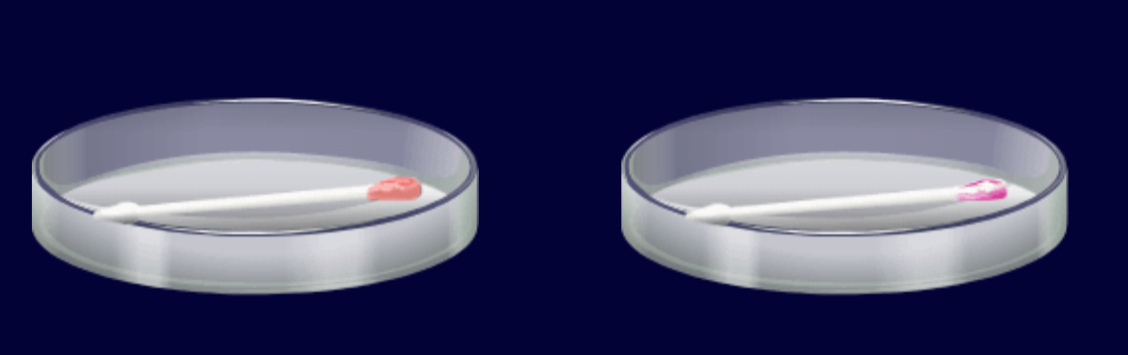
Match the pictures to the blood test best associated with it.
| Draggable item | arrow_right_alt | Corresponding Item |
|---|---|---|
| arrow_right_alt | Kastle-Meyer reagent | |
| arrow_right_alt | Luminol test | |
| arrow_right_alt | ELISA test |
Which of the following can be used to estimate the area of origin? (Select all that apply):
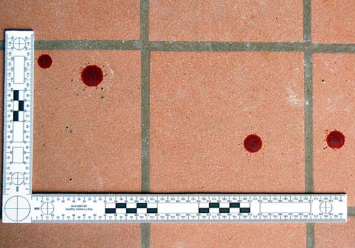
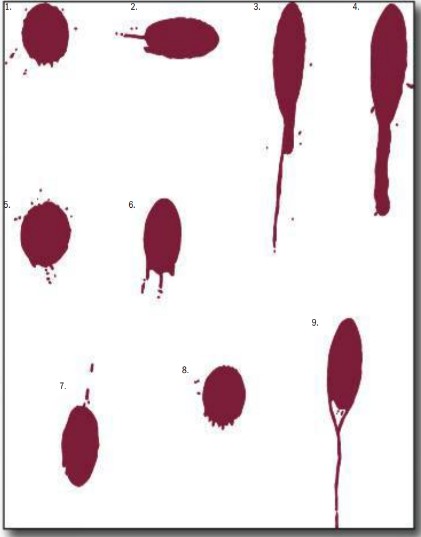
Examine the 9 blood droplets. Which 3 drops struck the surface farthest from a 90-degree angle?
Calculate the impact angle of blood droplet A and B. Round all answers to 2 decimal places.
Impact angle = sin-1(width/length)
A:
B:
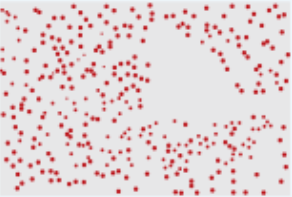
The white circled area in the following image indicates the .
Below is an illustration of white and red blood cells. Select the type of cell that can provide individual evidence.