Astronomy Halfway Test
star
star
star
star
star
Last updated over 1 year ago
30 questions

1
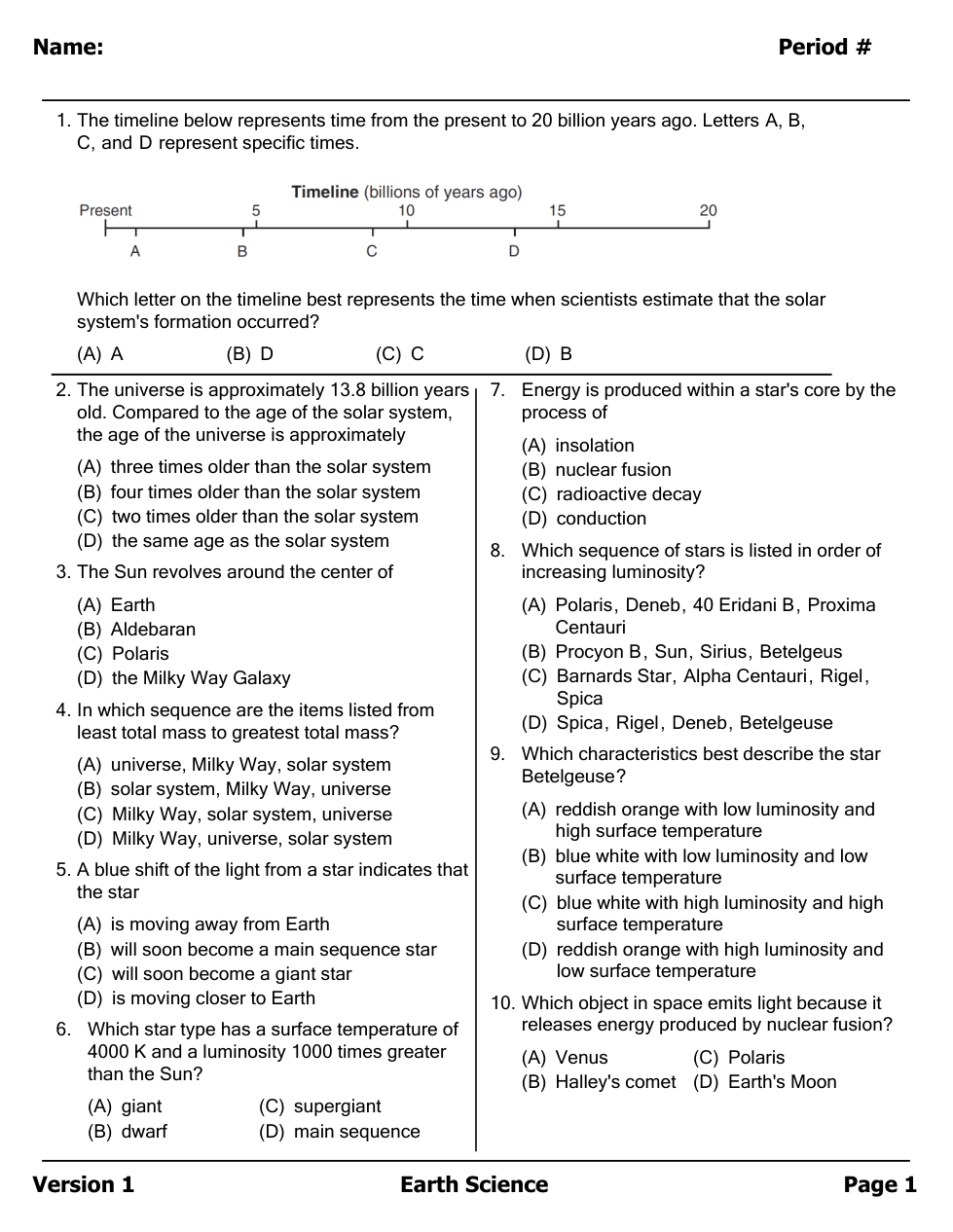
The timeline below represents time from the present to 20 billion years ago. Letters A, B, C, and D represent specific times. Which letter on the timeline best represents the time when scientists estimate that the solar system's formation occurred?
1
The universe is approximately 13.8 billion years old. Compared to the age of the solar system, the age of the universe is approximately
1
The Sun revolves around the center of
1
In which sequence are the items listed from least total mass to greatest total mass?
1
A blue shift of the light from a star indicates that the star
1
Which star type has a surface temperature of 4000 K and a luminosity 1000 times greater than the Sun?
1
Energy is produced within a star's core by the process of
1
Which sequence of stars is listed in order of increasing luminosity?
1
Which characteristics best describe the star Betelgeuse?
1
Which object in space emits light because it releases energy produced by nuclear fusion?

1
The timeline below represents time from the present to 20 billion years ago. Letters A, B, C, and D represent specific times.
Which letter on the timeline best represents the time when scientists estimate that the Big Bang occurred?
The timeline below represents time from the present to 20 billion years ago. Letters A, B, C, and D represent specific times.
Which letter on the timeline best represents the time when scientists estimate that the Big Bang occurred?
1
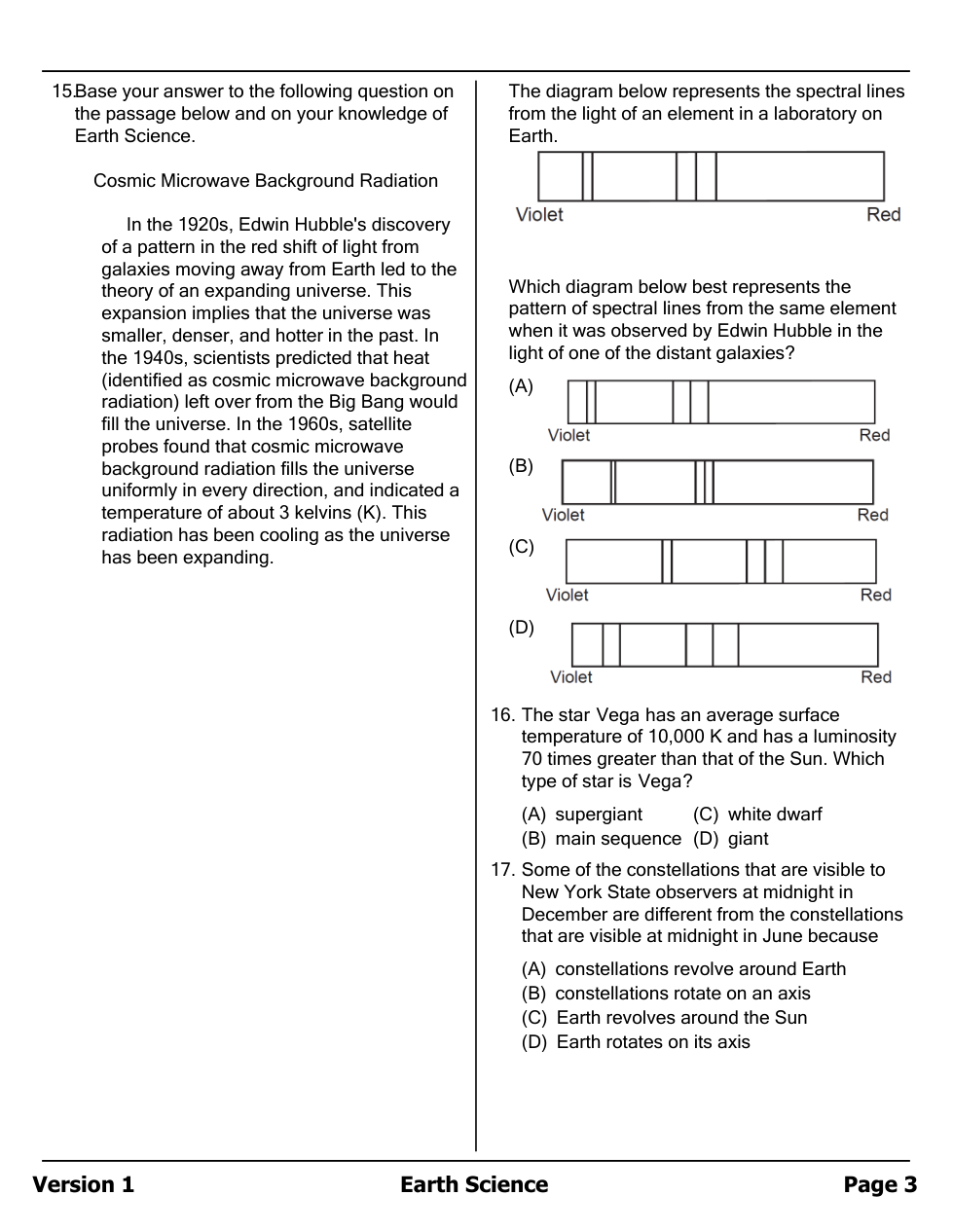
Base your answers to questions 12 and 13 on the diagram below and on your knowledge of Earth science. The diagram represents the expansion of a portion of the universe from its origin until the present. The timeline represents billions of years. Letter X indicates two celestial objects.
12. The two spiral-shaped celestial objects labeled X are
Base your answers to questions 12 and 13 on the diagram below and on your knowledge of Earth science. The diagram represents the expansion of a portion of the universe from its origin until the present. The timeline represents billions of years. Letter X indicates two celestial objects.
12. The two spiral-shaped celestial objects labeled X are
1
13. Two pieces of evidence that support the theory that the universe is expanding are the
1
Approximately how many degrees does Earth travel in its orbit in one month?

1
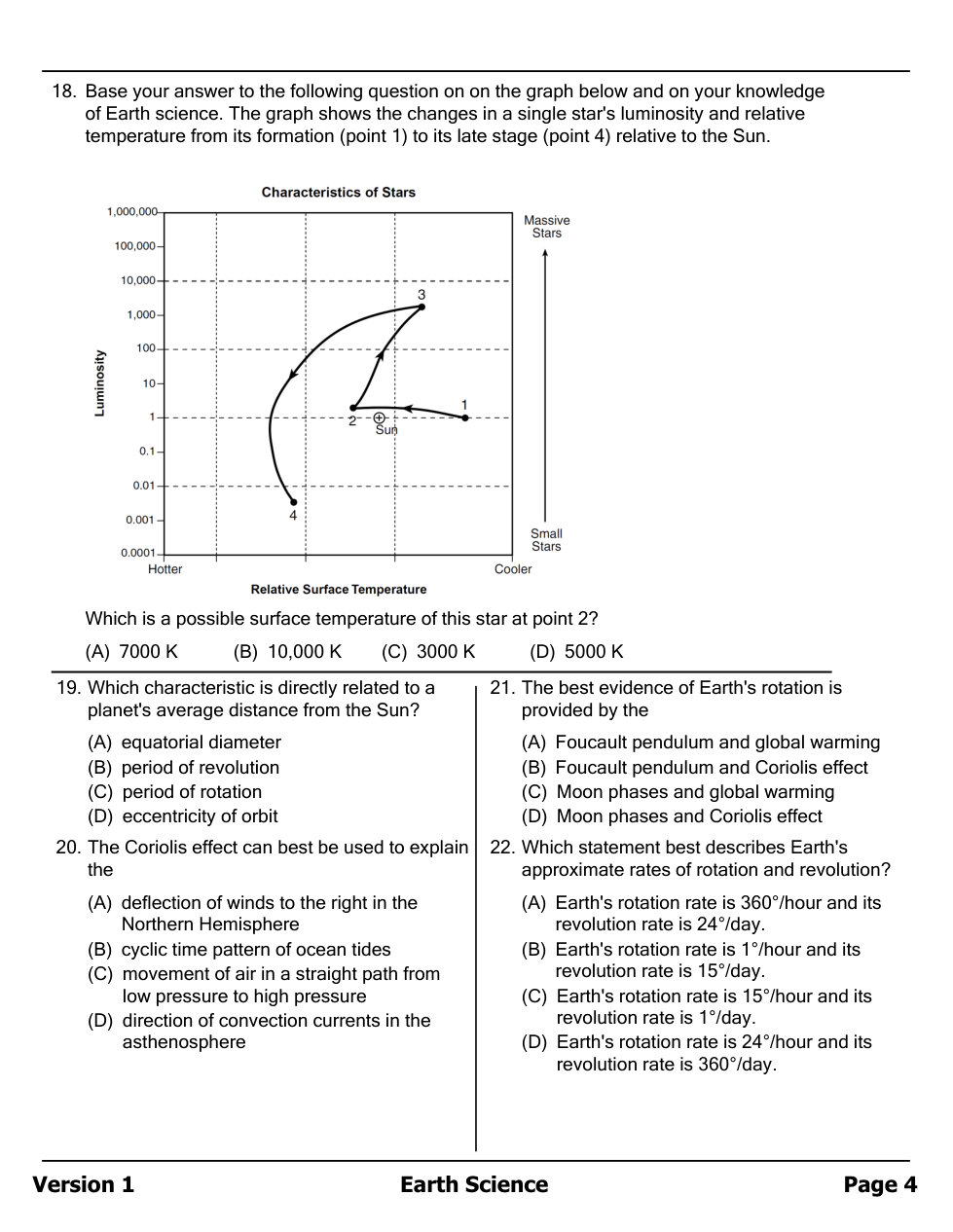
Which diagram below best represents the pattern of spectral lines from the same element when it was observed by Edwin Hubble in the light of one of the distant galaxies?
1
The star Vega has an average surface temperature of 10,000 K and has a luminosity 70 times greater than that of the Sun. Which type of star is Vega?
1
Some of the constellations that are visible to New York State observers at midnight in December are different from the constellations that are visible at midnight in June because

1
Question 18: Base your answer to the following question on the graph below and on your knowledge of Earth science. The graph shows the changes in a single star's luminosity and relative temperature from its formation (point 1) to its late stage (point 4) relative to the Sun.
Which is a possible surface temperature of this star at point 2?
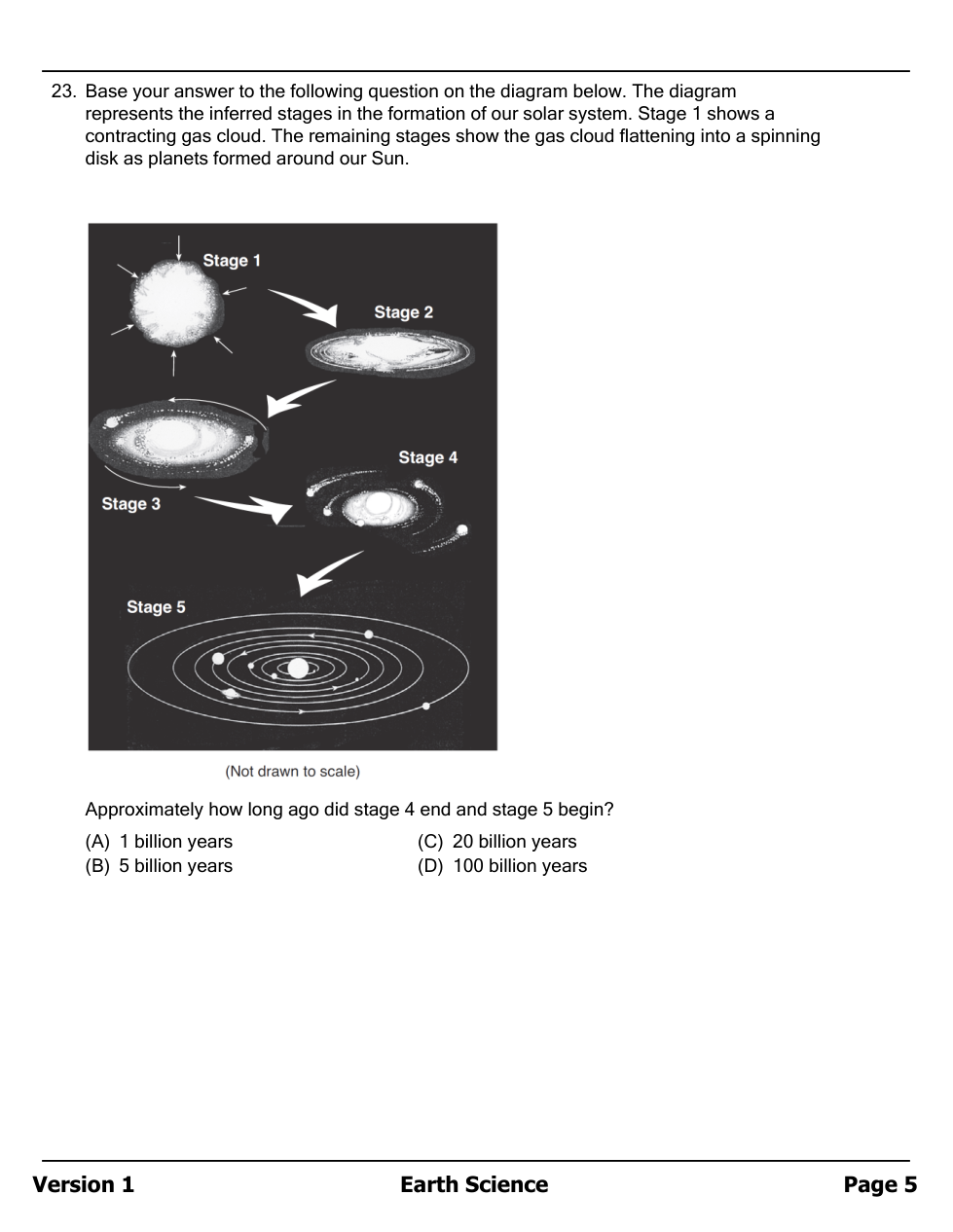
Question 18: Base your answer to the following question on the graph below and on your knowledge of Earth science. The graph shows the changes in a single star's luminosity and relative temperature from its formation (point 1) to its late stage (point 4) relative to the Sun.
Which is a possible surface temperature of this star at point 2?
1
Which characteristic is directly related to a planet's average distance from the Sun?
1
The Coriolis effect can best be used to explain the
1
The best evidence of Earth's rotation is provided by the
1
Which statement best describes Earth's approximate rates of rotation and revolution?

1
The question is: Base your answer to the following question on the diagram below. The diagram represents the inferred stages in the formation of our solar system. Stage 1 shows a contracting gas cloud. The remaining stages show the gas cloud flattening into a spinning disk as planets formed around our Sun.
Approximately how long ago did stage 4 end and stage 5 begin?
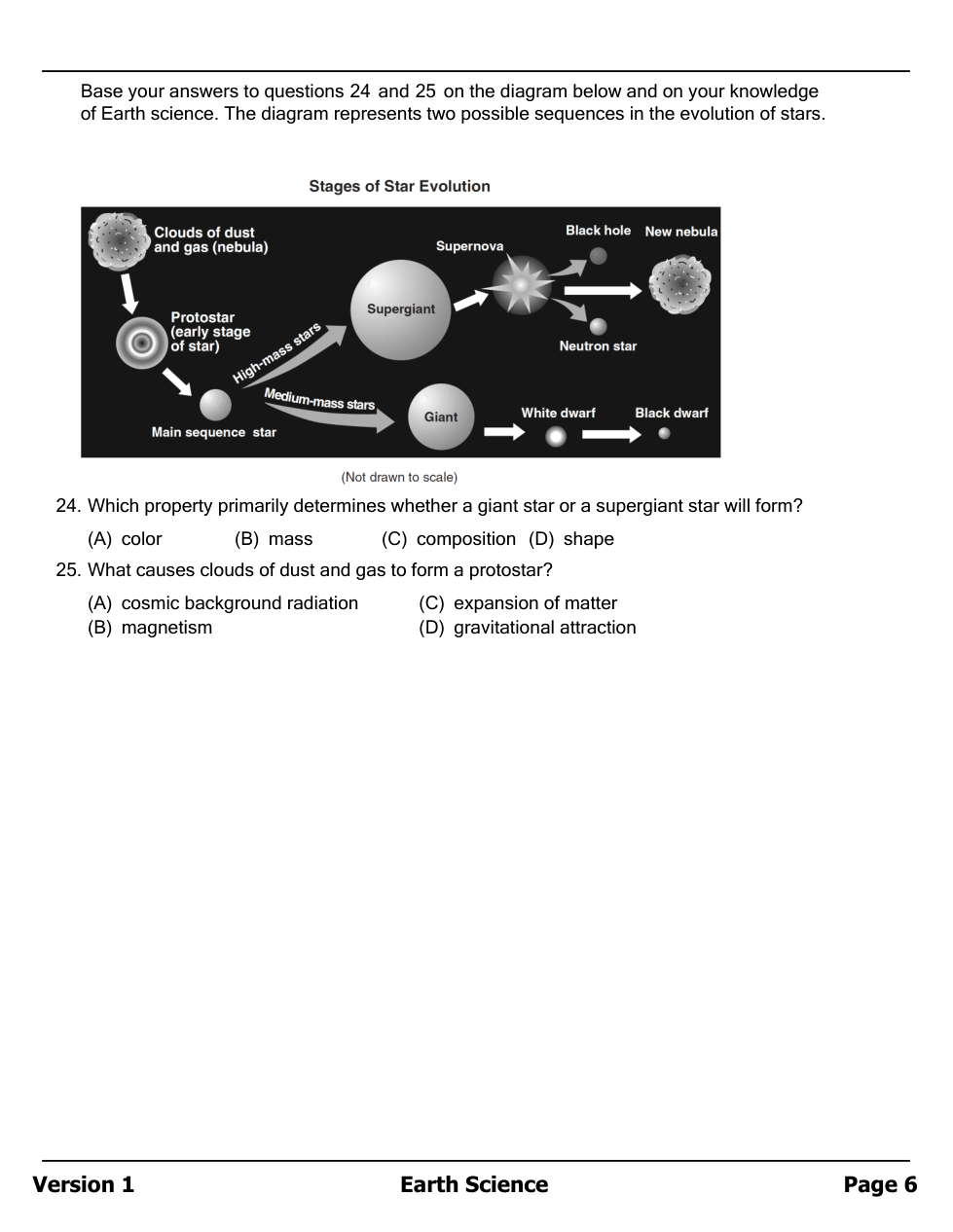
The question is: Base your answer to the following question on the diagram below. The diagram represents the inferred stages in the formation of our solar system. Stage 1 shows a contracting gas cloud. The remaining stages show the gas cloud flattening into a spinning disk as planets formed around our Sun.
Approximately how long ago did stage 4 end and stage 5 begin?

1
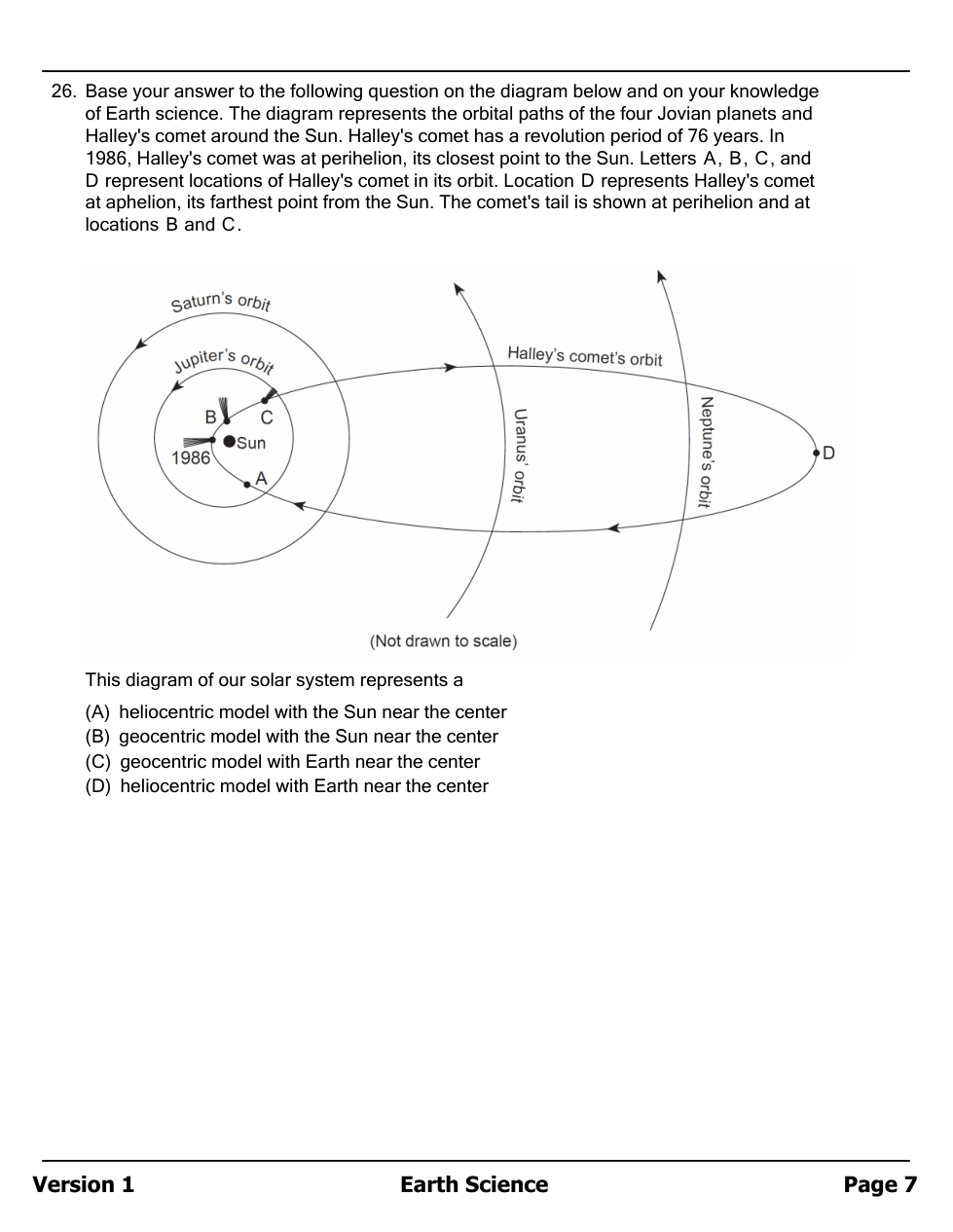
Which property primarily determines whether a giant star or a supergiant star will form?
1
What causes clouds of dust and gas to form a protostar

1
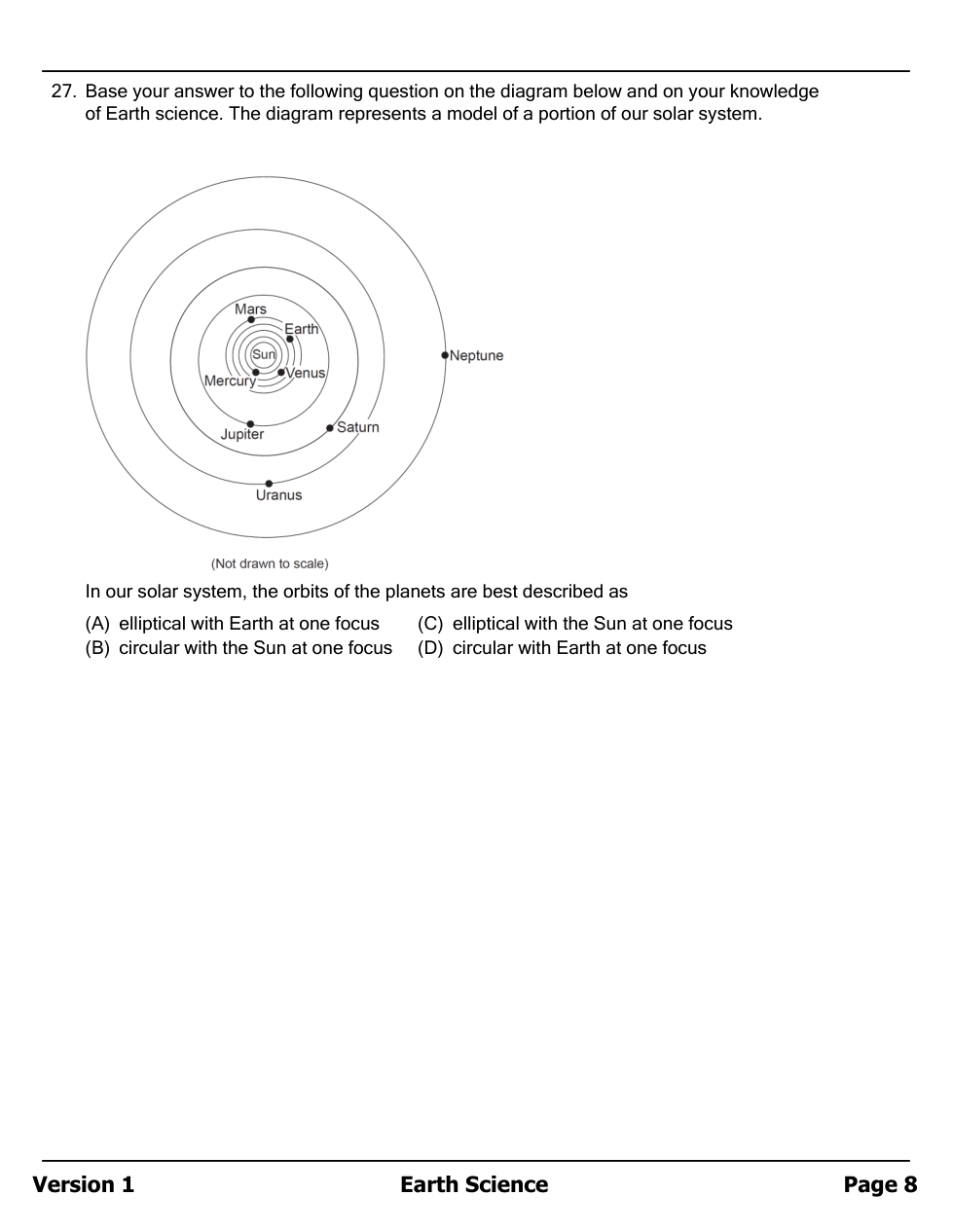
This diagram of our solar system represents a...

1
Base your answer to the following question on the diagram below and on your knowledge of Earth science. The diagram represents a model of a portion of our solar system.
In our solar system, the orbits of the planets are best described as
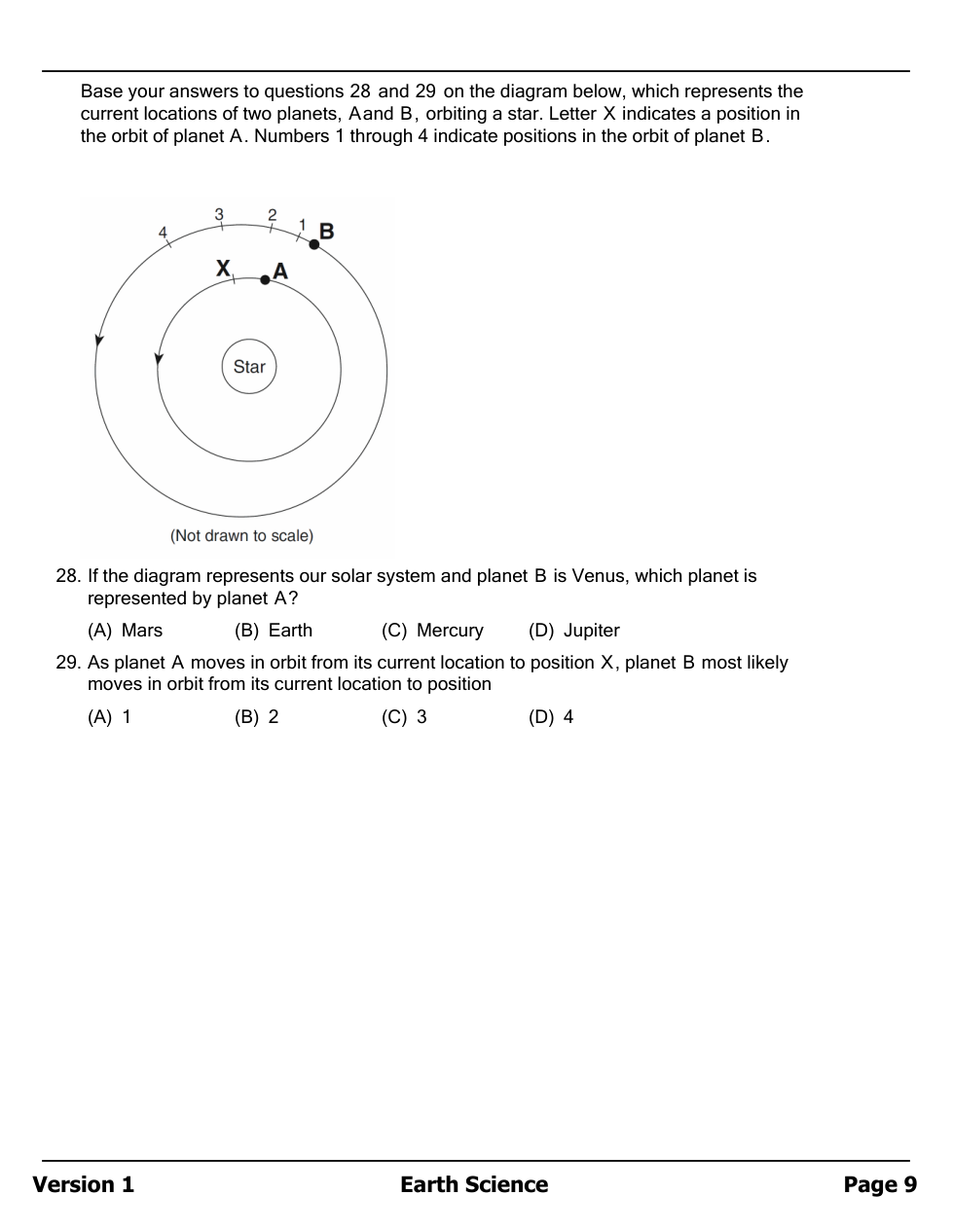
Base your answer to the following question on the diagram below and on your knowledge of Earth science. The diagram represents a model of a portion of our solar system.
In our solar system, the orbits of the planets are best described as

1
If the diagram represents our solar system and planet B is Venus, which planet is represented by planet A?
1
As planet A moves in orbit from its current location to position X, planet B most likely moves in orbit from its current location to position_____.

1
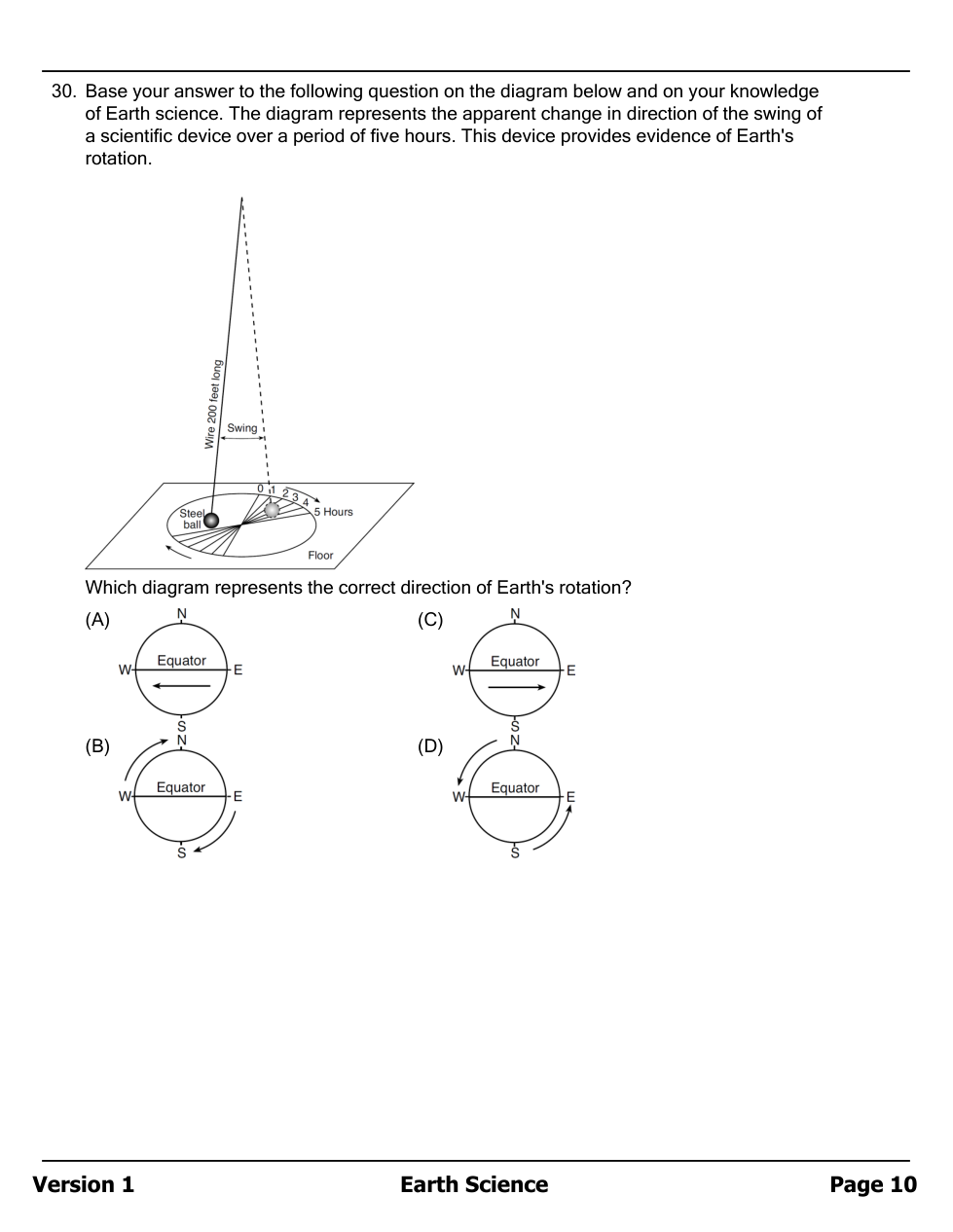
Question 30: Base your answer to the following question on the diagram below and on your knowledge of Earth science. The diagram represents the apparent change in direction of the swing of a scientific device over a period of five hours. This device provides evidence of Earth's rotation.