Please find the Hydrostatic Pressure at TVD if we are pumping a sand concentration of 1.75ppg.
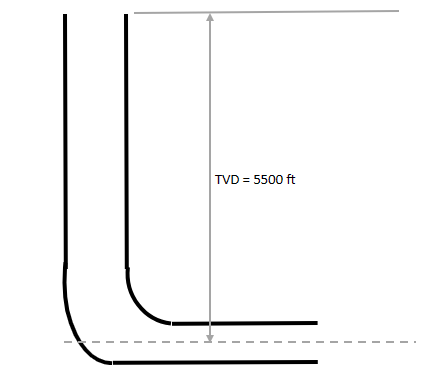
Please find the Hydrostatic Pressure at TVD if we are pumping a sand concentration of 1.75ppg.
1) For numbers >1,000, add a comma as no comma will mark the answer as wrong.
2) All numbers should be reported with 2 decimal places. Ex: 1.00, not 1.
3) Include units in your answer when appropriate. (psi, gals, bbls, lbs, gpt, RPM)
Please find the Hydrostatic Pressure at TVD if we are pumping a sand concentration of 1.75ppg.
If flush is 325 bbls, how many gallons is that?
Find the density of slurry if the target concentration is 1.25 ppg.
Find the clean rate when you are pumping at a rate of 100bpm with a sand concentration of 0.75ppg. Assume the SG of the sand is 2.65
If you have a frac gradient of 0.88 and a TVD of 8,674' what is the bottom hole pressure?
How much proppant did you pump if you pumped 1,267 bbls of slurry at 1.75 ppg?
If 9,126 gals of 36% acid is ordered and it needs to be diluted to 15%, how many barrels of water needs to be delivered first?
At what rate, in gpm, is FR being pumped during the initial pad if rate is 109.6 bpm and FR loading is at 1.0 gpt?
How many suction hoses do you need, attached to the blender, if the target rate is 110 bpm at 2.5 ppg concentration?
What is the maximum rate that can go through iron if it has an OD of 4" and ID of 3.8"?
How much horsepower is our fleet running if average is pressure is 8,250 psi @ 101.1 bpm?
What is the purpose of hydraulic fracturing?
Label the parts of this frac location.
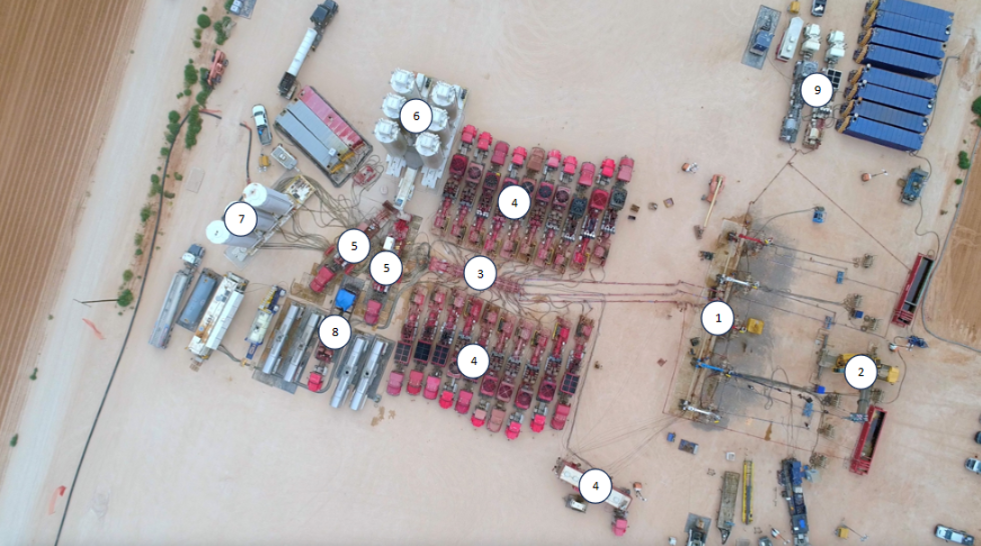
| Draggable item | arrow_right_alt | Corresponding Item |
|---|---|---|
3 | arrow_right_alt | Chemical Units (Chemadd, Chemical Trailer, Totes, etc.) |
8 | arrow_right_alt | Blender |
7 | arrow_right_alt | Pumpdown unit |
5 | arrow_right_alt | Fluid Storage (Water Transer, Frac Tanks, Water Silos, etc.) |
1 | arrow_right_alt | Wireline Crane |
2 | arrow_right_alt | Proppant Storage (Sand Silos, Sandkings, etc.) |
6 | arrow_right_alt | Frac Pumps |
9 | arrow_right_alt | Wellheads/Zipper manifold |
4 | arrow_right_alt | Manifold (Missile, Monoline, etc.) |
Where is the transducer for pressure A?
Where is the transducer for the zipper manifold?
What are the hoses on the discharge side of the blender hooked to?
What is the size of a standard tote?
What are the engines on the blender used for?
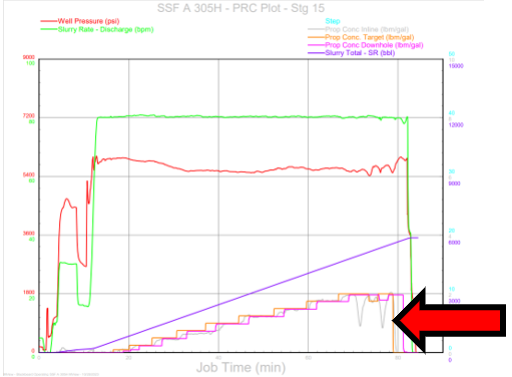
What part of operations could cause a drop in the inline such as in the plot below?
What is a screen-out?
What does it mean when a pump operator asks for PTO?
Describe the difference between pressure A and pressure B
What does it mean the fluid tech is getting a "strap"
Describe what a blender does in frac operations.
Describe ISIP and how to find it.
Match the type of frac fluid component with its purpose
| Draggable item | arrow_right_alt | Corresponding Item |
|---|---|---|
Scale inhibitor | arrow_right_alt | Dissolves formation and increases fracture conductivity |
Crosslink | arrow_right_alt | Prevents bacteria growth |
Gel | arrow_right_alt | Slowly breaks down FR to help with fluid recovery |
Surfactant | arrow_right_alt | Reduces swelling in clay formations |
Breaker | arrow_right_alt | Links polymers to make a viscous fluid |
Biocide | arrow_right_alt | Reduces friction in wellbore |
Corrosion inhibitor | arrow_right_alt | Increases viscosity of frac fluid to carry proppant |
Friction reducer | arrow_right_alt | Prevents mineral deposits from building up in the wellbore |
Acid | arrow_right_alt | Reduces surface tension of frac fluid |
Clay Inhibitor | arrow_right_alt | Protects the wellbore from corroding |
Select all the types of frac proppant
What is the difference between 100 mesh sand and 40/70 sand?
Bleed off valves are located before the check valve.
Which process is essential before resuming operation every time the line is broken for pumps swap or changing pieces of iron?
Why is it important for the treater to record the closure pressure of a well?
What is the area within the high pressure zone called?
What kind of gloves is required when handling frac iron?
Classify the following into pump maintenance or pump failure (NPT)
Pump maintenance | Pump failure (NPT) | |
|---|---|---|
Packing/Plunger | ||
Mechanical issue (overheating, drive shaft, etc.) | ||
Seat & valves | ||
Cracked fluid end | ||
Water in fuel lines | ||
Scheduled PMs | ||
Unscheduled PMs |
How much sand is in the silo if it is at 47%? (Assume the Silo percentage doesn't include the cone)
In preparing to wrap up a Endeavor's job, the sand tracker says the amount of sand needed to complete the job is 355431 of 100M and 246025 of 40/70, how would you place your sand order?
When setting up DataAcq, what needs to be checked in Job Header Information or else the job data will not be uploaded to the server?
To have engineer/treater/consultant names auto-populate on the report, where would you input the names?
When populating the Reference Sheet on the Engineering Report, what cell needs to be manually inputted?
Select the option that has the following stage order.
1. 111-1
2. 212-1
3. 151-1
4. 252-1
5. 212-2
6. 111-2
7. 151-2
8. 212-3
You send out an stage update email and it says "Stage 1 of 52" when it should be "Stage 3 of 52". Which Excel file/tab do you need to check & correct?
What is the maximum amount that should be remaining in an ISO when a full delivery is getting offloaded into it?
At the end of the job, on what documents should the total used sand be the same?
How many hours ahead of start time is it best to schedule chem ISO delivery for a new job?
What part of the inventory must be zeroed out at the end of a job?
| Draggable item | arrow_right_alt | Corresponding Item |
|---|---|---|
Pump Operator | arrow_right_alt | Controlling chemical setpoints and maintaining chemical pumps |
Treater | arrow_right_alt | Responsible for all the iron, open and closing the well, looking for leaks |
Sand Coordinatior | arrow_right_alt | Often the outside supervisor, straps chemicals, moves ISOs, and calibrating chemical pumps. |
ChemAdd Operator | arrow_right_alt | Ensures hopper stays full of sand |
Line Boss | arrow_right_alt | Maintaines pumping rate |
Sand Operator | arrow_right_alt | In charge of all electronics on site including: maintaining communications, pressure transducers, pump control boxes, and the datavan. |
Fluid Tech | arrow_right_alt | Oversees the frac operation on their shift. Ensures operations run smoothly and efficiently. |
E-Tech | arrow_right_alt | Directs sand deliveries and offloading into the correct storage compartment. |
Which of the following eFieldPro dashboards AST field engineer use to check whether frac plots and chems & sand straps are uploaded correctly?
When should ISO pickups be scheduled?