Population Characteristics

Last updated 7 months ago
4 questions
All species occur in groups called populations. All populations have certain characteristics, including population density, spatial distribution, and growth rate. These characteristics are used to classify all populations of organisms, including bacteria, animals, and plants.
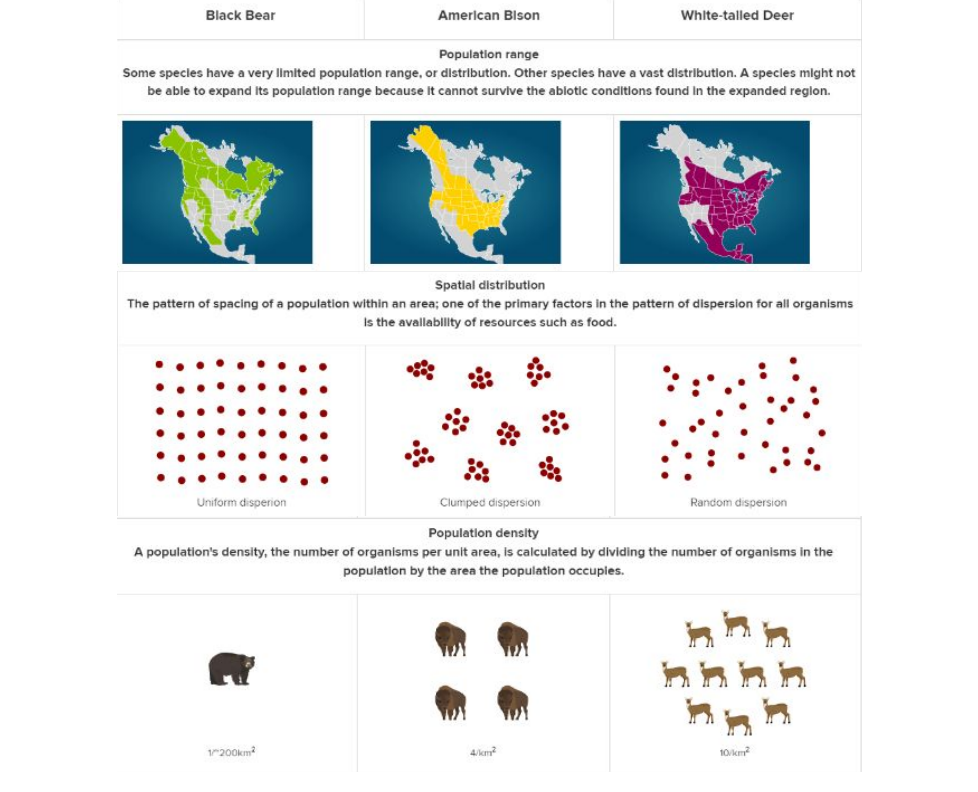
Population Range
No population, not even the human population, occupies all the different habitats in the biosphere. Some species have a very limited population range, or distribution. Other species have a vast distribution. A species might not be able to expand its population range because it cannot survive the abiotic conditions found in the expanded region.

Population Density- The number of organisms per unit of area. Population density can be calculated by dividing the number of organisms in the population by the area the population occupies.


Spatial Distribution
Another characteristic of a population is called dispersion (the pattern of spacing of a population within an area). On of the primary factors in the pattern of dispersion for all organisms is the availability of resources, such as food. There are 3 main types of dispersion-- uniform, clumped groups, and random.
2

Select the abiotic reasons that a species might not be able to expand its range.

2

Select the biotic reasons that a species might not be able to expand its range.

3
Draggable itemCorresponding Item
Spatial distribution
the pattern of spacing of a population within an area
Population density
number of organisms per unit of area
Population range
the area(s) in which a population can be found
3

Match the dispersion patterns listed to the examples of organisms provided.

Draggable itemCorresponding Item
White-tailed deer
Uniform dispersion
Black bear
Clumped dispersion
Bison
Random dispersion