LT 3.1 ATP & LT 3.2 Photosynthesis Quiz

Last updated over 1 year ago
10 questions
Required
1

What function does ATP carry out in living things?

Required
1

A scientist observed that during the course of a chemical reaction the number of ATP molecules was reduced . What did the scientist most likely learn from the observation?

Required
1

Which statement BEST describes the relationship between adenosine diphosphate (ADP) and adenosine triphosphate (ATP)?

Required
1

Where does your body get the energy for reattaching a third phosphate to ADP, creating ATP?

Required
1

Neurons are cells of the nervous system. As part of its normal function, a neuron pumps sodium ions (Na+) out of the cell and potassium ions (K+) into the cell. Which statement describes the role of energy in this process?

Required
1

Photosynthesis uses sunlight to convert water and carbon dioxide into

Required
1

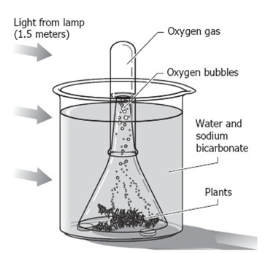
A student prepared two beakers with identical sprigs of an aquarium plant, elodea. She placed one beaker in the shade and the other beaker beside a fluorescent lamp. She counted the bubbles given off by each sprig of the plant. Which plant produced more bubbles?
Required
1

In South America, rainforests are cleared at a high rate in order to provide lumber for export and to accommodate urban development.  A direct consequence of such practices is:

Required
1

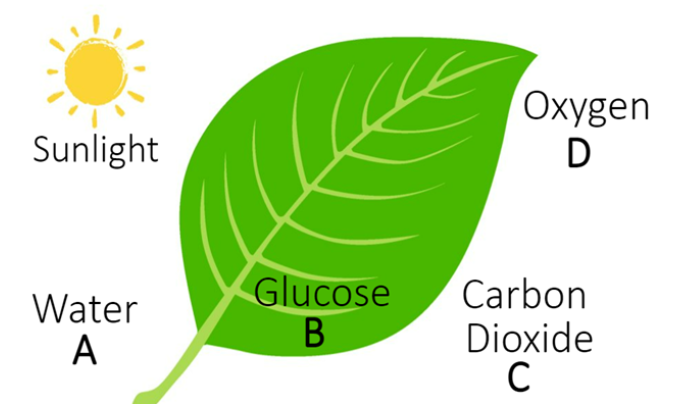
Use the image to answer the question.


Which equation illustrates a process of photosynthesis carried out within the leaf?

Required
1

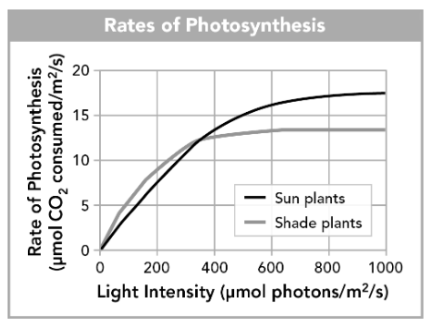
The graph shows how the rates of photosynthesis vary with light intensity for two groups of plants: plants that thrive in direct sunlight, and plants that thrive in the shade. The plants in both groups receive the same amount of water and are kept at the same temperature. For both groups of plants, what BEST describes the relationship between light intensity and rate of photosynthesis?