[AP Statistics] 4.3 Using Studies Wisely - Classwork/Homework
star
star
star
star
star
Last updated about 1 year ago
22 Nsɛmmisa
1
1
1
1
1
1
1
1
1
1
1
1
1
1
1
1
1
1
1
1
1
1
The director of student life at a small college wants to know what percent of students eat regularly in the cafeteria. To find out, the director selects an SRS of 300 students who live in the dorms.
A study in El Paso, Texas, looked at seat belt use by drivers. Drivers were observed at randomly chosen convenience stores. After they left their cars, they were invited to answer questions that included questions about seat belt use. In all, 75% said they always used seat belts, yet only 61.5% were wearing seat belts when they pulled into the store parking lots.
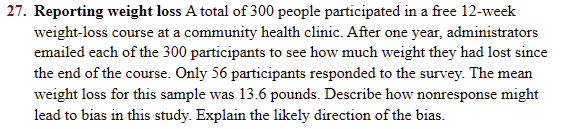
A total of 300 people participated in a free 12-week weight-loss course at a community health clinic. After one year, administrators emailed each of the 300 participants to see how much weight they had lost since the end of the course. Only 56 participants responded to the survey. The mean weight loss for this sample was 13.6 pounds.
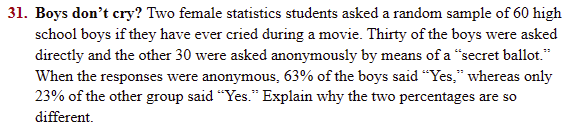
Two statistics students asked a random sample of 60 high school boys if they have ever cried during a movie. Thirty of the boys were asked directly and the other 30 were asked anonymously by means of a “secret ballot.” When the responses were anonymous, 63% of the boys said “Yes,” whereas only 23% of the other group said “Yes.”
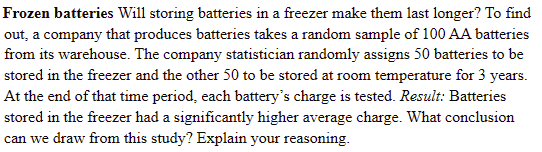
Many students insist that they study better when listening to music. A teacher doubts this claim and suspects that listening to music hurts academic performance. The teacher selects a random sample of 30 students from the school to participate in the study. Each of the selected students is asked whether he or she studies while listening to music, and then their GPAs at the end of the semester are recorded.
Results: Students who listened to music while studying generally had lower GPAs than students who didn’t listen to music while studying.
What conclusion can we draw from this study? Explain your answer.
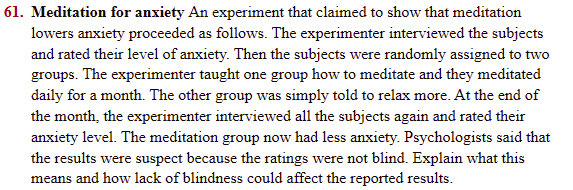
Is it possible to conduct this experiment as a double-blind experiment? Why or why not?
Are there any problems above that you would like to go over in class? Indicate the question numbers below (Numbers refer to the Formative question number). I'll try to cover anything that is highly requested.