[AP Statistics] 7.3a Classwork/Homework
star
star
star
star
star
Last updated about 1 year ago
23 Nsɛmmisa
1
1
1
1
1
1
1
1
1
1
1
1
1
1
1
1
1
1
1
1
1
1
1
The number of absences last year for students at a large high school (2000+ students) has a mean of 5.6 days with a standard deviation of 4.1 days. Suppose we take an SRS of 80 of last year’s students and calculate the mean number of absences for the members of the sample.
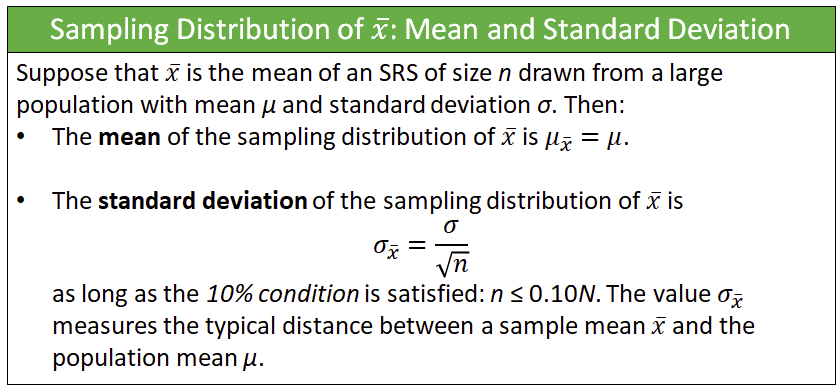
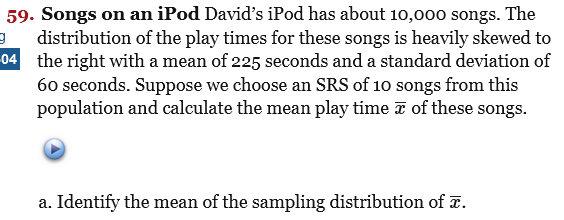
(a) Identify the mean of the sampling distribution of x̅.
Is the 10% Condition satisfied?
Explain how you know the 10% condition is met
Calculate the standard deviation of the sampling distribution of x̅.
Round to the nearest hundredth
Interpret the standard deviation of the sampling distribution of x̅.
We have described the mean and standard deviation of the sampling distribution of a sample mean x̄ but not its shape. That’s because the shape of the sampling distribution of x̄ depends on the shape of the population distribution.
For now, all you need to know is if the population is normally distributed, the sampling distribution of x̄ is also normally distributed.
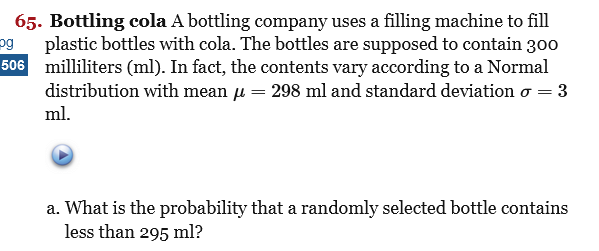
Mr. Rose is a new quality-control inspector at a factory that produces axles for a certain model of car. Because the manufacturing process takes several steps, there is some variability in the length of the axles produced at the factory. Specifically, the distribution of axle lengths is Normal with a mean of 597 mm and a standard deviation of 5.3 mm.
(a) Mr. Rose randomly selects one axle. Find the probability that the length of the axle is less than 595 mm.
Round to the nearest hundredth
(b) Mr. Rose randomly selects 20 axles. Find the probability that the mean length of the axles is less than 595 mm.
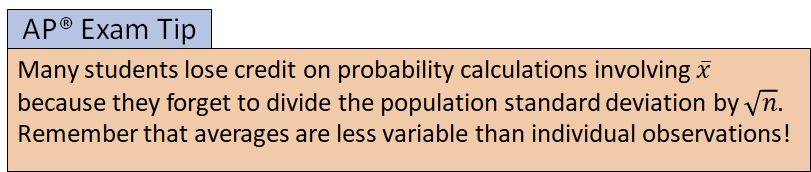
Note: Because we are averaging 20 axles together, we must calculate the mean and standard deviation of the sampling distribution of
Round to the nearest Thousandth
Calculate the standard deviation of the sampling distribution of x̄
Round to the nearest Hundredth
Interpret the standard deviation of the sampling distribution of x̄
You will need to solve an equation for this one.
Round to the nearest whole number
Is the 10% Condition satisfied?
Explain how you know.
Round to the nearest Thousandth
Round to the nearest Thousandth
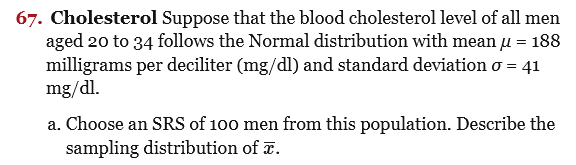
What is the shape of the sampling distribution of x̅? How do you know?
Round to the nearest Hundredth
Choose an SRS of 1000 men from this population. Now what is the probability that x¯ falls within ±3 mg/dl of μ?
Round to the nearest Hundredth
In what sense is the larger sample better?
Round to the nearest Hundredth
Explain why.
Are there any problems above that you would like to go over in class? Indicate the question numbers below (Numbers refer to the Formative question number). I'll try to cover anything that is highly requested.