H0: p=
Ha: p≠
Round to the nearest Hundredth
Amazon.com is one of the largest Internet-based retailers in the world. The company offers a “prime” membership for a fee, which provides certain benefits for members. A recent report states that 46% of U.S. households have an Amazon “prime” membership. Penelope wants to know if this proportion is different for her large hometown. She selects a random sample of 80 households from her hometown and finds that 45 of them have an Amazon “prime” membership.
State the hypotheses to test:
H0: p=
Ha: p≠
Find the p-value for this test.
Round to the nearest Thousandth
At a significance level of 10%, what would you conclude?
At a significance level of 5%, what would you conclude?
At a significance level of 1%, what would you conclude?
What would be the p-value if this were a one-sided test instead?
H0: p=0.46
Ha: p>0.46
Round to the nearest Thousandth
How does that relate to the p-value for a two-sided test?
A statistics major and a finance major decide to get married. They are trying to save money to pay for the wedding and need to figure out how many people will actually attend out of the 200 they plan to invite. For most weddings, data suggests that about 75% of people you invite to a wedding actually come. They suspect their friends and family are more dedicated than most, so they believe more than 75% will come.
They want to test the hypothesis:
H0: p = 0.75
Ha: p > 0.75
Where p is the true proportion of invited people that will actually come to the wedding.
They select a random sample of their guests and determine how many of them actually plan on coming to the wedding.
What is a Type 1 error in this context?
What is a Type 2 error in this context?
In your opinion, which error is more consequential? Why?
Does a significance level of 1% or 10% make more sense in this context? Explain why
Blank question, ignore
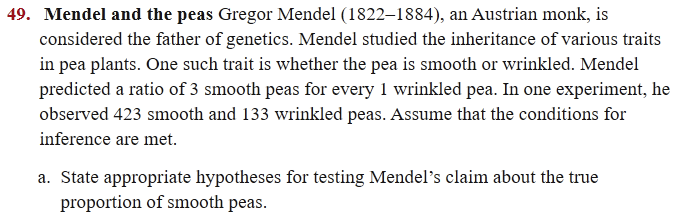
H0: p=
Ha: p≠
Round to the nearest Hundredth
Calculate the Standardized Test Statistic
Round to the nearest Hundredth
Calculate the P-Value
Round to the nearest Hundredth
What conclusion would you make at the 5% level?
Explain
Section 9-2
STATE
PLAN
DO
CONCLUDE
Section 9-1
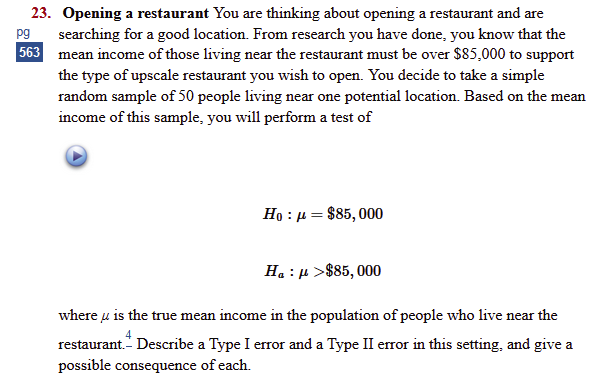
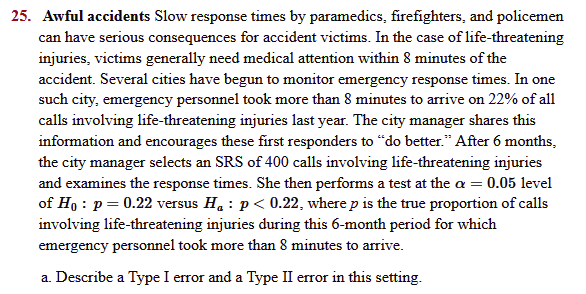
Describe a Type 1 Error in this context
Describe a Type 2 Error in this context
Which one is more consequential?
Explain why
What significance level should you choose: 5% or 10%?
Explain why
Section 9-1
Explain
Are there any problems above that you would like to go over in class? Indicate the question numbers below (Numbers refer to the Formative question number). I'll try to cover anything that is highly requested.