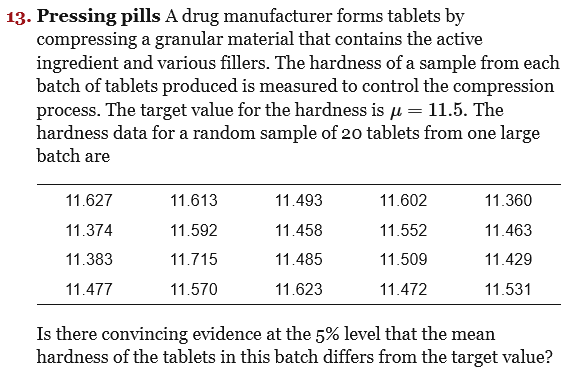
Conduct a significance test
Conduct a significance test
You are a journalist for a sketchy paper that is incredibly biased. You will get paid to write an article smearing a particular politician. Your journalistic integrity, however, means that you refuse to falsify data and will only report statistically conclusive evidence.
That politician claims to go on a 60 minute walk every day. You wonder if they are lying about this. If they are, you plan to write an article about it. If you find convincing evidence that the politician walks less than 60 minutes, the article will be about how the politician exaggerates their claims. If you find convincing evidence that they walk more than 60 minutes, the article will be about how they waste their entire day and aren't focused on their job.
You camp outside and record the number of minutes spent walking for 10 days.
71 61 59 55 62 63 67 52 71 62
Your goal is to publish a confidence interval for the true mean number of minutes spent by the politician on their daily walk. You want to ensure that your confidence interval shows CONVINCING EVIDENCE so that people will actually read your article.
Create a 95% confidence interval using the data above along with T-Interval on your calculator. Is there convincing evidence that the politician is lying?
Explain
Create a 20% confidence interval using the data above along with T-Interval on your calculator. Is there convincing evidence that the politician is lying?
Explain
A 20% confidence interval sounds questionable, even to someone not familiar with statistics.
What is the highest you can increase the confidence level and still have convincing evidence of a lie? Use trial and error and only whole percentage numbers (like 55% or 83%).
Write you answer as a decimal rounded to the nearest hundredth (for example: write 31% as 0.31)
Let's say we decided to conduct a significance test instead. Should we conduct a 1 or 2 sided test?
Explain
Write the hypothesis for our significance test.
Assume we meet the conditions for the test. Conduct a 1 sample t test using your calculator (T-Test). What is the p-value of our test?
Round to the nearest hundredth
What is the relationship between the numbers you found in questions 5 and 9? Why do you think they have this relationship?
At the Hawaii Pineapple Company, the mean weight of the pineapples harvested from one large field was 31 ounces last year. A different irrigation system was installed in this field after the growing season. Managers wonder if this change will affect the mean weight of future pineapples grown in the field. To find out, they select and weigh a random sample of 50 pineapples from this year’s crop.
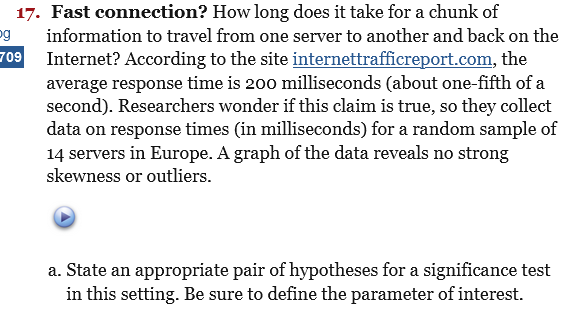
State an appropriate pair of hypotheses for a significance test in this setting. Be sure to define the parameter of interest.
A 95% confidence interval for the mean weight of all pineapples grown in the field this year is (31.255, 32.616). Based on this interval, what conclusion would you make for a test of the hypotheses in part (a) at the α = 0.05 significance level?
Conduct a significance test
Explain
Explain
Explain
Explain
Explain
Are there any problems above that you would like to go over in class? Indicate the question numbers below (Numbers refer to the Formative question number). I'll try to cover anything that is highly requested.