Twa kɔ nsɛm atitiriw so
Log in
Sign up for FREE
arrow_back
Laabri

[AP Statistics] 12.2a Chi-Square test for Homogeneity

star
star
star
star
star
Last updated 11 months ago
27 Nsɛmmisa
1
1
1
1
1
1
1
1
1
1
1
1
1
1
1
1
1
1
1
1
1
1
1
1
1
1
1

Last time, we learned the Chi-Square test for Goodness of Fit. This test is used when you have 1 sample (Harvard Applicants in 2019) and 1 variable (Racial Identity).

Today we will learn the Chi-Square test for Homogeneity, which is used when you have 2 samples and 1 variable.

Asemmisa {{asɛmmisaAhyɛnsode}}
1.

One thing I've been curious about: does the AP Statistics class period you are in affect which test you did best at this semester? My lessons always end up playing out slightly differently, and students in each class ask different questions.

There are 4 graded tests so far this semester (Chapters 7, 8, 9, and 10). For each person in each class period, I looked in my grade book and noted the test they did best on out of the 4. Turns out no one did best on Chapter 9 so we will ignore it for convenience!

Observed Counts for best test:
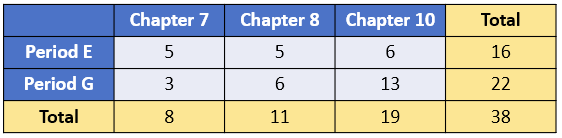
Just looking at the data, do you think the difference between the periods could be due to random chance?
Asemmisa {{asɛmmisaAhyɛnsode}}
2.

What are the sample(s) and variable(s) in this study?

Asemmisa {{asɛmmisaAhyɛnsode}}
3.

In general terms, what should be the null hypothesis for our significance test?

Asemmisa {{asɛmmisaAhyɛnsode}}
4.

In general terms, what should be the alternative hypothesis for our significance test?

Asemmisa {{asɛmmisaAhyɛnsode}}
5.

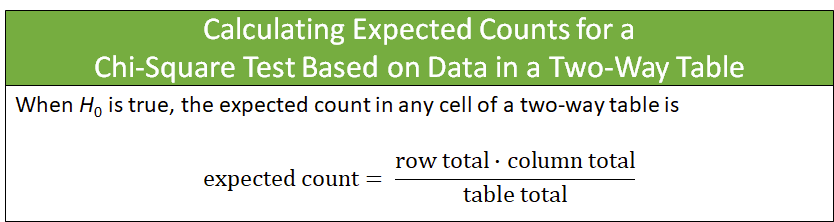
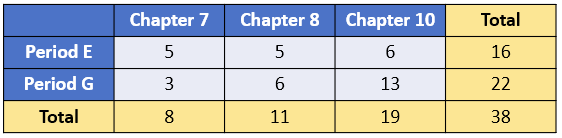
Like our other Chi-Square test, we will need to calculate the expect count

Observed:

What is the expected count for Students in Period E doing best on Chapter 7?

Round to 1 decimal place

Asemmisa {{asɛmmisaAhyɛnsode}}
6.

What is the expected count for Students in period G doing best on Chapter 10?

Round to 1 decimal place

Asemmisa {{asɛmmisaAhyɛnsode}}
7.

I'm only going to make you calculate two of those since it is tedious. Your calculator will take care of the rest soon.

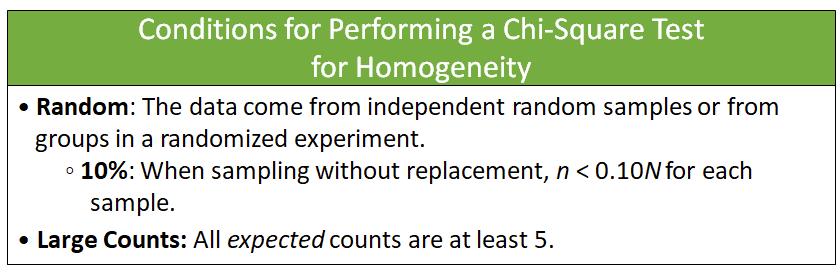
Now we need to check our conditions, which are the same as for the other Chi-Square test

Do we meet the Large Counts condition?

Asemmisa {{asɛmmisaAhyɛnsode}}
8.

Explain

Asemmisa {{asɛmmisaAhyɛnsode}}
9.

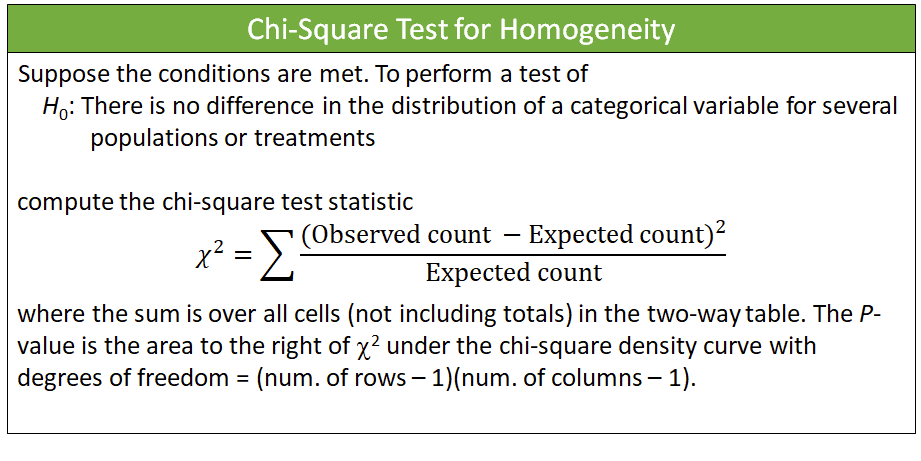
The degrees of freedom are calculated in a different way than last time. What are the degrees of freedom for this study?

Asemmisa {{asɛmmisaAhyɛnsode}}
10.

The Chi-Square test statistic is calculated the same way as we did last time. We will let our calculator do the heavy lifting.

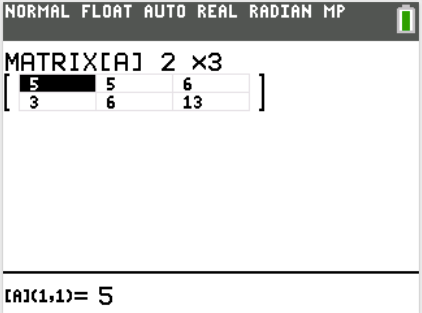
Because our data is in a 2 way table, we need to enter it into a matrix instead of a list.

Enter the OBSERVED data into matrix A: 2nd->Matrix->Edit->[A]

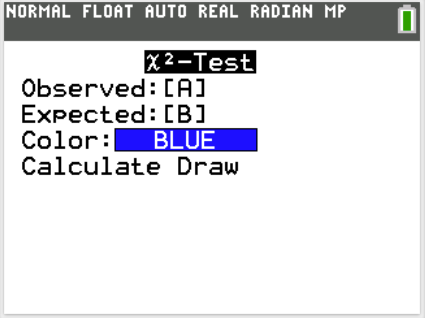
Stat->Test-X^2-Test shows the following, indicating that it will read the observed in Matrix [A] and output the expected values into Matrix [B]

When you hit enter, you should see the X^2 test statistic. Type it below.

Round to 1 place

Asemmisa {{asɛmmisaAhyɛnsode}}
11.

You should also see the p-value. Type it below

Round to 2 places

Asemmisa {{asɛmmisaAhyɛnsode}}
12.

If you hit 2nd->Matrix->[B] and hit enter, you can see the expected values that your calculator calculated.

Note: It might actually be easier to see the values if you go 2nd->Matrix->Edit->[B]

What is the expected value for Period G students who did best on Chapter 7 (2nd row first column)?

Round to 1 place

Asemmisa {{asɛmmisaAhyɛnsode}}
13.

Do we have convincing evidence that 2 classes differ in terms of which test they did best?

a=0.05

Asemmisa {{asɛmmisaAhyɛnsode}}
14.

Explain

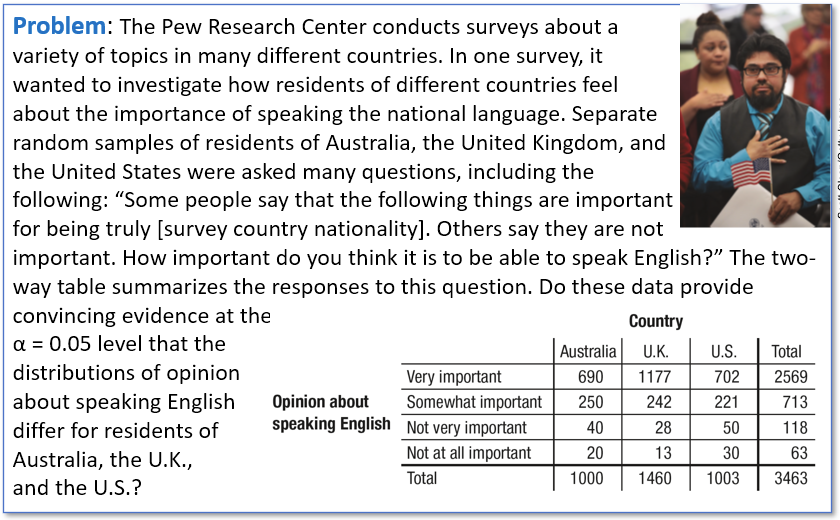
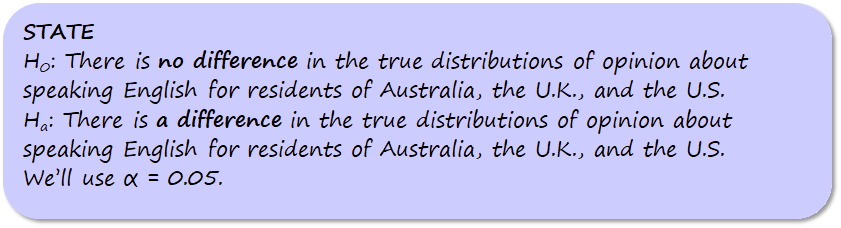
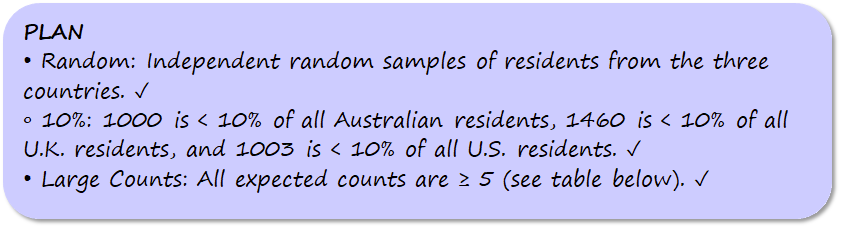
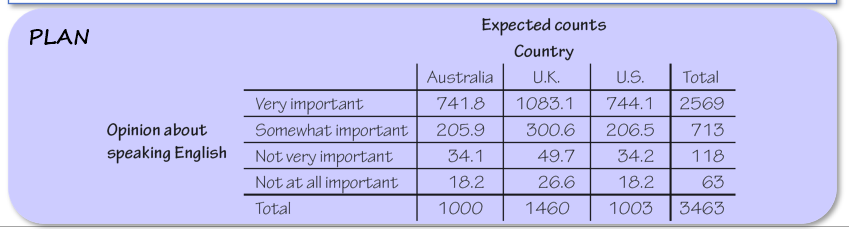
SAMPLE STATE PLAN DO CONCLUDE

DO

X2=68.57, df = 6, p-value ~= 0

Asemmisa {{asɛmmisaAhyɛnsode}}
15.

Asemmisa {{asɛmmisaAhyɛnsode}}
16.

Asemmisa {{asɛmmisaAhyɛnsode}}
17.

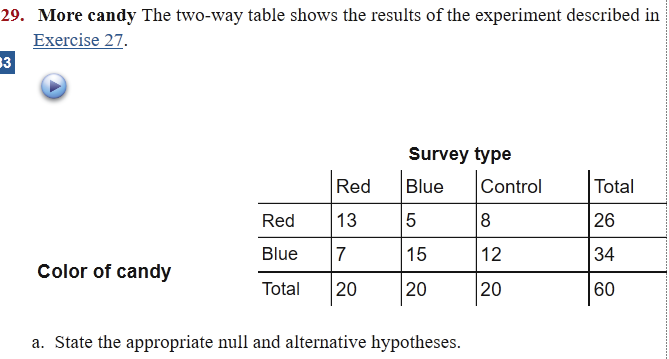
What should be the expected value for the Red/Red cell?

Round to 1 place

Asemmisa {{asɛmmisaAhyɛnsode}}
18.

How many degrees of freedom?

Asemmisa {{asɛmmisaAhyɛnsode}}
19.

What is the chi-square test statistic?

Round to 2 places

Asemmisa {{asɛmmisaAhyɛnsode}}
20.

What is the p-value?

Round to three places

Asemmisa {{asɛmmisaAhyɛnsode}}
21.

What is your conclusion at the a=0.05 level?

Asemmisa {{asɛmmisaAhyɛnsode}}
22.

Asemmisa {{asɛmmisaAhyɛnsode}}
23.

STATE

Asemmisa {{asɛmmisaAhyɛnsode}}
24.

PLAN (You probably want to complete the Do step first to get the table of expected values)

For my class, you don't need to recreate the table for the plan step like they do in the sample. If this comes up on the AP exam, you SHOULD recreate the table

Asemmisa {{asɛmmisaAhyɛnsode}}
25.

DO

Record P-Value, Degrees of Freedom, and the Chi Square Test Statistic

Asemmisa {{asɛmmisaAhyɛnsode}}
26.

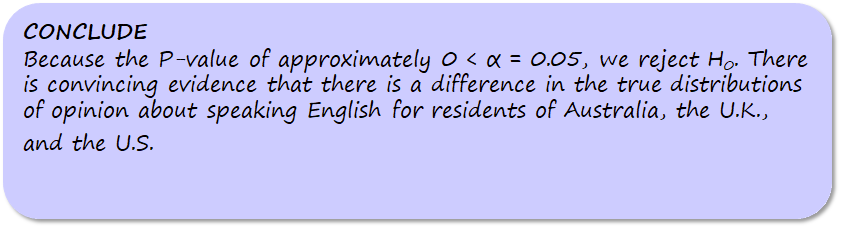
CONCLUDE

Asemmisa {{asɛmmisaAhyɛnsode}}
27.

Are there any problems above that you would like to go over in class? Indicate the question numbers below (Numbers refer to the Formative question number). I'll try to cover anything that is highly requested.