Log in
Sign up for FREE
arrow_back
Library
Origins of Genetic Variation Practice Formative
By Kate Turner
star
star
star
star
star
Share
share
Last updated 4 months ago
15 questions
Add this activity
1
1
1
1
1
1
1
1
1
1
1
1
1
1
1
Question 1
1.
Which of the following are examples of genetic variation? Select all that apply
Mutations
Crossing over
Random fertilization
Independent assortment
Question 2
2.
During what process (not phase) do mutations occur? This should be a two word answer.
Question 3
3.
Independent assortment is the random alignment of ____________ during metaphase 1.
Question 4
4.
Which of the following are more likely arrangements of chromosomes during metaphase 1?
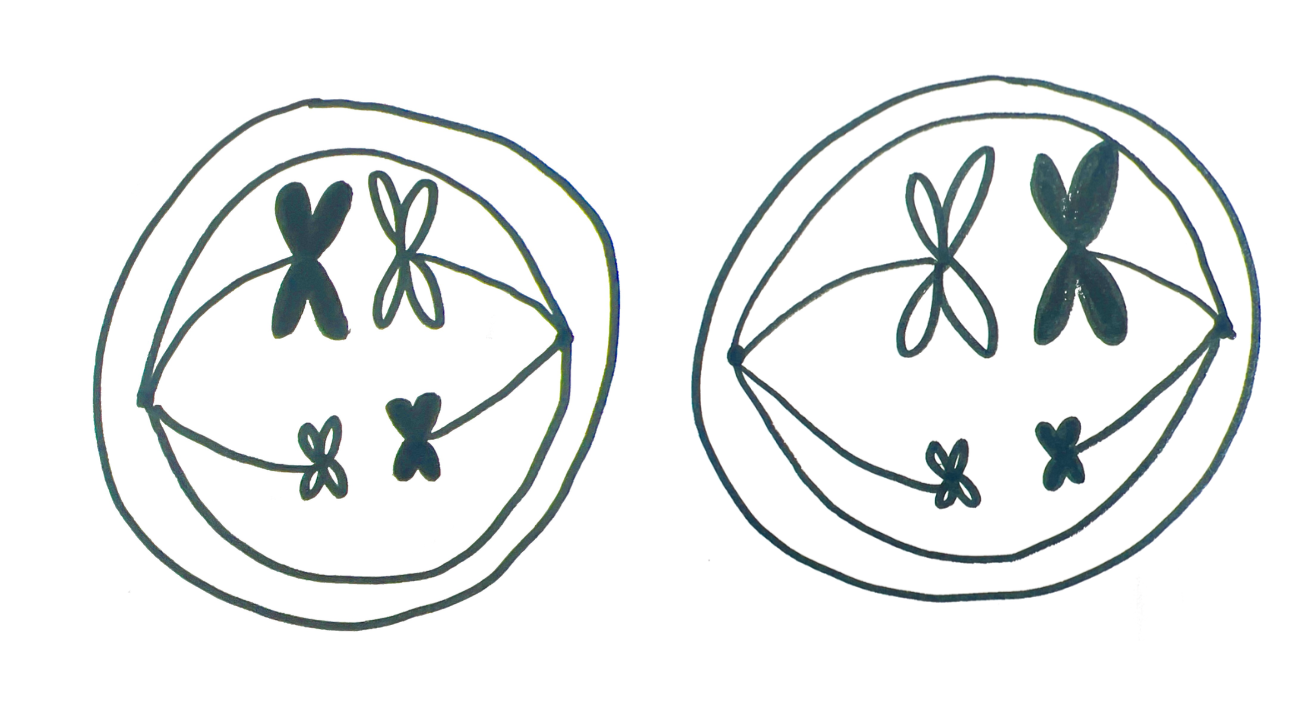
A
B
They are equally likely
Question 5
5.
Crossing over involves the genetic exchange of information between _______ during prophase 1 inside a tetrad.
Question 6
6.
What is independent assortment during meiosis primarily responsible for?
Random combination of gametes during fertilization
Genetic variation in gametes
Increasing chromosome number
Uniform gamete characteristics
Question 7
7.
During crossing over, what occurs between the sister chromatids?
Separation of homologous pairs
Replication of DNA segments
Alignment along the equator
Exchange of genetic material
Question 8
8.
How does random fertilization contribute to genetic diversity?
Prevents genetic variation entirely
Ensures identical offspring creation
Selects the dominant sperm only
Combines unique gametes from two biological parents
Question 9
9.
Which stage of meiosis does independent assortment occur?
Telophase II
Anaphase I
Prophase II
Metaphase I
Question 10
10.
What effect does crossing over have on offspring?
Copies DNA without change
Creates identical offspring traits
Increases genetic diversity
Reduces mutation rates
Question 11
11.
What is a mutation?
A change in the DNA sequence.
A gene transfer between species.
A form of genetic isolation.
An adaptive response to the environment.
Question 12
12.
How do mutations contribute to evolution?
They eliminate genetic variation entirely.
They are always harmful to the organism.
They only affect physical traits.
They create new traits for natural selection.
Question 13
13.
Which type of mutation is most likely to have no effect?
A missense mutation
A nonsense mutation
A silent mutation
A deletion mutation causing a frameshift.
Question 14
14.
Which type of mutation is most likely to lead to a smaller protein size?
A missense mutation
A nonsense mutation
A silent mutation
A deletion mutation causing a frameshift.
Question 15
15.
Which can increase the likelihood of mutations?
Environmental factors like radiation or chemicals.
Lack of genetic variation in a population.
Natural selection eliminating weak traits.
The presence of identical twins.