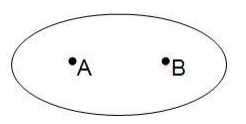
Label each ellipse with the correct eccentricities.
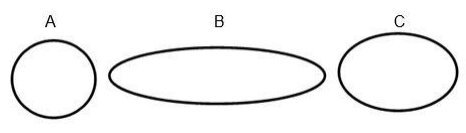
Label each ellipse with the correct eccentricities.
| Draggable item | arrow_right_alt | Corresponding Item |
|---|---|---|
C | arrow_right_alt | 0 |
A | arrow_right_alt | 0.7 |
B | arrow_right_alt | 0.4 |
What two details of a satellite's orbit can be determined from examining a ground trace?
Many of Kepler's theories were based on the documentation of this philosopher that he worked with for a short time.
Label each ellipse with the correct eccentricities.
| Draggable item | arrow_right_alt | Corresponding Item |
|---|---|---|
C | arrow_right_alt | 0 |
A | arrow_right_alt | 0.7 |
B | arrow_right_alt | 0.4 |
To make the pictured ellipse more circular, you should move foci A and B _________.
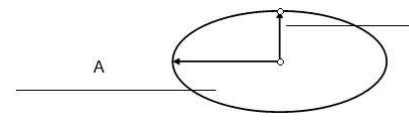
What is the name of the "radii" labelled A in the pictured ellipse?
| Draggable item | arrow_right_alt | Corresponding Item |
|---|---|---|
The measure of how circular or elliptical an orbit is. | arrow_right_alt | Inclination |
The point in the orbit of an object (such as a satellite) orbiting the earth that is at the greatest distance from the center of the earth. | arrow_right_alt | Eccentricity |
The "tilt" of the orbit relative to the equator. | arrow_right_alt | Semi-Major Axis |
The point in the orbit of an object (such as a satellite) orbiting the earth that is the closest to the center of the earth. | arrow_right_alt | Apogee |
Describes the size of an orbit. For circular orbits, altitude is often used in place of this term. | arrow_right_alt | Perigee |
The value of which orbital parameter is 0 when the satellite is at its perigee point and 180 when the satellite is at apogee?
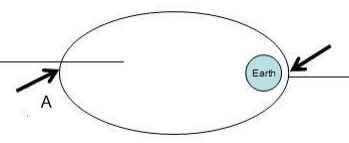
Label the position indicated with the A in the pictured orbit.
Both size (semi-major axis and/or altitude) and eccentricity play an important role in determining the period of the orbit.
The Voyager 1 spacecraft was launched in 1977 to explore the solar system and beyond. In 2008, it was entering the region between our solar system and interstellar space known as the heliosheath. It is the furthest manmade object from the Eatch and it continuing its journey into the unknown. Based on what you have learned about orbital elements, the eccentricity of Voyager is greater than 1.
This philosopher believed that everything rotates around the Earth.
This philosopher was the first to propose heliocentric theory.
_________________ is the angle between the Earth’s equatorial plane and the
plane of the orbit. It describes the tilt of the orbit.
The point in an orbit that is closest to the Earth.
What is the projection of a satellite's orbit onto the earth, represented in a 2D map called?
A satellite designed to take images to monitor the polar ice caps would have an inclination of ___ degrees.
A satellite crosses the equator in a northerly direction at 0 degrees longitude. On its next northerly pass over the equator it crosses at 23 degrees west longitude. How many minutes did it take this satellite to complete one orbit?
A circular orbit has an apogee roughly twice the altitude of its perigee.
Which orbital parameter must use a reference point in space, because an earth based reference point will move as the earth rotates?
Kepler has two different sets of laws of orbital motion. One set applies to planets orbiting the Sun, and the other set applies to man-made satellites orbiting the Earth.
This scientist was the first to use a telescope to help prove heliocentric theory.
An argument of perigee would be easiest to see in a picture of an orbit with which eccentricity?
Which of the following orbital parameters describes the size of the orbit?
Who developed the Keplerian Element Set which describes the orbital parameters of satellites' orbits?
All circles are ellipses and all ellipses are circles.
Which is NOT one of the six elements of the Keplerian element set?
An orbiting object is moving slowest at apogee.