6.5 Developing an Investment Strategy
star
star
star
star
star
Last updated 10 months ago
23 questions
Note from the author:
OBJECTIVES & STANDARDS
Math Objectives
- Use a spreadsheet to create a dollar-cost averaging calculation
Common Core Math Standards
- Link to all CCSS Math
- CCSS.HSM
Personal Finance Objectives
- Recognize biases that might affect investing decisions
- Explain how dollar cost averaging works and what it is used for
- Open a brokerage account
- Explain how risk decisions affect your portfolio
National Standards for Personal Financial Education
Investing
- 1b: Discuss how a person’s risk tolerance influences their investment decisions
- 9a: Identify several behavioral biases that can result in poor investment decisions (e.g. loss aversion, investing in employer stock, home bias, mental accounting)
- 9b: Explain how automating investment activities can help people avoid making emotional investment decisions
- 11a: Discuss how the development of financial technology has made it easier for people of all income and education levels to participate in financial markets
DISTRIBUTION & PLANNING
Distribute to students
- Student Activity Packet
OBJECTIVES & STANDARDS
Math Objectives
- Use a spreadsheet to create a dollar-cost averaging calculation
Common Core Math Standards
- Link to all CCSS Math
- CCSS.HSM
Personal Finance Objectives
- Recognize biases that might affect investing decisions
- Explain how dollar cost averaging works and what it is used for
- Open a brokerage account
- Explain how risk decisions affect your portfolio
National Standards for Personal Financial Education
Investing
- 1b: Discuss how a person’s risk tolerance influences their investment decisions
- 9a: Identify several behavioral biases that can result in poor investment decisions (e.g. loss aversion, investing in employer stock, home bias, mental accounting)
- 9b: Explain how automating investment activities can help people avoid making emotional investment decisions
- 11a: Discuss how the development of financial technology has made it easier for people of all income and education levels to participate in financial markets
DISTRIBUTION & PLANNING
Distribute to students
- Student Activity Packet
Intro/Warm-Up:
ACTIVITY: INTERACTIVE: Invest With Stax
In this unit and the last, we have covered a variety of investment types as well as strategies to diversify your portfolio and manage your risk. Before we look at investing strategies, let’s see how your new knowledge is applied in an investing simulation! Play STAX, then use the experience to answer the question.
1
What strategies did you use while playing STAX that might not work as well in the real world?
Learn It
ARTICLE: 4 Behavioral Biases and How to Avoid Them
Behavioral finance is a field of study that focuses on the psychological components of finance. It studies how biases can affect your investment decisions. Read the article starting at the section Overconfidence to learn about 4 different biases. Then, follow your teacher’s instructions to complete the table and answer the questions.
8
Answer in Book and here if absent.
1
What is the result of being too overconfident when choosing your investments?
1
The article notes that we have a natural tendency to avoid feeling regret. What is a strategy that you can use when investing to avoid regret aversion?
1
Give an example of chasing trends when investing. It could be a real life example or one that you make up to show your understanding.
VIDEO: Is Dollar-Cost Averaging Better Than Lump Sum Investing?
Let’s look at a strategy to manage investment risk - spreading out your investments over time. One way to do this is Dollar-Cost Averaging. Watch this video to learn how it works compared to Lump Sum Investing. Then, answer the questions.
1
In your own words, explain the difference in how a person invests their money using dollar-cost averaging versus lump sum investing.
1
Antonio received a $4,000 bonus and would like to invest it. Explain why it is riskier to put all $4,000 into a mutual fund at the same time instead of putting $1,000 per month into the same mutual fund over the next 4 months.
1
Aside from risk, what are some other reasons it is a smart investment strategy to invest a specific amount from your budget every single month?
ARTICLE: What Is a Brokerage Account and How Do I Open One?
Now that we’ve talked about behavioral biases and ways of managing risk, we’re ready to start investing. You can begin investing by opening a brokerage account. Read the article until you reach Brokerage Account vs IRA (we’ll see more on this later) to learn what a brokerage account is and how to open one. Then, answer the questions.
1
In at least 3 steps, write out the process that you would use to start investing in a taxable online brokerage account.
1
What is the main difference between an online brokerage account and a managed brokerage account?
MATH CONNECTION - Dollar-Cost Averaging in Action
ACTIVITY: ANALYZE: Dollar-Cost Averaging In Action
Now that we’ve seen the benefit of dollar-cost averaging and how it can help minimize risk, let’s take a look at the numbers in action! Follow the directions on the worksheet to complete the activity.
ANALYZE: Dollar Cost Averaging in Action
When saving for retirement, the important first step is to start saving as early as possible.
A second important step is to put your retirement savings on auto-pilot: Have a fixed amount of money automatically deducted from your paycheck or bank account every month, which will allow you to take advantage of dollar cost averaging. Let’s explore how this works.
Part I - A step-by-step example
To minimize risk, you’ve decided to invest your IRA money in a low cost index fund called Einstein’s Index Fund 500 (EIF). You’ve decided you can afford to invest $200 per month, and your account is set to automatically buy $200 worth of shares on or near the 15th of every month. Your first contribution is on Jan 15. Answer the following questions:
1
On Jan 15, if EIF costs $50/share, how many shares did your contribution buy?_______
7
On Feb 15, if EIF costs $40/share…
- How many new shares did your contribution buy?_______
- How many total shares do you now own?_______
- How much have you spent so far on your whole portfolio?_______
- What is the average cost you’ve paid per share?_______
- What is the current value of your whole portfolio?_______
- How did you benefit from the share price dropping?_______
- What is a downside of the share price dropping?_______
6
On Mar 15, if EIF costs $37/share…
- How many new shares did your contribution buy?_______
- How many total shares do you now own?_______
- How much have you spent so far on your whole portfolio?_______
- What is the average cost you’ve paid per share?_______
- What is the current value of your whole portfolio?_______
- Oh no! The share price is even lower. Why might some investors consider this a good thing?_______
7
On Apr 15, if EIF costs $65/share…
- How many new shares did your contribution buy?_______
- How many total shares do you now own?_______
- How much have you spent so far on your whole portfolio?_______
- What is the average cost you’ve paid per share?_______
- What is the current value of your whole portfolio?_______
- How did you benefit from the share price increasing?_______
- What is a downside of the share price increasing?_______
Part II - Dollar cost averaging in the real world
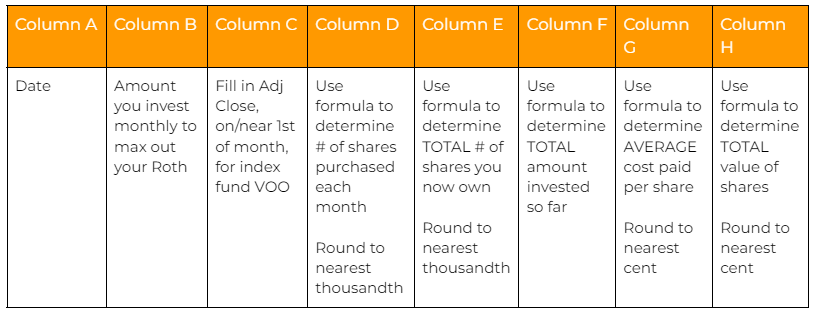
Let’s see what happens if you contribute $500 per month to your Roth IRA by buying a real index fund, the Vanguard S&P 500 ETF (VOO) in the year 2021.
- Use Yahoo! Finance to look up the historical adjusted close for VOO on a monthly basis on the 1st of the month for all 12 months of 2021.
- Note: Yahoo will give you the next business day’s price if the 1st is a holiday or weekend.
- If you need help finding historical stock prices, watch this quick How To video.
- Make a copy of this Dollar Cost Averaging Spreadsheet and complete your copy as follows:
10
Screen shot your spread sheet here and add the link in the comments.
Then answer the following questions based on your spreadsheet.
Screen shot your spread sheet here and add the link in the comments.
Then answer the following questions based on your spreadsheet.
1
What was the average price you paid, per share, over the course of the year?_______
0
Compare the amount of money you invested in 2021 to the value of your portfolio when 2021 ended. Was this a wise investment strategy? Why or why not?
0
On January 1, 2021, If you had had a way of knowing the adjusted close prices for each month in the year…
- During which month would you have bought all $6,000 worth of shares?_______
- During which month would you have sold all your shares?_______
- How much money would you have made using this transaction?_______
- Why is this strategy not possible to execute in the real world?_______
1
In your own words, describe what is meant by dollar cost averaging.
0
In what ways do you, the investor saving for retirement, benefit from dollar cost averaging?
Exit Ticket
1
An investor might choose to utilize dollar cost averaging because …A They want to reduce the overall volatility of their portfolioB. They want to reduce the portion of their portfolio invested in stocksC. They want to reduce the overall fees associated with their portfolioD. They want to reduce the size of their portfolio
An investor might choose to utilize dollar cost averaging because …
A They want to reduce the overall volatility of their portfolio
B. They want to reduce the portion of their portfolio invested in stocks
C. They want to reduce the overall fees associated with their portfolio
D. They want to reduce the size of their portfolio
1
All of the following are biases that might affect your investing decisions EXCEPT …A. Chasing TrendsB. OverconfidenceC. Self-AssessmentD. Regret Aversion
All of the following are biases that might affect your investing decisions EXCEPT …
A. Chasing Trends
B. Overconfidence
C. Self-Assessment
D. Regret Aversion
1
All of the following are factors to consider when opening a brokerage account EXCEPT …A. Fees associated with tradingB. Who is managing the account (you, an investment advisor, or a robo-advisor)C. The performance of the market over the past yearD. Your investment goals
All of the following are factors to consider when opening a brokerage account EXCEPT …
A. Fees associated with trading
B. Who is managing the account (you, an investment advisor, or a robo-advisor)
C. The performance of the market over the past year
D. Your investment goals